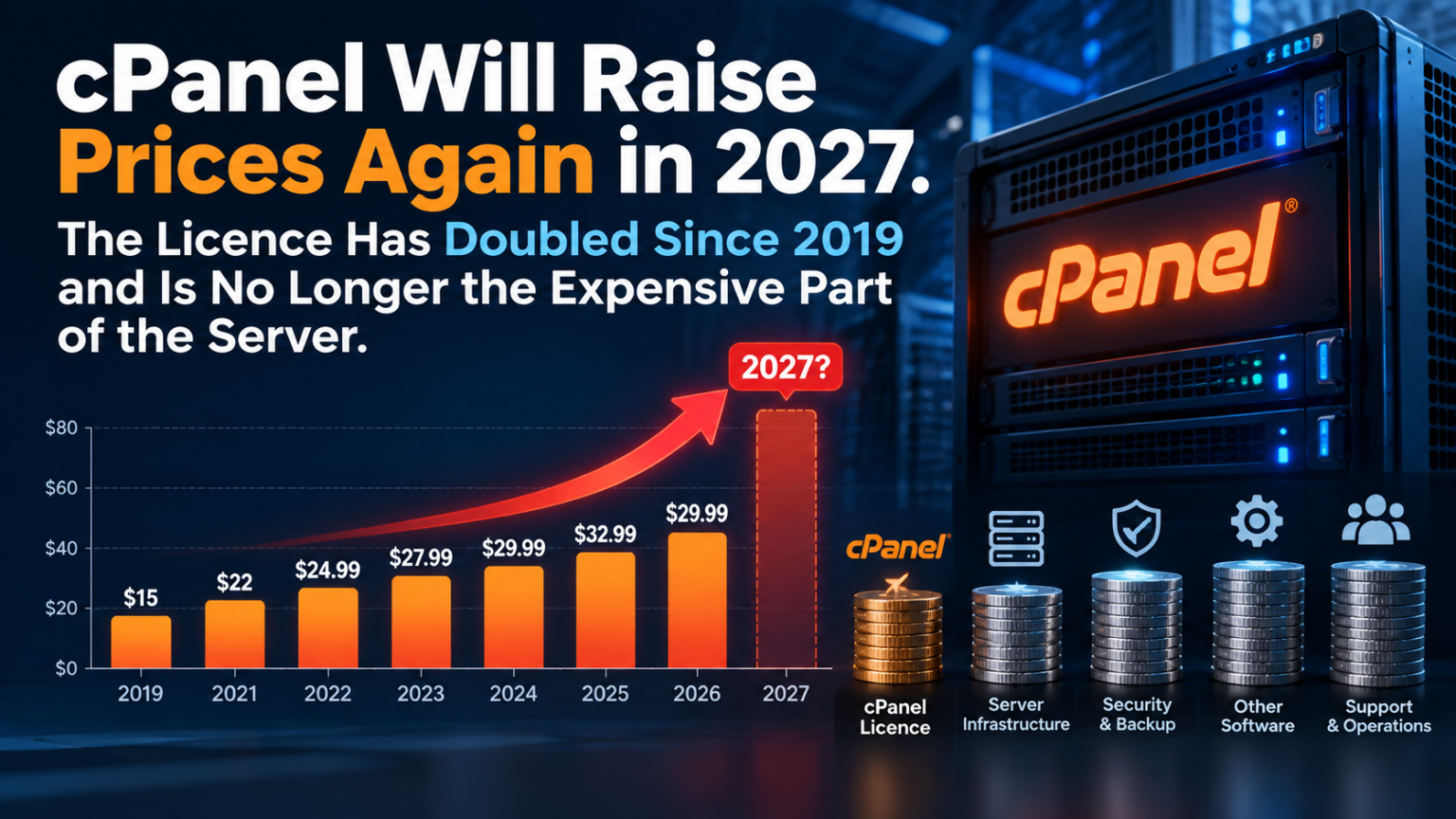
cPanel Will Raise Prices Again in 2027. The Licence Has Doubled Since 2019 and Is No Longer the Expensive Part of the Server
For hosting providers, the real problem is no longer the price of the server. It is the growing cost of the software stack running on top of it.
For years, cPanel was considered a relatively predictable operating expense for web hosting companies.
A hosting provider could rent a VPS or dedicated server, install cPanel & WHM, add a few essential services, and build a profitable hosting business around it.
That model has changed.
Since cPanel moved from its traditional per-server licensing model to account-based pricing in 2019, licensing costs have steadily increased. The current 2026 direct-store pricing is $29.99/month for Solo, $35.99 for Admin, $53.99 for Pro and $69.99 for Premier, with Premier accounts above 100 charged at $0.49 per additional account per month.
The Solo license has effectively doubled from the $15/month level used when the account-based structure was introduced.
Premier, meanwhile, has increased from $45/month in 2019 to $69.99/month today.
And there is another issue.
cPanel has indicated that it reviews pricing regularly, and another increase in 2027 would not be surprising. However, as of October 2026, cPanel has not published an official 2027 retail price list.
For hosting providers, that uncertainty is becoming a business-planning problem.
From $20–$45 Per Server to Account-Based Pricing
The biggest change happened in 2019.
Before the pricing restructure, cPanel & WHM was traditionally licensed on a per-server basis.
A VPS license was around $20 per month, while a dedicated-server license was around $45 per month, without the modern account-based limits.
In 2019, cPanel introduced account-based tiers.
The structure included:
- Solo — 1 account
- Admin — up to 5 accounts
- Pro — up to 30 accounts
- Premier — up to 100 accounts
- Additional accounts charged separately
The September 2019 pricing was approximately:
| Plan | 2019 Price |
|---|---|
| Solo | $15/month |
| Admin | $20/month |
| Pro | $30/month |
| Premier | $45/month |
| Additional account | $0.20/month |
Historical pricing records published in cPanel’s community forums document the progression from the 2019 structure through subsequent increases.
The change fundamentally altered the economics of high-density hosting.
A server with a small number of customers could remain relatively inexpensive.
A server with hundreds of accounts became increasingly expensive.
The Price Has Continued to Move Up
The increases have not been limited to one year.
The published pricing history shows the following progression for the major tiers:
| Period | Admin | Pro | Premier |
|---|---|---|---|
| 2019 | $20 | $30 | $45 |
| 2021 | $22 | $32.25 | $48.50 |
| 2022 | $24.99 | $35.99 | $53.99 |
| 2023 | $27.99 | $39.99 | $59.99 |
| 2024 | $29.99 | $42.99 | $60.99 |
| 2025 | $32.99 | $46.99 | $65.99 |
| 2026 | $35.99 | $53.99 | $69.99 |
The current 2026 prices are confirmed by cPanel’s own pricing documentation.
The trend is obvious.
The direction has consistently been upward.
The Licence Has Doubled — But Not Every Tier
The statement that “the cPanel license has doubled since 2019” needs some clarification.
It is accurate for the Solo tier:
$15 → $29.99
That’s essentially a 100% increase.
But the other tiers have increased by different amounts.
Premier went from:
$45 → $69.99
That’s approximately a 56% increase.
Admin went from:
$20 → $35.99
Approximately 80% higher.
Pro went from:
$30 → $53.99
Approximately 80% higher.
So the broader story is not simply that every cPanel license doubled.
It is that cPanel licensing has become substantially more expensive across almost every hosting tier since 2019.
The Bigger Problem: The Server Is No Longer the Expensive Part
This is where the discussion becomes particularly interesting for hosting companies.
Consider a modern VPS.
A provider might be able to obtain a capable virtual server for a relatively modest monthly cost.
For example, imagine a VPS costing:
$30/month
Now add:
- cPanel
- Backup software
- Security software
- Malware scanning
- WAF
- CDN
- Monitoring
- Billing software
- Support
- Payment processing
- IP addresses
- Control-panel integrations
Suddenly, the operating system and server resources are only one component of the total cost.
The software ecosystem surrounding the server can become more expensive than the infrastructure itself.
That is the real change.
cPanel Is Only One Part of the Hosting Software Stack
A professional hosting company rarely runs only cPanel.
A typical commercial hosting environment may include:
Control panel
cPanel & WHM
Billing and automation
WHMCS or another billing platform
Backup
JetBackup or another backup system
Security
Imunify360, malware scanning, firewall and related services
Web server
Apache, Nginx, LiteSpeed or another web stack
Monitoring
Server and service monitoring
DNS
Authoritative DNS infrastructure
Mail filtering, spam protection and reputation management
CDN
Cloudflare or another CDN provider
Operating system
AlmaLinux, CloudLinux or another supported platform
Each individual component may appear affordable.
Together, they can represent a significant portion of the cost of operating a hosting server.
The Per-Account Model Changes Everything
The biggest concern for shared hosting providers is not necessarily the base cPanel price.
It is account density.
Suppose a provider has a Premier license with 100 accounts.
At the current $69.99/month base price, that looks manageable.
But now consider a server with:
200 accounts
The current direct-store calculation becomes:
$69.99 + (100 × $0.49)
= $118.99/month
At:
300 accounts
the cPanel cost becomes:
$69.99 + (200 × $0.49)
= $167.99/month
At:
500 accounts
it becomes:
$69.99 + (400 × $0.49)
= $265.99/month
These are direct-store list-price calculations using cPanel’s current 2026 pricing. Partner and distributor pricing can differ.
This creates an unusual situation.
A provider can have a server that is inexpensive to rent but increasingly expensive to license.
Why Hosting Providers Cannot Simply Absorb the Increase
A hosting company has several options when software costs increase:
- Absorb the additional cost.
- Increase hosting prices.
- Reduce infrastructure costs.
- Reduce other software expenses.
- Increase customer density.
- Move customers to a different platform.
- Develop or adopt an alternative control panel.
None of these choices is completely free.
Absorbing the cost reduces margins.
Increasing prices risks customer churn.
Increasing account density can affect performance and support workload.
Moving platforms introduces migration costs.
And building an alternative infrastructure requires engineering resources.
This is why repeated licensing increases are strategically important.
Why 2027 Could Be Another Turning Point
cPanel’s own pricing FAQ says the company periodically assesses pricing and may make further pricing adjustments in the future. Its partner pricing documentation also states that pricing is evaluated regularly, currently on an annual basis.
That doesn’t mean a specific 2027 price increase has already been officially announced.
But the historical pattern matters.
Over the last several years, cPanel has repeatedly adjusted pricing.
Therefore, hosting companies should not build their 2027 business plans around the assumption that the 2026 price will remain unchanged indefinitely.
A prudent hosting provider should model at least one higher-cost scenario for 2027.
The Real Question: Is cPanel Still Worth the Money?
This is not necessarily an argument that cPanel is a bad product.
It remains one of the most widely adopted hosting control panels.
It provides:
- Mature account management
- WHM administration
- Email management
- DNS management
- Database management
- Backup integrations
- Security integrations
- Reseller functionality
- Extensive documentation
- Large ecosystem
- Familiarity among hosting administrators
For many hosting businesses, those capabilities have real value.
The question is different:
Does the value provided by cPanel justify its increasing share of the hosting provider’s cost structure?
For some businesses, the answer will remain yes.
For others, particularly high-density shared hosting providers, the calculation may be changing.
Alternatives Are Becoming More Interesting
Repeated cPanel price increases naturally make alternatives more attractive.
Hosting providers can evaluate platforms such as:
- DirectAdmin
- Plesk
- CyberPanel
- ISPConfig
- HestiaCP
- Virtualmin
- Custom management platforms
Each has different capabilities, licensing models, ecosystems and migration considerations.
There is no universal replacement.
A provider managing hundreds or thousands of cPanel accounts cannot simply switch control panels overnight.
Migration involves:
- Customer accounts
- DNS
- SSL certificates
- Databases
- Cron jobs
- PHP versions
- Backups
- Reseller accounts
- Billing integration
- API integration
- Support procedures
The migration itself can cost considerably more than the license savings in the short term.
The Hosting Industry Is Moving Toward Software Cost Optimization
The next phase of hosting competition may not be determined only by who has the cheapest servers.
It may be determined by who operates the most efficient software stack.
Hosting providers should ask:
How much does each customer actually cost?
Not just the server.
Calculate:
Infrastructure + Licensing + Security + Backup + Support + IP + Payment + Monitoring + Operations
Then determine the actual cost per customer.
For example:
If a server costs $50/month but software and operational costs add another $150/month, the server is not really a $50 hosting platform.
It is a $200/month operating environment.
That is the number that matters.
What Hosting Providers Should Do Before 2027
There are several practical steps hosting businesses can take now.
1. Audit cPanel account usage
Find out exactly how many active cPanel accounts are running on every server.
Remove unused accounts where appropriate.
2. Calculate your real cPanel cost per customer
Don’t look only at the monthly license invoice.
Calculate:
cPanel cost ÷ active paying customers
This reveals how much the license contributes to your cost per customer.
3. Review low-margin plans
Some old hosting plans may no longer be profitable under current licensing.
A plan sold for ₹999/year may have looked attractive several years ago.
The economics may be very different today.
4. Review your software stack
Look at every recurring license.
Ask:
Do we actually need this?
Is there an open-source alternative?
Can we consolidate multiple tools?
5. Evaluate alternatives before you need them
Don’t wait until the next price increase to investigate another control panel.
Build a test server.
Migrate a small number of non-critical websites.
Test:
- Performance
- Backup
- DNS
- Security
- Customer experience
- WHMCS integration
- Migration tools
Then you have an alternative ready if the economics change.
The Future May Be Less About cPanel
For years, hosting businesses were built around a simple combination:
Server + cPanel + WHMCS
That model remains viable.
But it is becoming less financially attractive for some hosting providers.
The future may instead look like:
Cloud/VPS + Automation + Security + Managed Services + Multiple Control-Panel Options
This allows providers to select the technology according to the customer rather than forcing every customer into the same infrastructure model.
A basic business website may not need an expensive control panel.
A reseller may.
A developer may prefer a different deployment environment.
A high-traffic ecommerce customer may need a managed VPS.
An agency may want centralized application management.
The hosting provider’s role is increasingly becoming one of infrastructure orchestration, rather than simply selling cPanel accounts.
Final Thoughts
cPanel is not suddenly becoming irrelevant.
But its economics are changing.
Since 2019, the licensing model has moved from relatively simple per-server pricing to an increasingly account-sensitive model. Current direct-store pricing has reached $29.99 for Solo, $35.99 for Admin, $53.99 for Pro and $69.99 for Premier, with additional Premier accounts costing $0.49 each per month.
The Solo tier has doubled from its 2019 $15 price.
Premier has risen from $45 to nearly $70.
And cPanel has explicitly left the door open to future pricing adjustments.
So the important question for hosting providers isn’t:
“Will cPanel become expensive?”
It already has.
The more important question is:
“How much of our hosting business depends on a software license whose pricing we don’t control?”
That is the question hosting companies should be asking before entering 2027.
Because in modern hosting, the server may be cheap—but everything running around the server is where the real cost is starting to accumulate.