Writing code is only one part of building software. Once a developer opens a pull request, the work often moves into a slower cycle: wait for review, respond to comments, fix failing checks, resolve merge conflicts and get approval. When AI coding tools produce changes quickly, that review process can become the next bottleneck.
Anthropic wants to address that gap with Claude Ship, a new set of AI-powered tools that can review pull requests, help resolve issues and decide whether routine changes meet a team’s approval rules. Announced on 23 November 2026, Claude Ship extends Claude’s role beyond writing code and into the process of getting that code ready to merge.

What is Anthropic Claude Ship?
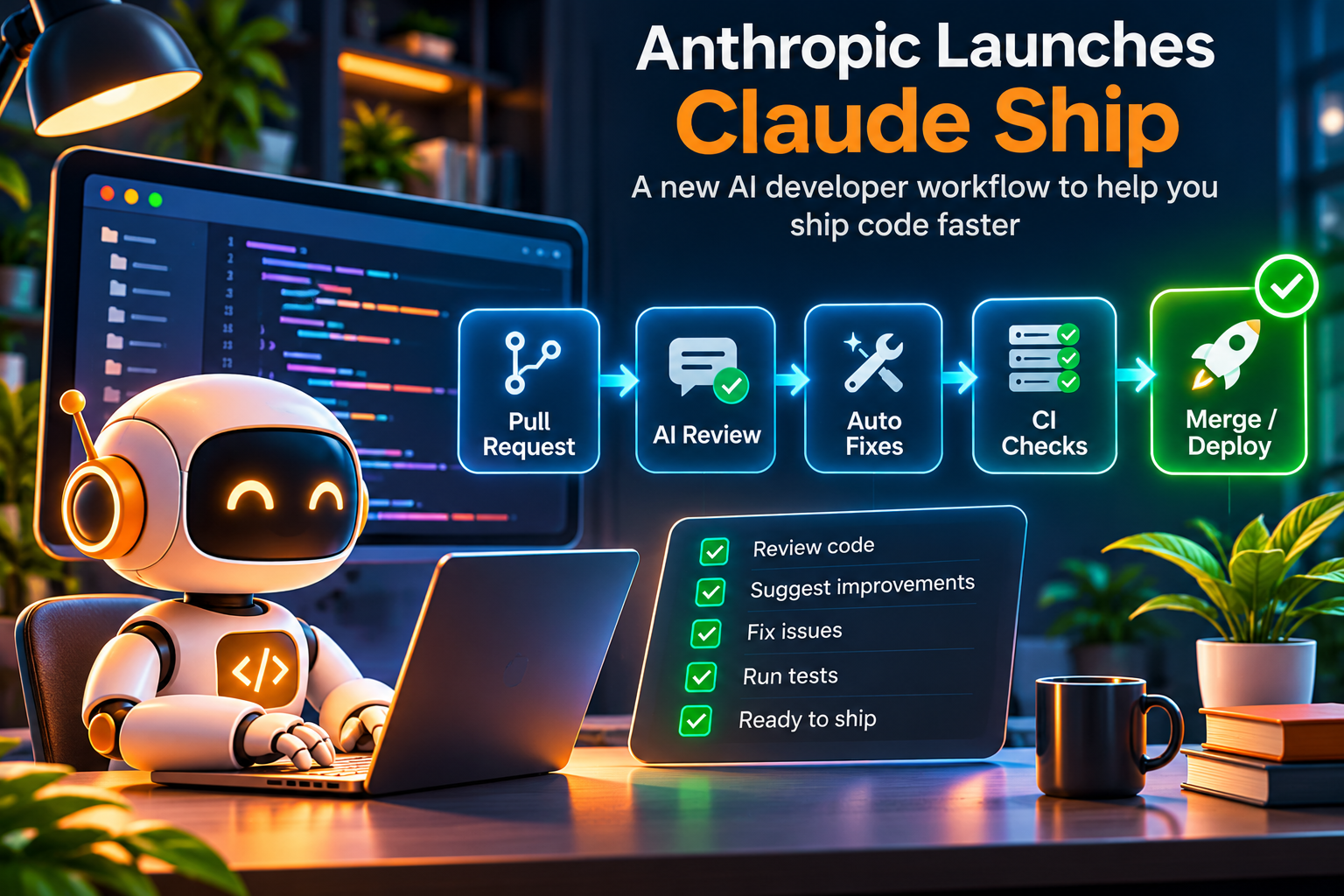
Claude Ship is a workflow for software teams using GitHub repositories. It brings together three capabilities: Code Review, PR Steward and Claude Approvals. Together, they are intended to help teams inspect proposed changes, deal with problems that appear during review or continuous integration, and apply approval rules consistently.
The important distinction is that Claude Ship is not simply another tool for generating code. It focuses on the work that happens after code has been written. Anthropic’s argument is straightforward: if AI agents help developers produce more code, teams also need a way to review and process those changes without allowing the pull-request queue to grow indefinitely.
The three parts of Claude Ship
1. Code Review: find issues before merging
Code Review examines pull requests against the wider codebase. Anthropic says it gathers findings from multiple review perspectives, checks those findings, categorises them and posts the results to the pull request. Teams can choose Quick, Standard or Deep review levels for a repository.
Code Review is already generally available. Anthropic has shared an internal result from its Claude Code team: between June and September, merged pull requests more than doubled while the share of changes later reverted fell by more than 40%. That is a company-reported result from its own workflow, not a guarantee that every team will see the same improvement.
2. PR Steward: help keep pull requests moving
PR Steward is designed to respond when a pull request gets stuck. It can work on failing CI checks, merge conflicts and feedback from Code Review, other review tools or human reviewers. After a push, it comments on what it changed and how the change can be undone.
Developers can guide it by commenting @claude with an instruction, or tell it to stop with @claude stop. Anthropic says PR Steward is designed to keep a pull request in good shape, not to approve or merge it.
3. Claude Approvals: apply rules set by the team
The most consequential part of Claude Ship may be Claude Approvals. It evaluates a pull request against an approval policy maintained as a file in the repository. Teams can describe which changes are routine, which signals matter and when a human reviewer must be involved.
If a change meets the policy, Claude Approvals can approve it. If it falls outside the permitted conditions, the policy can require human sign-off. Anthropic compares the idea to a more flexible CODEOWNERS-style process, with rules that can consider Code Review findings and other signals, including a team’s own classifiers.
Anthropic recommends starting in observe-only mode so teams can see how the policy behaves before making its decision a required branch-protection check. That is a sensible first step when introducing automated approval into a production repository.
How developers can use Claude Ship
For an individual developer, Anthropic is rolling out a /ship command in Claude Code and the Claude desktop app. When a change is ready, the developer can run /ship. Claude can push the work, open a pull request, review the change and help address feedback or failing checks. What it can ultimately merge still depends on the developer’s permissions and the repository’s branch rules.
For engineering teams, administrators can enable Code Review and PR Steward repository by repository. They can choose review depth, decide when reviews run, set spend limits and configure an approval policy. Developers do not need to invoke /ship manually when the repository has been configured for automatic operation.
Who can access Claude Ship?
At launch, Claude Ship is available to customers on Claude Team and Claude Enterprise plans for repositories hosted on GitHub. Code Review is generally available, while PR Steward and Claude Approvals are in beta. The /ship command is rolling out in Claude Code and the desktop app.
There are also important exclusions: Anthropic says Claude Ship is not available to organisations using Zero Data Retention, the HIPAA configuration or customer-managed encryption keys. Teams should check the current product documentation and their organisation’s eligibility before planning a rollout.
Does Claude Ship cost extra?
Usage is billed on tokens, so enabling Claude Ship can add to an organisation’s costs. The amount depends on factors such as the number and size of pull requests, the selected review depth, how often reviews run and how much work PR Steward performs. Administrators can set spend limits for Code Review and PR Steward. Claude Approvals has no base charge, although classifiers and policies that invoke Claude Code Review can consume billable tokens.
For that reason, teams should begin with a limited pilot. Measure how many review cycles are shortened, how often automated fixes need human correction and how much token usage is generated before enabling the workflow across every repository.
What developers should consider before trusting AI approvals
Automating routine review can save time, but approval is not the same as proof that software is safe. AI systems can miss defects, misunderstand project-specific requirements or fail to recognise a security issue. A pull request that looks straightforward may still affect authentication, billing, data access or production infrastructure.
- Start with one repository: choose a project where the team can closely observe results.
- Use observe-only mode first: compare Claude Approvals’ decisions with human reviewers before making it a required check.
- Keep sensitive changes under human review: define clear rules for security, permissions, payments, infrastructure and data-handling code.
- Retain branch protection: do not remove existing safeguards simply because an AI agent is available.
- Review every automated fix: check the diff, tests and explanation before accepting changes.
- Set usage limits: monitor token costs during the pilot and adjust review depth where necessary.
Anthropic itself notes that Claude Ship can miss bugs, security vulnerabilities or other issues. Human oversight and a strong test pipeline remain essential.
Why Claude Ship matters for the future of software development
AI coding assistants have changed how quickly developers can generate prototypes, features and code changes. But producing code faster does not automatically make a software team faster. Review queues, failing tests, merge conflicts and approval processes can absorb the time saved during implementation.
Claude Ship is Anthropic’s attempt to tackle that second half of the problem. Rather than stopping when code is generated, it brings AI into the pull-request workflow and gives teams a way to define which decisions can be automated and which still require a person.
Its success will depend on reliability, clear policies, cost control and how well it fits into existing engineering practices. For teams that already use Claude Code and GitHub, a carefully managed trial could be worthwhile. For critical systems, however, automated approval should complement—not replace—experienced engineering judgement.
Final thoughts
Claude Ship is an interesting step in the evolution of AI-assisted development. Its combination of code review, automated pull-request maintenance and policy-based approvals addresses a real challenge: keeping software delivery moving as AI-generated code increases.
The best way to approach it is not to hand over the keys immediately. Start small, observe its decisions, preserve human review for high-risk changes and measure the results. If it can reliably reduce repetitive work without weakening code quality, Claude Ship could become a useful addition to a modern GitHub-based development workflow.
Sources and further reading
- Anthropic: Introducing Claude Ship (23 November 2026)
- TechCrunch: Anthropic launches Claude Ship
- Reuters: Anthropic launches Claude Ship to help developers ship code faster
Editorial note: This article is based on Anthropic’s product announcement and independent reporting available on 25 November 2026. Features and availability may change while beta testing continues.