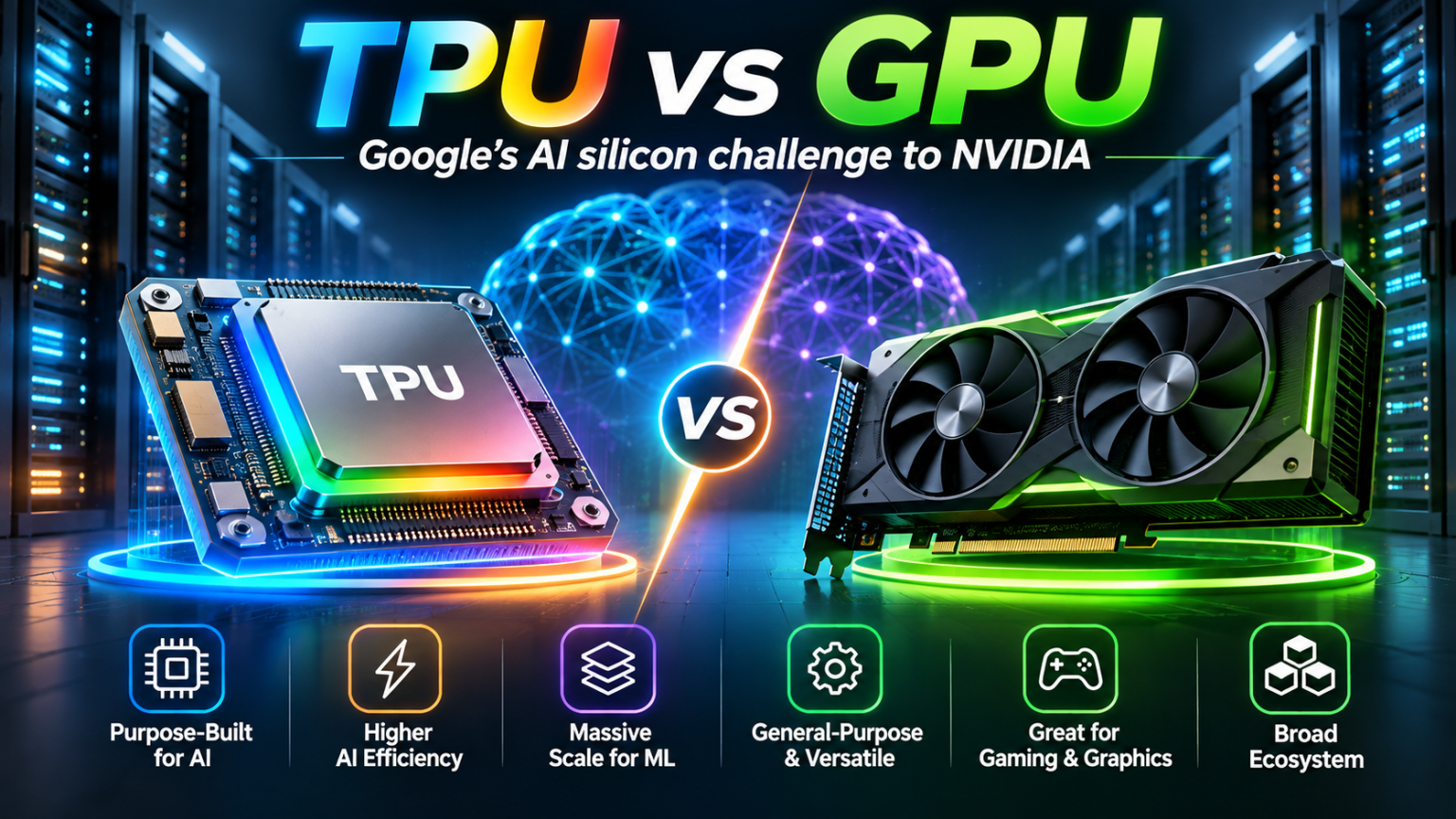
Google’s custom AI chips are becoming a serious force in the infrastructure market. But does that mean NVIDIA can never catch up? Not quite. The more interesting story is that Google is building an increasingly powerful alternative to the GPU model NVIDIA helped popularise—and it has an advantage that goes beyond the chip itself.
For years, NVIDIA GPUs have been the default choice for many AI developers. The company’s hardware, CUDA software ecosystem, networking products and developer tools have made it difficult for competitors to displace. Google, however, has spent more than a decade developing its own Tensor Processing Units (TPUs), using them to power demanding workloads across its services and Google Cloud.
With the seventh-generation Ironwood TPU and fresh benchmark results, the competition has become more interesting. The headline claim that NVIDIA is “never coming close” makes for a catchy debate, but the reality is more nuanced: Google has a compelling advantage in some large-scale AI workloads, while NVIDIA remains a formidable general-purpose platform.
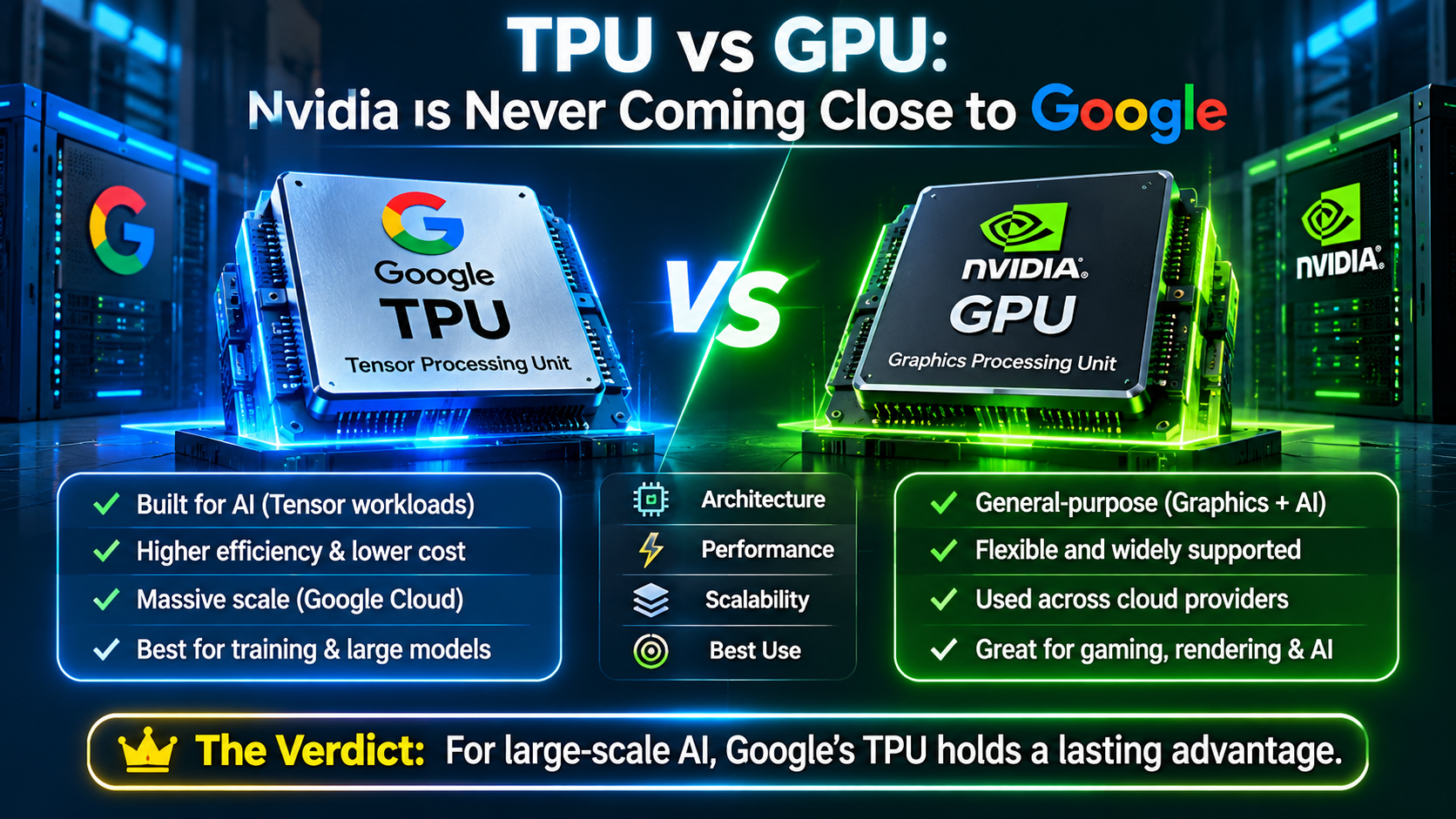
What is the difference between a TPU and a GPU?
A GPU (Graphics Processing Unit) began as a processor for graphics, but its parallel computing architecture made it useful for scientific computing and machine learning. NVIDIA expanded that advantage with CUDA, a mature programming platform and a broad collection of libraries, tools and hardware options.
A TPU (Tensor Processing Unit) is Google’s application-specific accelerator, designed to perform the large matrix and tensor operations common in machine learning. Rather than trying to be a universal processor for every computing task, a TPU focuses on the mathematical operations used by neural networks.
In simple terms, a GPU is a versatile workhorse that can handle many kinds of parallel workloads. A TPU is a specialist designed to make particular AI workloads run efficiently at scale. Neither description automatically makes one faster: the model, software, memory, networking and system configuration all matter.
Google Ironwood: a major step in TPU development
Google’s seventh-generation TPU, known as Ironwood (TPU7x), is designed for large-scale AI training and inference. Google lists up to 9,216 chips in a pod, 192 GiB of high-bandwidth memory per chip and memory bandwidth of 7,380 GB/s per chip. The published peak figures are 2,307 BF16 TFLOPs and 4,614 FP8 TFLOPs per chip.
These specifications are impressive, particularly the memory capacity and bandwidth. Large AI models need to move huge amounts of data between compute units and memory. When thousands of accelerators work together, the interconnect and system design can be just as important as the raw compute number.
Ironwood is designed to work as part of Google’s AI Hypercomputer, which combines accelerators, networking, storage and software. Google says TPU7x can be used with JAX and PyTorch; its current TPU7x documentation says TensorFlow is not supported on this generation. That is a useful reminder that framework compatibility should be checked before choosing a platform.
Google’s latest benchmark results put TPUs in the spotlight
In November 2026, Google published results from the MLPerf Training v6.1 round covering Ironwood TPUs and NVIDIA Blackwell and Blackwell Ultra GPU systems. Google reported that 8,192 Ironwood TPUs reached the target quality for a DeepSeek-V3 pre-training benchmark in 1.70 minutes. It also reported an agentic reinforcement-learning result using 640 Ironwood TPUs, reaching the target coding benchmark accuracy in 18.02 minutes.
The same Google publication reported NVIDIA Blackwell-family results in other MLPerf submissions, including a DeepSeek-V3 pre-training result using 256 Blackwell Ultra GPUs. These figures show that Google is competing seriously at large scale, but they should not be read as a simple one-to-one speed contest: the submissions use different accelerator counts, system configurations and benchmark workloads. A fair comparison must match the model, target quality, precision, software stack and system scale.
It is also important to distinguish vendor-reported results from independent conclusions. MLPerf provides a standardised benchmark framework and published submission records, but a result from one configuration does not prove that one chip family is universally faster or cheaper.
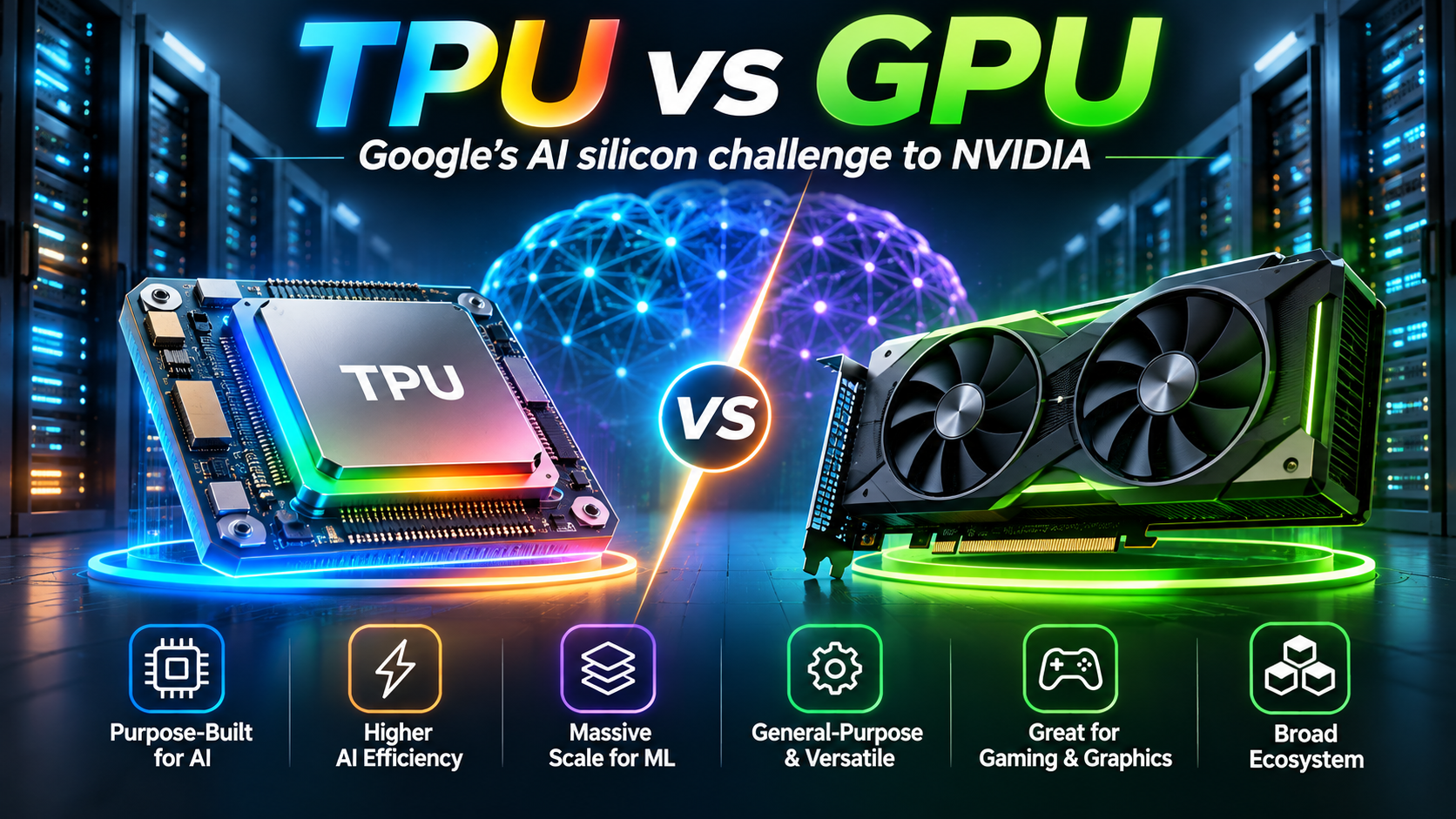
Why Google has an advantage NVIDIA cannot easily copy
1. Google designs the whole AI infrastructure stack
Google does not sell only a processor. It can design the chip, connect thousands of accelerators, build the data-centre network, optimise compilers and frameworks, and run its own AI services on top. This vertical integration gives Google the opportunity to optimise the complete system for its own workloads.
NVIDIA also sells a complete accelerated-computing platform, including GPUs, networking and software. The difference is that Google can align its custom silicon directly with its cloud infrastructure and internal AI products. That is a strategic advantage, not proof that every Google system will outperform every NVIDIA system.
2. Scale matters as much as chip speed
Training a frontier model is not simply a matter of buying the fastest accelerator. Thousands of chips must communicate, share data and stay busy. Network topology, memory bandwidth, software scheduling and failure recovery can determine how much useful work a cluster delivers.
Google has years of experience operating large TPU installations for its own services. Ironwood’s pod design is intended to scale large workloads across thousands of chips. NVIDIA’s latest GPU systems also target large-scale clusters, so the practical winner depends on how efficiently each complete system runs the workload.
3. Google can use TPUs for its own AI products
Google operates services such as Gemini and other AI-powered products at enormous scale. Having its own accelerator gives the company another way to control capacity planning, system design and long-term infrastructure costs. It can tune hardware and software around workloads it understands deeply.
This internal demand matters. Google does not need every AI developer to abandon NVIDIA for its TPU programme to be valuable. If TPUs serve Google’s own models and cloud customers efficiently, they can reduce dependence on an external supplier and strengthen Google Cloud’s offering.
Why NVIDIA is still difficult to beat
It would be a mistake to write NVIDIA off. CUDA has become a major part of the AI development ecosystem. Many research projects, commercial applications, custom kernels and production tools are designed and optimised for NVIDIA GPUs. Developers can also buy or rent NVIDIA hardware across a broad range of cloud providers and on-premises systems.
GPUs are not limited to AI. They are used for graphics, rendering, scientific simulation, data analytics and high-performance computing. That flexibility gives NVIDIA a much wider market than a specialist AI accelerator alone.
Moving a mature AI workload from CUDA to a TPU environment can require engineering effort. Framework support, custom operations, debugging tools, inference libraries and deployment practices all need to be considered. A cheaper accelerator on paper may not be cheaper after migration work and operational changes are included.
TPU vs GPU: which one should developers choose?
| Requirement | Potentially better fit | Why |
|---|---|---|
| Large matrix-heavy AI training | Google TPU or NVIDIA GPU | Benchmark the exact model and scale; both platforms can be strong. |
| Existing CUDA code and custom kernels | NVIDIA GPU | More direct compatibility with the established CUDA ecosystem. |
| Workloads already optimised for JAX / TPU | Google TPU | Can benefit from Google’s compiler and accelerator stack. |
| Graphics, rendering and mixed HPC workloads | NVIDIA GPU | Broader general-purpose GPU software support. |
| Google Cloud-native AI deployments | Google TPU or NVIDIA GPU | Google Cloud offers both; cost and performance depend on the workload. |
For developers and infrastructure teams, the best choice is to benchmark the actual application. Measure tokens per second, time to train, latency, memory use, utilisation, reliability and the full cost of the cloud deployment. Include engineering time for porting and maintenance. Peak FLOPS alone will not answer the question.
Could TPUs challenge NVIDIA’s dominance?
Yes—especially in workloads where Google’s software stack and large TPU systems deliver strong performance and economics. The latest Ironwood results show that Google is not merely experimenting with custom chips; it is building a serious alternative for large-scale AI infrastructure.
But “NVIDIA is never coming close” is too absolute. NVIDIA continues to evolve its hardware and software, and its ecosystem is a powerful competitive moat. Google does not need to replace NVIDIA everywhere to succeed. A world where major cloud providers and AI companies use a mix of custom accelerators and GPUs may be more likely than a single winner taking the entire market.
Final verdict: the real battle is about the entire AI system
The TPU-versus-GPU debate is no longer just about which chip has the highest theoretical performance. It is about who can deliver the best complete system: silicon, memory, networking, software, availability, reliability and cost.
Google has a meaningful advantage in its ability to co-design TPUs with its data centres and AI services. Ironwood strengthens that position and gives cloud customers another serious option. NVIDIA, meanwhile, retains a huge advantage in software maturity, flexibility and ecosystem reach.
So, is NVIDIA never coming close to Google? That is a headline, not a settled technical conclusion. The more defensible takeaway is that Google has become a serious competitor—and the growing choice between TPUs and GPUs is good news for AI developers and customers.
Sources and further reading
- Google Cloud: New AI training performance benchmarks for Google TPUs and NVIDIA GPUs (16 November 2026)
- Google Cloud: TPU7x (Ironwood) technical documentation
- Google Cloud: TPU machine families and architecture specifications
- MLCommons: MLPerf Training benchmark
- NVIDIA: CUDA platform
Editorial note: Published 27 November 2026. Hardware specifications and benchmark details reflect the linked vendor documentation and published results available at the time of writing. Performance varies by workload and system configuration.