
For years, Fiverr made it possible for almost anyone with a useful digital skill to turn that skill into a small online business. Need a logo? Hire a designer. Need a blog post, a WordPress fix, a video edit or a voice-over? There was probably a freelancer ready to do it for a few dollars.
Then generative AI arrived—and the economics of those small jobs changed almost overnight.
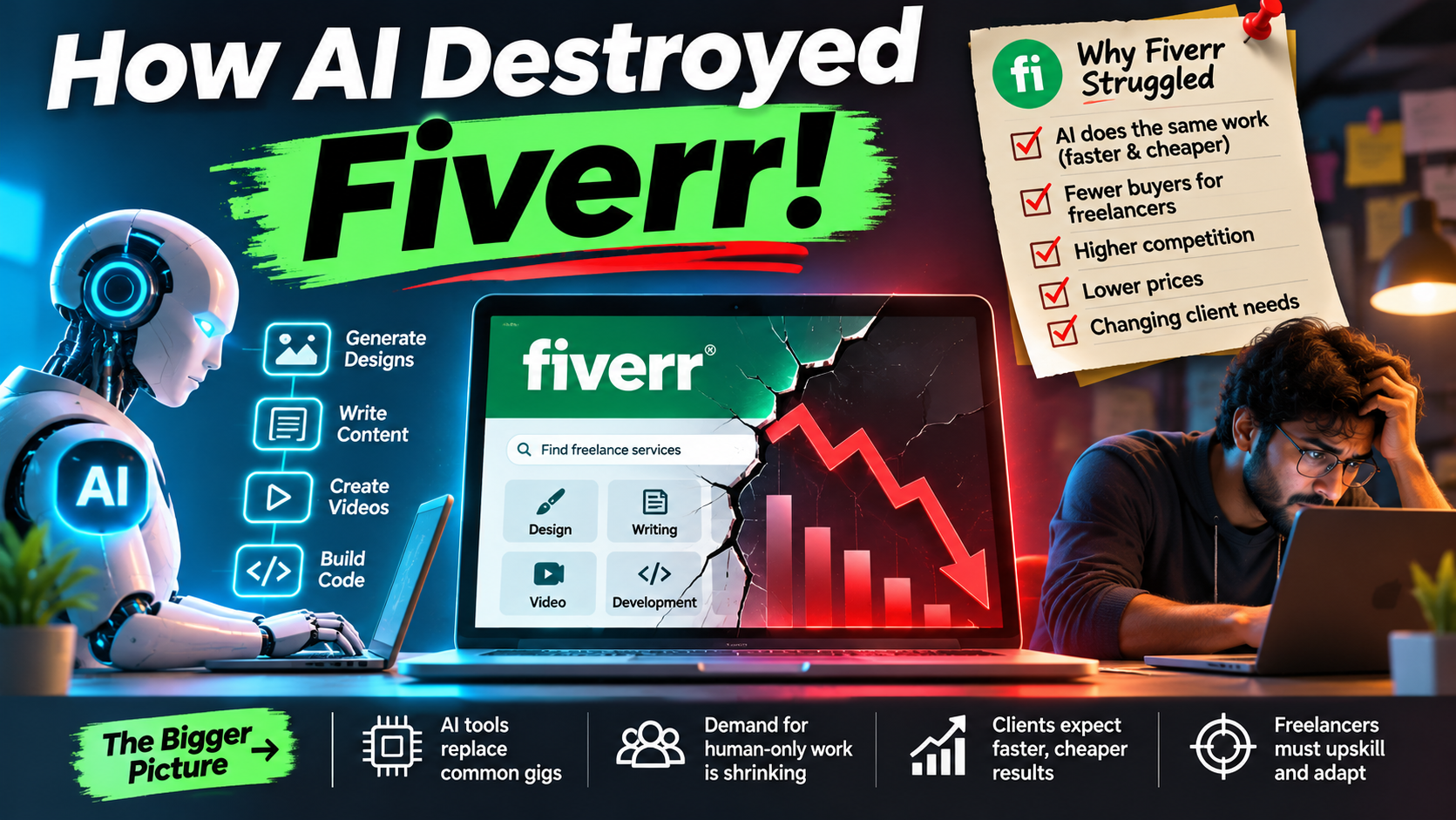
A business owner can now draft marketing copy, generate a basic logo concept, create social media images, build a simple website or produce a first-cut video with AI tools. Tasks that once required a freelancer, a budget and several days can sometimes be attempted in minutes. That is a serious challenge for a marketplace built around buying individual digital services.
So, did AI destroy Fiverr? The headline captures the frustration many freelancers feel, but the reality is more complicated. AI is putting pressure on low-cost, repeatable gigs. At the same time, Fiverr’s own data shows demand for AI-related services growing quickly—and businesses still need people to guide, verify and deliver professional work.
The old Fiverr model: small jobs, clear prices and fast delivery
Fiverr’s original appeal was its simplicity. Sellers packaged a service into a listing, or Gig, with a defined price, scope and delivery time. Buyers could compare offers and place an order without going through a lengthy hiring process.
That model worked particularly well for tasks with a predictable output: removing a photo background, designing a simple banner, writing a short product description, converting a document, editing a short clip or making a small website change.
But these are also the kinds of tasks where generative AI can make a noticeable difference. A buyer who once needed to pay for a first draft may now generate one independently. A small business can experiment with several logo directions before deciding whether it needs a professional designer. A developer can ask an AI coding assistant to produce a simple script instead of purchasing a basic programming gig.
The result is not that every freelancer has become unnecessary. It is that buyers have more options, and the value of routine execution is under pressure.
Fiverr’s own numbers show the pressure
Fiverr’s second-quarter 2026 results showed a difficult transition. Revenue was $97.8 million, down 10% year over year. Marketplace revenue declined 15.5% to $63.1 million, while annual active buyers fell 21.9% to 2.7 million. Average annual spend per buyer, however, rose 15.6% to $368.
Those figures point to a marketplace with fewer active buyers but higher spending among the customers who remain. They do not prove that AI alone caused the decline. Economic conditions, weaker small-business demand, changes in online discovery and other marketplace factors also matter.
Fiverr’s leadership has directly connected the pressure in lower-value transactional work to AI adoption. In its Q2 shareholder communication, the company described a compression in high-volume, low-value work and said it was repositioning toward larger projects that require expertise, workflow management and accountability.
The company’s 2026 outlook was also reduced after the second-quarter results. That is a clear sign that Fiverr is dealing with real business pressure—not simply a social-media debate about whether AI can make a logo.
AI is replacing some gigs—but creating new ones too
There is another side to the story. Fiverr’s own November 2026 guide to AI skills says businesses completed more than 137,000 AI-related projects on the platform over the preceding 12 months, up 52% from roughly 90,000 in the previous year. AI-related services also more than doubled their share of completed projects.
Fiverr reported strong growth in several areas: AI videography projects grew more than sevenfold, AI mobile app projects increased 114%, and AI video projects grew 83%. Newer categories include AI automation and agents, AI websites and software, vibe coding, AI UGC and generative engine optimisation.
These are platform-reported figures, and they measure completed projects rather than the entire freelance economy. Still, they show that buyers are not simply abandoning freelancers. Some are changing what they purchase.

Which Fiverr services are most exposed?
There is no universal list of jobs that AI will eliminate. The level of risk depends on the complexity of the work, the buyer’s quality expectations and how much context or accountability the task requires. But some categories are easier to automate than others.
1. Basic content writing
Simple product descriptions, short generic blog drafts, basic captions and routine rewrites can now be produced quickly with AI. That makes it harder to charge for words alone. Writers who understand a client’s industry, interview subject-matter experts, check facts and create a distinctive editorial voice have a stronger proposition.
2. Simple graphic design
AI image tools can generate concepts, social graphics and basic visual assets. A buyer may no longer need to hire someone for every simple design. But brand systems, typography, production-ready files, accessibility, art direction and consistent campaign design still require skilled judgement.
3. Basic website and coding tasks
AI coding assistants can create simple pages, scripts and prototypes. That can reduce demand for very small coding jobs. But deploying a secure website, integrating payments, fixing production bugs, improving performance and maintaining a complex WordPress installation are different challenges. Businesses need someone who can take responsibility for the result.
4. Routine image and video editing
Automated background removal, captions, resizing, basic cuts and template-based videos are increasingly accessible. Editors can protect their value by specialising in storytelling, motion design, sound, brand consistency and final quality control.
Why clients still need human freelancers
Generating an output is not the same as solving a business problem. A company may ask for a logo, but what it really needs is a visual identity that works across packaging, websites, advertising and print. It may ask for a chatbot, but the real project includes knowledge-base design, integrations, testing, privacy and ongoing maintenance.
Fiverr’s November 2026 data offers an interesting signal: around one in eight clients who commissioned AI video also hired a human video editor within 90 days. Fiverr also reported growth in customer-support and software-testing work alongside AI adoption. These figures suggest that AI output can create follow-on work for people who improve, validate and deliver it.
Human skills are especially important when a project needs:
- Understanding of a client’s business, audience and constraints.
- Fact-checking, technical testing and quality assurance.
- Creative direction and a consistent brand identity.
- Integration with existing software, websites and business processes.
- Communication, project management and accountability.
- Judgement when the brief is unclear or the output has real-world consequences.
Fiverr is trying to become a higher-value marketplace
Fiverr’s response is not simply to add AI buttons to its existing Gig listings. The company says it is moving toward larger, more complex projects and improving how it matches buyers with suitable talent.
Its Q2 2026 shareholder letter highlighted growth in customers completing projects worth $1,000 or more. That customer group grew 13% year over year on a trailing twelve-month basis. Fiverr also reported growth in higher-value Programming & Tech and Graphics & Design projects.
The strategy makes sense: when a buyer can generate a basic deliverable with AI, the marketplace needs to make it easier to find someone who can deliver an entire outcome. That might mean a complete website, a tested application, an automated business workflow or a video campaign—not just one isolated task.
Whether Fiverr can complete this transition successfully is still an open question. The company itself has described it as a multi-quarter transformation, and the financial pressure shows that changing a marketplace’s business model is not easy.
How Fiverr freelancers can adapt in the AI era
Freelancers do not need to become AI researchers. They do need to understand how the tools affect the service they sell. The goal is to combine useful automation with a skill that clients cannot easily replace with a one-line prompt.
1. Stop selling only the task
Instead of offering “I will write 500 words,” offer a researched article with source verification, search intent, editing and a clear publishing-ready structure. Instead of “I will make a logo,” offer a small brand identity with usage guidelines and production files.
2. Learn the tools used in your category
Writers can use AI for research organisation and first drafts, then apply subject expertise and editing. Designers can use image-generation tools for exploration while retaining control of composition and final production. Developers can use coding assistants but remain responsible for architecture, security, testing and deployment.
3. Build a specialised portfolio
Generic services compete mainly on price. A portfolio showing real outcomes in a specific niche gives buyers a reason to choose you. Examples include WordPress speed optimisation, e-commerce integrations, SaaS explainer videos, technical documentation or automation for a particular industry.
4. Sell packages and ongoing support
One-off micro-jobs can be easy to automate and easy to compare on price. Maintenance, monthly content operations, analytics, testing, technical support and ongoing creative services build longer relationships and make the value of human expertise clearer.
5. Be transparent about AI use
Do not promise fully original human work if AI has generated substantial parts of it. Explain how you use tools, what you personally review and what the client receives. Trust matters, particularly when a project involves confidential data, copyrighted material or a business-critical system.
6. Compete on reliability, not just speed
AI can produce a quick answer. Clients still need someone who asks the right questions, meets deadlines, handles revisions and stands behind the delivered work. Clear communication and dependable delivery are competitive advantages.
Is AI also making Fiverr cheaper for buyers?
In some categories, yes. When a buyer can generate a first draft or visual concept at little cost, the price they are willing to pay for a basic version of that output may fall. More sellers using the same AI tools can also increase competition and make generic services harder to differentiate.
But cheaper production does not always mean a cheaper finished project. AI-generated work may need editing, fact-checking, licensing review, integration or rework. A business that values quality should compare the total cost of getting a usable result—not just the price of the first output.
Did AI destroy Fiverr—or expose a weakness in the old model?
AI has exposed how vulnerable a marketplace can be when a large part of its value comes from selling small, repeatable digital tasks. If software can produce an acceptable first version instantly, the seller must offer something more valuable than access to the same output.
But Fiverr is not simply disappearing. Its own data shows growing AI-related project activity, and the company is trying to move toward higher-value work. The real question is whether it can help buyers find trusted experts and help freelancers package their skills around outcomes rather than isolated tasks.
Final verdict: the gig economy is changing, not ending
AI has made life harder for freelancers who depend on basic writing, simple graphics, routine editing and entry-level coding gigs. It has also changed what buyers expect to pay and how quickly they expect work to be delivered. For those sellers, pretending nothing has changed is not a strategy.
At the same time, AI is creating new categories of work and increasing the need for people who can guide, integrate, test and take responsibility for AI-assisted results. Fiverr’s future may depend on how well it makes that transition—and whether it can rebuild trust and value in a marketplace where the first draft is no longer scarce.
So perhaps AI did not destroy Fiverr. It destroyed the assumption that every small digital task will remain valuable simply because it takes a human time to complete. The freelancers who adapt fastest may find that the next opportunity is bigger than the old Gig economy.
Sources and further reading
- Fiverr: Second-quarter 2026 financial results
- Fiverr: Q2 2026 shareholder letter
- Fiverr: AI skills in demand—fastest-growing freelance skills of 2026 (19 November 2026)
- Upwork: Future Workforce Index 2026
- The Guardian: Freelancers are getting buried with AI cleanup work (2 September 2026)
Editorial note: Published 27 November 2026. Marketplace statistics are attributed to Fiverr and Upwork. The headline is deliberately provocative; the evidence points to a major disruption and business-model transition, not the literal end of Fiverr.