How an AI-Discovered Flaw in PHP Sparked a Global Security Scramble
Artificial intelligence is changing the way security researchers discover software vulnerabilities. But a recent discovery in PHP has highlighted a difficult reality: the same technology that helps defenders uncover hidden flaws can also make it easier for attackers to understand and exploit them.
On October 21, 2026, government agencies and organisations in Europe and elsewhere temporarily took some websites and online services offline after two critical vulnerabilities in PHP were disclosed. The programming language powers a large portion of the web, including websites built with WordPress, Drupal, Joomla and Magento.
The flaws had remained hidden for years. Researchers used AI-assisted tools to help identify them, triggering an urgent effort to patch vulnerable systems before attackers could take advantage of the weaknesses on a larger scale.
The incident, reported by Reuters cybersecurity reporter Raphael Satter and colleagues, is a striking example of how AI is reshaping both cybersecurity research and the risks facing the internet.
What happened, and why did websites go offline?
The immediate problem was the disclosure of two critical PHP vulnerabilities: CVE-2026-109618 and CVE-2026-109619.
Both flaws affect the PHP runtime, the software that processes PHP code on a server and generates dynamic web pages and application responses. Under certain conditions, the vulnerabilities could allow an attacker to execute code remotely without authenticating first.
That is a particularly serious risk. If an attacker can execute code through a vulnerable server, they may be able to access application data, modify website files, or attempt to gain further access to the system.
As the vulnerabilities became public, security teams had to make a difficult decision. Should they keep their services online while preparing and applying a fix, or temporarily disable access to reduce the chance of an attack?
Some chose the second option.
Reuters reported that organisations in the Netherlands, Denmark, Finland and France took websites or online services offline or placed them into preventive maintenance. The affected services included government portals, hospital websites, public-sector systems and other organisations.
Wikipedia and the Internet Archive also reported taking some systems offline temporarily while addressing the risk.
These shutdowns were precautionary measures, not proof that every affected organisation had been breached. In an emergency, temporarily restricting access can be a sensible way to reduce exposure while administrators patch and verify critical systems.
Source: Reuters — Government websites go dark after AI-discovered flaw sparks security scramble
How did AI help researchers find the PHP vulnerabilities?
Finding serious software vulnerabilities is rarely as simple as spotting an obvious coding mistake.
Large software projects contain years of development history, complex memory management, thousands of interacting functions and countless unusual execution paths. Some bugs only appear when the software encounters exceptional conditions that developers may not have anticipated.
AI-assisted security research can help investigators examine this complexity more efficiently. Researchers can use models to inspect code, identify suspicious patterns, develop hypotheses about how a flaw might behave, and help test whether those hypotheses are correct.
In this incident, cybersecurity companies Calif and Wiz reported AI-assisted discoveries involving the PHP codebase.
Reuters reported that Calif identified the flaws with help from a large language model, while Wiz described using its Wiz Atlas research tool alongside Google’s Gemini 4 Argon and OpenAI’s GPT-5.6 Sol. The research teams coordinated their work with relevant parties to support remediation and disclosure.
Google Cloud subsequently confirmed that Gemini 4 Argon contributed to vulnerability discovery, exploit development, attack detection and patch validation.
This does not mean an AI model independently handled every part of the research. Human researchers, security engineers, software maintainers and coordinated disclosure processes remained important to validating the findings and preparing fixes.
The significance is that AI helped make difficult security research more practical and efficient.
Sources:
Why were the bugs so dangerous?
The two vulnerabilities involve problems with PHP’s handling of memory and internal request state. Both received a CVSS v4.0 severity score of 9.2, placing them in the critical category.
CVE-2026-109618: An out-of-memory handling flaw
Software must handle situations where it cannot allocate the memory it needs. PHP has mechanisms for dealing with out-of-memory conditions, but the vulnerable code paths could leave internal request data in an unsafe state.
During subsequent cleanup, the runtime could incorrectly process that data. Under suitable conditions, an attacker could potentially turn the memory corruption into remote code execution.
CVE-2026-109619: A stale internal-state flaw
The second vulnerability involves internal state that can continue to refer to memory after that memory has been released.
This resembles a class of programming errors known as use-after-free. If a later request uses stale information before the runtime has safely reset it, the resulting behaviour can create an exploitable condition.
These are low-level software defects, but their consequences can reach much further. PHP processes requests for real websites and applications, often with access to files, databases and application secrets.
The risk therefore depends not just on the code defect but also on the privileges of the affected PHP process and the security controls surrounding it.
Technical details and remediation guidance are available in the NHS England Digital PHP2Shell advisory.
Why a PHP vulnerability can affect so much of the internet
PHP is one of the web’s long-standing building blocks. It is used to generate dynamic content, process forms, interact with databases, manage sessions and run application logic.
Many website owners never install PHP themselves. Their hosting provider manages it, or it arrives as part of a web server or application platform.
That can make a vulnerability in the PHP runtime particularly challenging to manage.
A WordPress administrator may keep WordPress core and every plugin updated yet still be exposed if the server is running a vulnerable PHP version. The same principle applies to other PHP-based applications: application updates and runtime updates are separate responsibilities.
Shared hosting introduces another complication. A single server may host hundreds of customer websites and multiple PHP versions. The hosting provider must identify which runtimes are affected and make sure each one is patched.
Reuters cited Censys data indicating that around 1.5 million of 2.6 million observed hosts were reporting PHP versions for which a fix was not available at the time of the analysis. Such figures are a snapshot of reported versions, not a count of confirmed compromised websites.
The uncomfortable part: attackers can use AI too
AI-assisted vulnerability discovery creates an advantage for defenders, but it also changes the economics of attacking software.
Once a vulnerability is disclosed, malicious actors can use technical reports, code analysis tools and AI assistants to understand the underlying defect. Some may try to develop exploits, automate scanning, or identify internet-facing systems that have not yet been patched.
That creates a race between attackers and defenders.
The window between a security fix becoming available and an organisation deploying it can be critical. Large technology companies may have dedicated security teams and automated deployment systems. Smaller organisations may depend on an external provider or run older applications that require testing before they can be upgraded.
Reuters also reported that Amazon detected an attempted exploitation against a decoy system on October 17, four days before public disclosure. The company said it was unclear how the actor learned of the vulnerabilities or whether those attempts would have succeeded against real websites.
This is an important distinction: early suspicious activity does not prove widespread successful compromise, but it reinforces the need to prepare for exploitation as soon as a serious flaw becomes known.
What website owners should do now
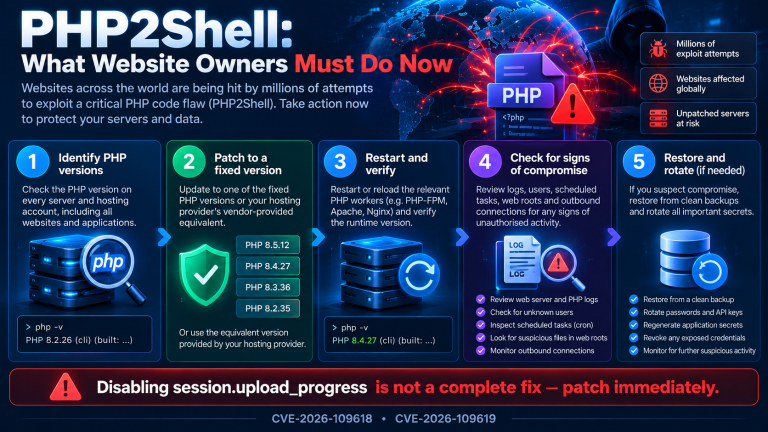
The PHP development team has released patches for the affected supported branches. The correct response is to identify affected installations, apply the appropriate updates, and verify that the live service is using a fixed runtime.
| PHP branch | Fixed version |
|---|---|
| PHP 8.5 | 8.5.12 |
| PHP 8.4 | 8.4.27 |
| PHP 8.3 | 8.3.36 |
| PHP 8.2 | 8.2.35 |
These are the versions identified in the official advisories for this incident. Install the appropriate fixed release or a later supported release, following your operating-system or hosting vendor’s instructions.
PHP 8.1 and older releases are end-of-life and do not receive fixes for these issues through the PHP project’s normal release process. Organisations still running them should plan a migration to a supported branch.
1. Check every PHP runtime
Start by checking the command-line version:
php -vHowever, this only tells you about the PHP executable available to that shell. Your live website may use a separate PHP-FPM pool, Apache module, LiteSpeed runtime, container or hosting-panel-managed version.
Check the PHP versions assigned to every website and application. Do not assume that updating one version updates all installed branches.
2. Install the security updates
Use the supported package manager, hosting control panel or deployment process for your environment. On managed hosting, contact the provider if you cannot update PHP directly.
After the update, restart or reload the affected PHP workers and web services when required by the vendor’s instructions.
Then verify the version actually serving requests. A successful package installation does not automatically prove that every live application has switched to the patched runtime.
3. Review logs for suspicious activity
Patching closes the vulnerability in the updated runtime, but it cannot undo an earlier intrusion.
Review relevant web server, PHP and system logs. Investigate unfamiliar accounts, unexpected scheduled tasks, modified files, suspicious processes and unexplained outbound connections.
If you find credible signs of compromise, preserve relevant evidence and follow your incident-response process rather than simply deleting suspicious files and assuming the system is clean.
4. Protect application secrets
If a server may have been compromised, consider which credentials the affected PHP process could access.
Depending on the incident, these may include database passwords, API keys, hosting credentials, deployment tokens and application secrets. Rotate exposed credentials from a trusted environment and revoke access that is no longer required.
Where necessary, restore from verified clean backups and investigate how the attacker may have gained access before bringing the service back online.
5. Avoid relying on temporary workarounds
A configuration change may reduce exposure to a particular attack path, but it should not replace the official security patch.
For these PHP vulnerabilities, the relevant security guidance identifies upgrading to a fixed version as the complete remediation. If immediate patching is not possible, assess the risk and consider taking the affected service offline until it can be secured.
What hosting providers need to do
Hosting providers have an especially important role because many customers cannot manage the underlying PHP installation themselves.
A strong response should include:
- An inventory of all PHP versions running across hosting servers.
- Prioritisation of internet-facing systems and vulnerable runtimes.
- Prompt deployment of vendor-supported security updates.
- Verification that PHP-FPM, Apache, LiteSpeed and other affected configurations use patched versions.
- Monitoring for suspicious activity and signs of compromise.
- Clear communication with customers about actions taken and any remaining requirements.
- A migration plan for unsupported PHP versions.
Providers should also test their emergency patching process before the next major vulnerability appears. When hundreds of sites share infrastructure, a reliable inventory and automated deployment process can significantly reduce the time needed to respond.
What this incident tells us about the future of AI security
The PHP incident is not simply a story about a programming bug. It demonstrates how AI is changing the speed and scale of security research.
For years, vulnerability discovery often depended on specialists spending significant time studying complex code, reproducing unusual conditions and validating possible exploits. AI tools can assist with parts of that work and help researchers explore more potential weaknesses.
That can be good news for software security. Bugs that might otherwise remain hidden may be discovered and fixed earlier.
But it also means that organisations cannot assume a flaw will remain obscure for long. Once a vulnerability becomes public, attackers may use AI-assisted workflows to analyse it and identify systems that have not been updated.
The response must therefore evolve too. Organisations need accurate asset inventories, supported software versions, tested backups, reliable patching processes and monitoring that can identify suspicious behaviour.
AI can accelerate discovery, but it cannot replace the operational discipline needed to keep systems secure.
Frequently asked questions
What is the PHP2Shell vulnerability?
PHP2Shell is the name used in security reporting for activity associated with two critical PHP vulnerabilities, CVE-2026-109618 and CVE-2026-109619. Successful exploitation could allow remote code execution or access to sensitive memory.
Did AI discover the PHP vulnerabilities?
AI tools contributed to the research. Calif and Wiz reported AI-assisted findings, and Google Cloud described a contribution from Gemini 4 Argon. Human researchers and software maintainers also played important roles in validating and fixing the issues.
Why did government websites go offline?
Some organisations temporarily disabled public-facing services as a precaution while preparing to patch vulnerable PHP installations. Taking a service offline can reduce exposure when an organisation cannot immediately confirm that it is protected.
Are WordPress websites affected?
WordPress runs on PHP, so a WordPress website using a vulnerable PHP runtime may be at risk. Updating WordPress core or plugins alone does not patch PHP itself. Website owners should confirm that the server’s PHP runtime is fixed.
Does the release of a patch mean the danger is over?
No. Vulnerable systems may remain exposed until they are updated, and a patch cannot reverse a compromise that has already occurred. Administrators should verify the live runtime and investigate suspicious activity where appropriate.
Can AI make cyberattacks more dangerous?
AI can help researchers analyse code and can also help attackers understand vulnerabilities, automate parts of reconnaissance and develop attack techniques. Its impact depends on the tools, the user’s capabilities and the security controls defending the target.
Conclusion
The AI-assisted discovery of critical PHP vulnerabilities has prompted an unusually broad security response, with organisations temporarily taking some public services offline while they worked to protect their systems.
It is also a warning about the changing pace of cybersecurity. AI can help uncover weaknesses that remained hidden for years, but once those weaknesses become known, defenders may have little time to respond before attackers begin looking for unpatched systems.
For website owners, developers and hosting providers, the practical priorities remain clear: update affected PHP installations, verify the runtime serving traffic, monitor for signs of compromise and keep a tested recovery plan.
The lesson is not that AI makes the internet inherently unsafe. It is that security teams must become faster at finding, fixing and verifying vulnerabilities in a world where AI can accelerate both defence and attack.
Sources and further reading
- Reuters: Government websites go dark after AI-discovered flaw sparks security scramble
- Google Cloud: Responding to core PHP vulnerabilities CVE-2026-109618 and CVE-2026-109619
- NHS England Digital: Critical vulnerabilities in PHP (PHP2Shell)
- PHP official security advisories
This article is an independently written explainer based on public reporting and security advisories. It is not a reproduction of the original Reuters report.