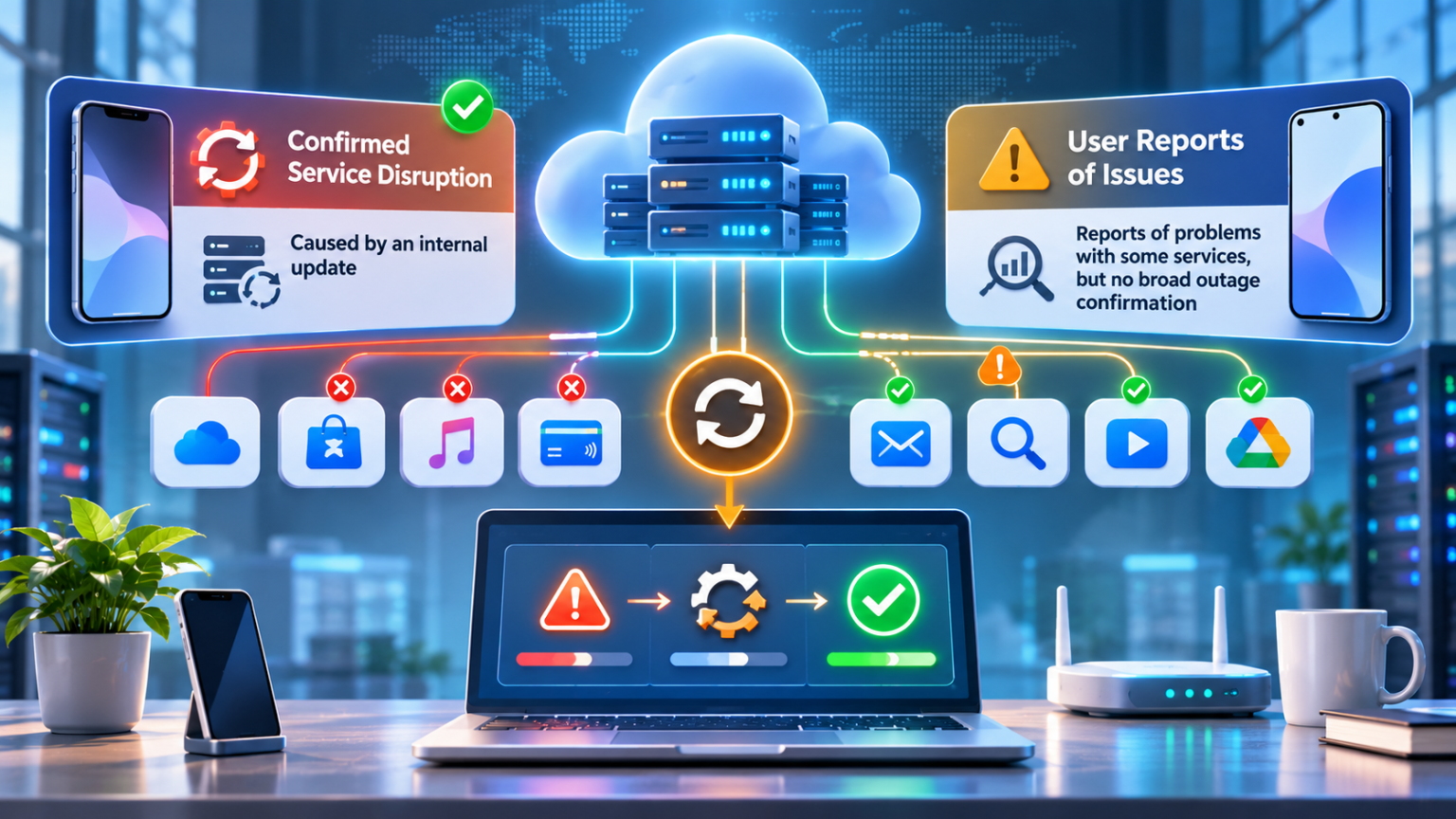
When Apple services began failing on November 17, 2026, users quickly noticed that the problem was bigger than one app refusing to load. Reports mentioned iCloud sign-in, the App Store, Apple Music and other parts of Apple’s ecosystem. Around the same time, people also posted complaints about Gmail and Google Search, creating the impression that two of the world’s biggest technology platforms were going down together.
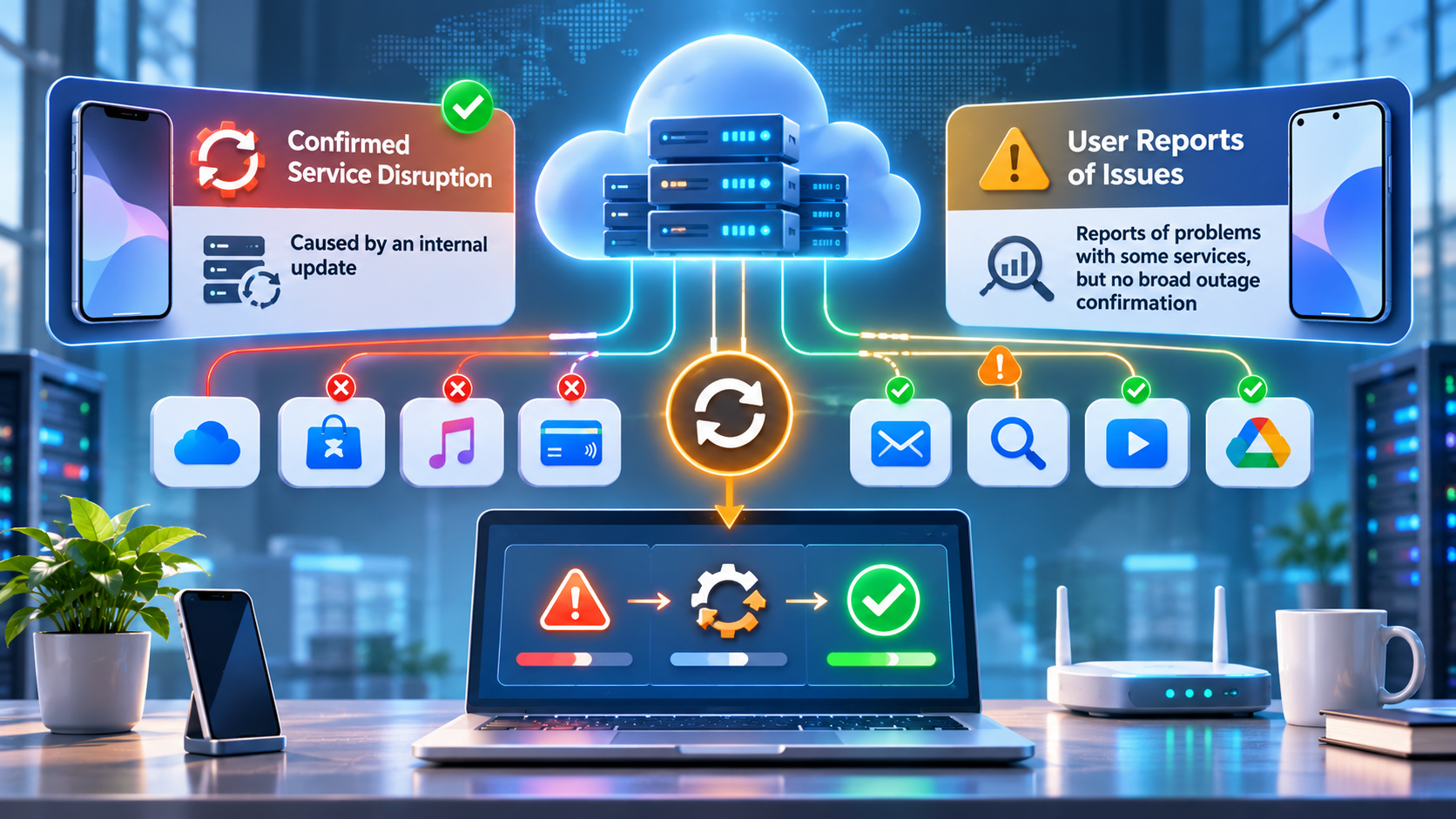
But the two stories were not identical. Apple confirmed that an internal update caused an outage affecting several services. Google, meanwhile, said it had no evidence of a broad Gmail disruption, and its public status dashboards did not show a matching service-wide incident. That distinction matters when separating a confirmed outage from individual reports or regional connectivity problems.
What happened on November 17?
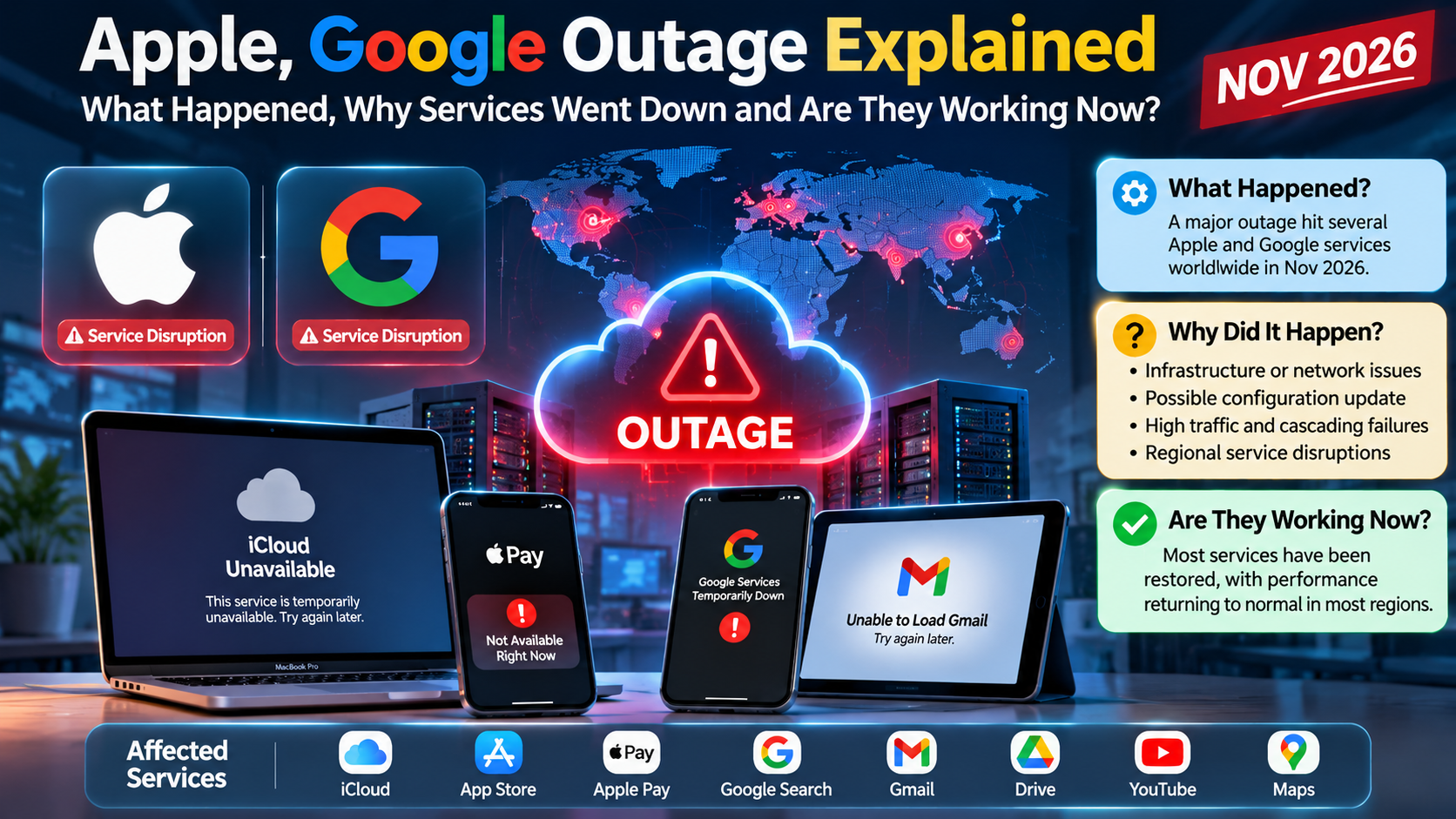
On Tuesday, November 17, users began reporting problems with multiple Apple services. Some could not sign in to their Apple Accounts or access iCloud. Others experienced trouble with the App Store, Apple Music, AppleCare and related services. Reports also described difficulties with Apple Pay, Apple Card and activating new devices, although Apple did not confirm every user-reported symptom as part of the same incident.
Apple acknowledged the disruption and said an internal update had caused some systems to go offline or become unavailable. The company said many systems were already running again and that teams were working to restore the remaining services.
By the evening of November 17 in the United States, the reported Apple service incidents had been marked as resolved. That means the main disruption had been cleared, although individual users could still experience temporary sign-in, payment or connectivity issues while systems and devices recovered.
Which Apple services were affected?
- iCloud Accounts and Sign In: Some users could not authenticate, access cloud services or complete account sign-in.
- iCloud Mail and Web Apps: Users reported trouble reaching mail and iCloud.com services.
- App Store: Store access, downloads and updates were affected for some users.
- Apple Music: Some customers experienced connection and access problems.
- AppleCare on Device: Apple’s device-based support and coverage services were among the systems listed as affected.
- Apple Business and School services: Apple Business Manager, Apple School Manager, Schoolwork and related services also appeared on Apple’s system-status listings.
Not every Apple product stopped working. An outage affecting account authentication or a cloud service can make several apps appear broken even when the apps themselves are functioning normally. Locally stored photos, files or music may still be available, for example, while services that need an account check or a server connection may fail.
Why did Apple’s services go down?
Apple’s explanation was that an internal update triggered the disruption. The company said the incident was not caused by a cyberattack. However, it has not publicly provided a detailed technical post-mortem explaining exactly what was changed, which component failed or how the issue spread between services.
That means it would be misleading to claim that a particular database, server, network device or software release was definitely responsible. The confirmed cause is limited to Apple’s statement about an internal update.
There are several ways an update can affect a large online platform. A change to authentication infrastructure could prevent users from signing in. A configuration error could interrupt communication between services. A software deployment could expose an unexpected dependency or overload a component as traffic moves through it. These are general examples of how cloud outages can happen—not confirmed details of Apple’s incident.
Why can one internal problem affect so many services?
Large technology ecosystems are connected behind the scenes. An App Store download, an iCloud sign-in and an Apple Music session may look like separate activities to a customer, but they can depend on shared identity systems, APIs, network infrastructure and cloud services.
If a shared component becomes unavailable, several products can fail at the same time. This is sometimes called a cascading failure: one fault affects a dependency, which then causes problems for other services that rely on it.
Companies reduce this risk through staged deployments, automated health checks, redundant systems, rollback plans and careful monitoring. But no large platform can eliminate every failure. Even a routine update can have unexpected effects when it interacts with a complex production environment.
Was Google down at the same time?
There were reports from users who said Gmail was not loading, messages were delayed or Google Search was behaving unexpectedly on November 17. Those reports spread quickly because they appeared alongside Apple’s confirmed disruption.
However, Google’s public response was different. The company said it was not seeing evidence of a broad Gmail service disruption. The Google Workspace Status Dashboard showed no active incident for Gmail at the time checked, and the Google Search Status Dashboard did not report a Search serving outage.
Google’s Search dashboard did show a November 2026 core update affecting rankings. That is a change to how Google ranks search results, not an outage that prevents people from using Google Search. It is important not to confuse ranking volatility with a service interruption.
So, what can we say with confidence? Users did report Google-related problems, but there was no public confirmation of a widespread Google outage matching Apple’s incident. The available information does not establish that Apple and Google suffered a shared failure or that one company’s systems caused problems for the other.
Could Gmail or Search still fail for individual users?
Yes. A service can be healthy at the global level while a particular user, internet provider, office network or region has a problem. DNS failures, routing issues, browser extensions, account authentication, device settings and local network congestion can all prevent access to a website or app.
Outage-reporting websites are useful because they reveal sudden increases in complaints, but their graphs are based on user submissions. A spike is a signal worth investigating; it is not, by itself, proof that a company’s entire service is offline.
Are Apple and Google services working now?
As of November 18, 2026, the November 17 Apple incidents had largely been resolved and were marked as resolved on Apple’s status reporting. Google’s Workspace Status Dashboard showed no active incidents at the time of the latest check, while its Search dashboard showed a core ranking update rather than a service outage.
Status can change, and a dashboard may not capture every local issue. If a service is still failing on your device, check the live status pages before assuming the entire platform is down.
- Apple System Status — iCloud, App Store, Apple Music, Apple Pay and other Apple services.
- Google Workspace Status Dashboard — Gmail, Drive, Calendar, Meet and other Workspace products.
- Google Search Status Dashboard — Search crawling, indexing, serving and ranking incidents.
What should you do if Apple or Google services stop working?
- Check the official status page. This helps establish whether the provider has acknowledged a wider incident.
- Test another connection. Switch between Wi-Fi and mobile data to see whether the issue is limited to one network.
- Avoid repeated password resets. If account sign-in infrastructure is having problems, repeated attempts may create confusion or trigger extra security checks.
- Do not install unofficial fixes. Outages often attract fake support pages, suspicious downloads and phishing messages claiming to restore access.
- Use a safe alternative where possible. If a cloud service is temporarily unavailable, use an offline copy of important files or another trusted payment method.
- Try again after the provider reports recovery. Close and reopen the app, check for updates and sign in again only when the service is stable.
Why have so many technology outages made headlines this month?
The Apple disruption arrived during a week of wider technology and infrastructure problems. Microsoft experienced a major disruption affecting services such as Outlook and Teams earlier in November. Other organisations also reported technical incidents involving transport, banking and airline systems.
These events involved different companies and different systems. Their timing does not prove that they share a common cause, and there is no confirmed evidence that the Apple incident was part of a coordinated cyberattack. Still, the sequence is a reminder of how much everyday activity now depends on large, interconnected digital services.
When email, identity, cloud storage, payments and business applications all rely on remote infrastructure, even a short interruption can affect millions of people. Reliability engineering, careful change management and clear incident communication are therefore essential—not optional extras.
What does this tell us about cloud reliability?
Cloud platforms are built to handle enormous traffic and remain available across regions, but they are not immune to software mistakes or infrastructure failures. A service can have multiple data centres and backup systems and still experience disruption if a shared dependency or configuration affects them.
The most useful lesson is not that cloud services are unreliable. It is that organisations need to plan for failure. That means testing changes before broad deployment, keeping rollback procedures ready, monitoring dependencies and communicating clearly when something goes wrong.
For users and businesses, it also makes sense to keep independent backups of important files, maintain recovery options for critical accounts and avoid relying on a single online service for every essential task.
Final takeaway
The November 17 incident was a confirmed Apple outage caused by an internal update, according to Apple. Several services were affected, and the company said it was not a cyberattack. The main incidents were resolved by later that day in the United States.
Google users did report problems around the same time, but Google did not confirm a broad Gmail outage, and its public dashboards did not show a matching widespread Search or Workspace incident. The two events should therefore not be described as one confirmed Apple-and-Google outage.
For now, the practical advice is simple: check official status pages, keep backups of important data and be cautious of anyone using outage fears to push downloads or request account credentials.
Sources and further reading
- Reuters: Apple works to restore services after outage caused by internal update
- TechCrunch: Apple services including iCloud, App Store and Apple Music hit by outage
- The Guardian: Apple outage and reports of Gmail disruption
- MacRumors: Apple says internal update caused outage, not a cyberattack
- Google Workspace Status Dashboard
- Google Search Status Dashboard