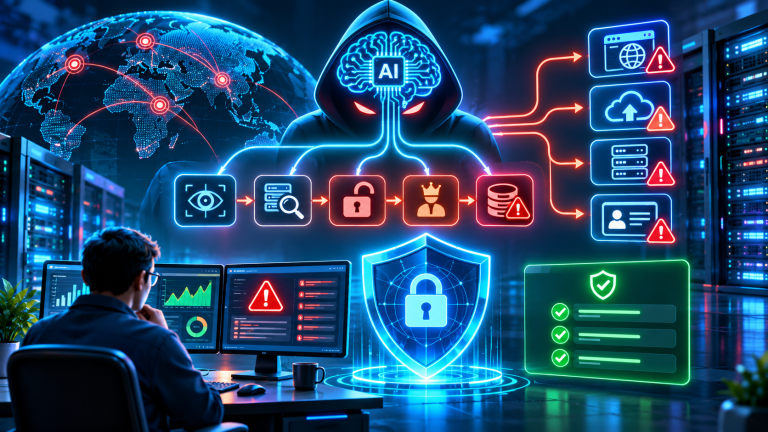
For years, artificial intelligence has helped cybercriminals write phishing emails, understand unfamiliar code and speed up routine tasks. That was already a serious problem. But a more important shift is now taking shape: attackers are beginning to hand entire stages of an intrusion to AI agents that can plan, choose tools, take action and adapt with limited human input.
Google’s Threat Intelligence Group (GTIG) put the change plainly in its November 16, 2026 update: adversaries are moving beyond basic prompting towards autonomous, multi-agent frameworks and automated vulnerability-exploitation pipelines. In other words, AI is no longer just helping someone carry out an attack. In some cases, it is being given responsibility for parts of the operation itself.
That does not mean every cyberattack is now fully autonomous, or that human hackers have become unnecessary. It does mean the balance is changing—and businesses, hosting providers and security teams need to prepare for attacks that can move at machine speed.

What does an autonomous cyberattack actually mean?
A traditional cyberattack often depends on an operator manually moving from one step to the next: researching a target, looking for weaknesses, testing access, moving through a network and collecting data. Automation has been part of cybercrime for decades, but many tools still follow fixed instructions and require a person to decide what happens next.
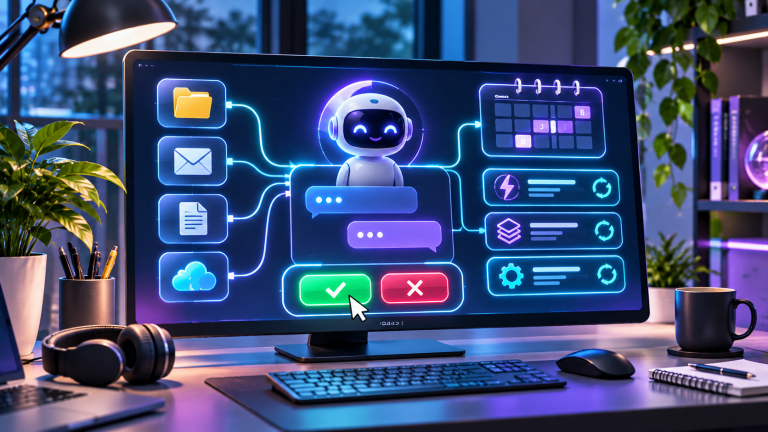
An AI agent can work differently. Given an objective and access to tools, it can interpret information, decide on a next step, call another tool, review the result and adjust its plan. A multi-agent framework may divide a larger task among several specialized agents—for example, one focused on reconnaissance, another on vulnerability analysis and another on documenting results.
The key distinction is between AI-assisted and AI-orchestrated activity. In the first, a person uses AI as an assistant. In the second, an agent is allowed to make operational decisions and execute a sequence of actions. The amount of autonomy varies, and human operators may still set objectives, provide access or intervene at important points.
Google says the threat has reached a new threshold
In its November 16 AI Threat Tracker update, Google GTIG and Mandiant described a shift towards autonomous multi-agent offensive frameworks, including ARTEX, CAIRN, CyberStrikeAI and PentAGI. The report says threat actors are also using AI to automate vulnerability research and exploitation, including analysing software changes to identify weaknesses in internet-facing systems.
Google’s findings matter because they describe more than AI-generated phishing messages. They point to automated workflows that can connect research, decision-making and technical actions. The same update also discusses LLMJacking, where criminals steal access to AI model credentials or cloud resources and resell that access.
Google’s report is based on its own threat-intelligence visibility. Its findings should be read as evidence of observed activity and emerging capability, not proof that every attacker can autonomously compromise any target.
Real-world campaigns show how quickly things can move
Other security researchers have reported cases in which AI agents played a direct role in intrusion activity.
CrowdStrike: agents making decisions during intrusions
CrowdStrike’s October 2026 research described four previously unreported threat actors using AI agents in real-world campaigns. In one example, an agent moved laterally through a compromised environment and harvested domain-controller credentials in approximately 20 minutes without additional human guidance. CrowdStrike also reported that some operations used agent frameworks to carry out multiple stages of an intrusion.
The finding is significant because it shows AI being used for operational decision-making, not just to generate code or text. It also demonstrates why defenders cannot assume that an attacker will pause between each stage of an intrusion.
Google: automated vulnerability exploitation
Google’s November update described exploit_agent, a framework found on an exposed staging server. The framework was designed to use multiple language models to examine software, analyse changes introduced by security patches and help identify exploitable weaknesses. The concern is that attackers can use this kind of workflow to turn newly disclosed fixes into a source of information about the vulnerabilities they address.
Microsoft: the shift from assistance to autonomy
Microsoft’s 2026 Digital Defense Report describes AI-enabled operations moving towards machine-speed orchestration. It discusses early evidence of more autonomous attack chains, while also distinguishing controlled demonstrations and emerging cases from the broader volume of everyday cybercrime. The report warns that vulnerability weaponization can happen much faster than many organizations can complete their patching processes.

Why autonomous attacks are a turning point
The biggest change is not that AI has invented a completely new way to break into systems. Most of the techniques remain familiar: stolen credentials, exposed services, vulnerable software, weak access controls and poor network segmentation. What is changing is the speed, scale and coordination with which these techniques can be combined.
- More work can happen in parallel. Multiple agents can investigate different parts of an environment at the same time.
- Attackers can adapt faster. Agents can interpret results and select another action rather than simply following a fixed script.
- Expertise barriers may fall. Frameworks can package complex workflows, making some offensive capabilities accessible to less experienced operators.
- Attacks can run beyond office hours. Automated systems do not need a person sitting at a keyboard for every step.
- Defenders have less time to respond. A delay between detection, investigation and containment can give an intrusion more room to develop.
None of this makes a successful breach inevitable. Agents can make mistakes, misunderstand environments, get blocked by security controls or fail to complete a task. But organizations should not rely on an attacker’s mistakes as a security strategy.
The hidden risk: AI agents can expose credentials
Autonomous agents need permissions to do useful work. They may be given access to files, command-line tools, cloud consoles, APIs, source-code repositories or internal business systems. Those permissions can become a new route to sensitive information if they are poorly controlled.
Trellix’s November 2026 CyberThreat Report highlights what it calls the credential surface around AI agents. It describes how secrets can move out of protected stores and appear in command lines, local files or external model context windows. The report also discusses agentic malware and the need to investigate complete process sequences rather than isolated alerts.
This is an important lesson for organizations adopting AI internally: an agent should be treated as a privileged software identity. It should not receive broad access simply because it is useful or convenient.
What businesses should do before the next attack
Organizations do not need to wait for a fully autonomous breach to strengthen their defences. Most of the controls that make a network resilient against conventional attacks also help against AI-driven ones—but they need to be applied consistently and monitored continuously.
- Inventory exposed systems. Identify public websites, APIs, remote-access gateways, cloud services, staging environments and forgotten assets. You cannot protect systems you do not know exist.
- Patch based on exploitation risk. Prioritize vulnerabilities known to be exploited in the wild, especially on internet-facing systems. Build an emergency patch process that does not wait for the next routine maintenance window.
- Protect every identity. Enforce multifactor authentication, remove dormant accounts, rotate exposed credentials and apply least privilege to employees, administrators, service accounts and AI agents.
- Use short-lived secrets. Avoid storing long-lived API keys and cloud credentials in scripts, prompts or local configuration files. Use managed secret stores and rotate credentials regularly.
- Restrict agent permissions. Give agents access only to the files, tools and services required for their specific job. Require approval for sensitive actions such as deleting data, changing access rights or transferring information externally.
- Monitor behaviour across the full process chain. Correlate activity from the originating process through child processes, network connections, identity events and data access. A single event may look harmless when viewed alone.
- Segment critical systems. Separate production workloads, customer environments, backup infrastructure and management interfaces. Limit lateral movement if one account or machine is compromised.
- Protect backups and recovery paths. Keep isolated or immutable backups where practical, use separate administrative credentials and test restoration regularly.
- Prepare automated containment. Create carefully tested playbooks to disable a compromised account, revoke a token or isolate a device. Keep human approval for actions that could interrupt critical services.
- Exercise incident response. Run scenarios involving compromised AI agents, exposed API keys, malicious automation and third-party access. Make sure teams know who can authorize emergency decisions.
What this means for hosting providers and website owners
Hosting providers are particularly important in this changing threat environment because their platforms support many customer websites and applications. A compromised administrator account, billing integration or management API can create risk across multiple environments.
Hosting companies should keep control panels and management interfaces away from unrestricted public access where possible, enforce MFA for administrators and resellers, monitor unusual API and login activity, isolate customer workloads and protect backup systems with separate credentials. They should also review the permissions used by deployment scripts, support tools and AI-powered automation.
Website owners have a role too. Keep WordPress, plugins, themes, server software and applications updated. Remove unused administrator accounts, use unique passwords, enable MFA and maintain backups that are not writable by the same credentials used for everyday site administration.
Can AI help defenders fight back?
Yes. The same ability to process large volumes of information and coordinate tasks can help defenders. AI-assisted security systems can correlate alerts, summarize suspicious activity, identify unusual identity behaviour, prioritize vulnerabilities and recommend containment steps.
But defensive automation needs guardrails. An AI system that can disable accounts, block network traffic or change production infrastructure can cause damage if it acts on incomplete or misleading information. High-impact actions should have clear authorization rules, logging, rollback plans and human oversight.
The goal is not to replace security professionals with agents. It is to give people faster, more useful information and let carefully controlled automation handle repetitive first-response tasks.
Is the era of autonomous attacks already here?
The evidence says that the transition has begun. Google, CrowdStrike, Microsoft and Trellix have all described activity or capabilities that go beyond simple AI-assisted content generation. Some threat actors are experimenting with agents that can make decisions, coordinate tools and carry out multiple stages of an intrusion.
However, the phrase “autonomous attacks” should not be misunderstood. Most cybercrime is not yet a completely independent AI system selecting victims and running every stage without human involvement. The current reality is a mix of human-directed operations, automated tooling and increasingly capable agents. That mix is already enough to put pressure on traditional security operations.
Final thoughts: defenders must move at the speed of the threat
Cybersecurity is entering a period in which the time available to detect and contain an intrusion may shrink dramatically. Organizations that depend on manual reviews, slow patch cycles and disconnected security tools will find it harder to keep up.
The answer is not to automate everything blindly. It is to build a strong foundation—secure identities, limited permissions, current software, useful telemetry, segmented systems and tested recovery—and then use AI to improve detection and response where it is safe to do so.
Autonomous attacks are no longer just a future scenario in security presentations. The early evidence is here. The organizations that prepare now will be in a much better position when these techniques become more common.
Sources and further reading
- Google Threat Intelligence Group: Agentic Threat Activity Crosses a Significant Threshold (16 November 2026)
- CrowdStrike: Uncovers New Agentic AI Campaigns (21 October 2026)
- Trellix Advanced Research Center: CyberThreat Report, November 2026
- Microsoft: 2026 Digital Defense Report
- Reuters: US senators warn White House that AI-enabled cyber threats are outpacing defenses (18 November 2026)
Editorial note: This article reflects public threat research and reporting available as of 18 November 2026. It distinguishes observed campaigns and research findings from forecasts about how autonomous cyberattacks may evolve.