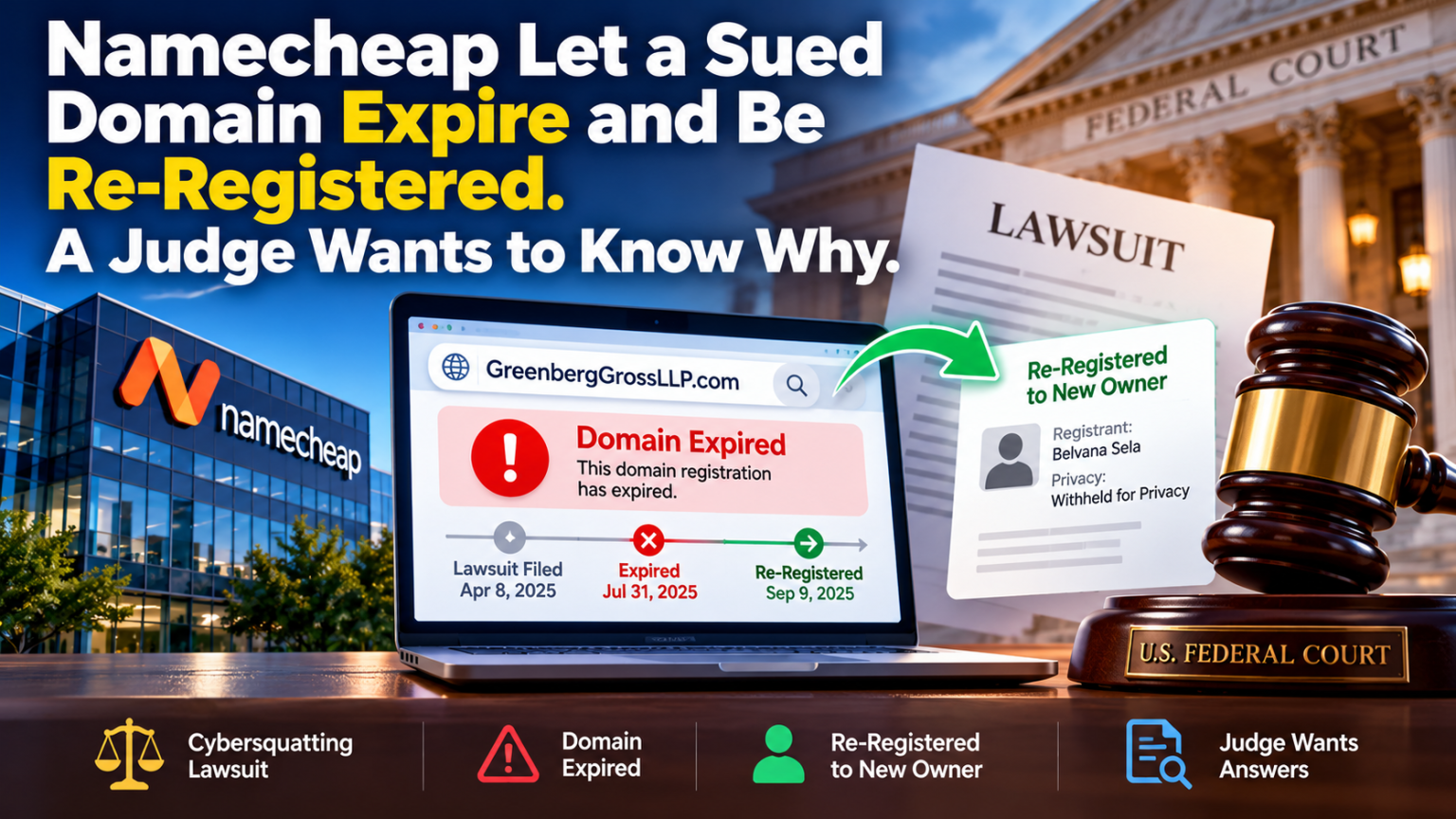
Namecheap Let a Sued Domain Expire and Be Re-Registered. A Judge Wants to Know Why.
A domain name caught in a lawsuit should not be treated like an ordinary expired registration. That is the central question in a US federal court case involving Namecheap, after a disputed domain expired and was subsequently registered to a new customer.
On September 28, 2026, Judge Michael T. Liburdi of the US District Court for the District of Arizona ordered Namecheap to explain why it should not be required to reimburse a law firm for legal costs allegedly caused by the registrar’s handling of the domain. Namecheap must respond by October 12, with the plaintiff’s reply due October 19. The order is not a final finding of liability.
The case could have implications for domain registrars, hosting providers, resellers, and anyone responsible for managing domains involved in legal disputes.
What Happened to the Domain?
The dispute involves GreenbergGrossLLP.com, a domain that California law firm Greenberg Gross alleged was copying its website while replacing its contact details. The original registrant was identified as Diverse ISP, with contact information listing an address in Ghana.
In April 2025, the firm filed a lawsuit against the domain itself under the US Anticybersquatting Consumer Protection Act (ACPA). This type of case, known as an in rem action, can be used when pursuing the domain name is more practical than bringing a conventional lawsuit against an identifiable registrant.
According to the court’s September order, the key events were:
| Date | Event |
|---|---|
| April 8, 2025 | The lawsuit was filed against the domain |
| April 23, 2025 | Namecheap was served with the amended complaint |
| July 31, 2025 | The original registration lapsed |
| September 9, 2025 | The domain was registered to a new customer |
| December 8, 2025 | Namecheap supplied the new registrant’s details after receiving a subpoena |
| February 12, 2026 | Default was entered against the domain |
| April 14, 2026 | The domain was transferred to the law firm |
| September 28, 2026 | The judge ordered Namecheap to explain why sanctions should not be imposed |
The new registrant was identified as Belvana Sela. The registration information was also anonymised through Withheld for Privacy, a privacy service partnered with Namecheap.
Why Is the Judge Questioning Namecheap?
The legal issue is not simply that a domain expired. Domains routinely expire when owners fail to renew them, and registrars have established processes for handling those registrations.
The question is whether the ordinary expiration process should have been allowed to proceed after Namecheap received formal notice of the lawsuit.
Under the ACPA provision cited by the court, a registrar that receives written notification of a filed, stamped complaint must not transfer, suspend, or otherwise modify the domain during the action, except as permitted by the statute and court orders. The law also limits a registrar’s liability for relief under that provision, except in cases involving bad faith or reckless disregard.
The judge’s order says the plaintiff presented substantial evidence that Namecheap had been notified of the case, that the original registration lapsed, and that the name was subsequently registered to someone else.
The court also pointed to the new registrant’s anonymised contact details as part of the circumstances that warranted further explanation.
These are allegations and preliminary concerns, not a final judgment that Namecheap deliberately ignored the law.
What Was Namecheap’s Position?
The law firm’s filings describe several explanations it says Namecheap provided during the dispute.
One was that the registrar had not received a court order specifically requiring the domain to be restricted. Another was that the original registration had expired and a different customer had registered the name, rather than Namecheap transferring it directly between accounts.
The plaintiff argues that these explanations do not resolve the issue because the ACPA addresses not only transfers but also suspension and other modifications during pending litigation. The firm also argues that the relevant statutory obligations can arise from notice of a filed complaint, rather than only after a separate court order.
The September order requires Namecheap to address these arguments and explain why the court should not impose sanctions to reimburse the plaintiff’s legal expenses. The court has not yet issued a final ruling on that question.
The Financial Stakes: More Than $50,000
Greenberg Gross sought reimbursement for additional legal fees and costs incurred while trying to identify the new registrant and obtain the domain.
The plaintiff’s motion sought at least $50,385.55 in additional fees and costs incurred from October 21, 2025 onward. This is the amount claimed by the law firm, not a sum the court has ordered Namecheap to pay.
The broader issue is operational. A registrar may handle millions of registrations, with renewals, cancellations, privacy services, transfers, and automated expiry processes running continuously. If a domain is subject to litigation, the registrar may need a way to ensure that its ordinary lifecycle processes do not conflict with a legal restriction.
What Does This Mean for Hosting Providers and Resellers?
Although the case concerns Namecheap, it offers practical lessons for companies that sell or manage domain registrations.
1. Treat legal notices as operational events. A complaint or court notice involving a domain should reach the team responsible for domain status, renewals, transfers, and cancellations—not remain solely in a legal inbox.
2. Record and escalate domain disputes. Maintain a documented process for recording the domain involved, the date notice was received, relevant deadlines, and any restrictions required by law or court order.
3. Do not assume expiration clears a legal problem. A domain’s registration status and the legal proceedings involving it are separate issues. Expiration should not automatically be treated as permission to release or re-register a disputed name.
4. Handle privacy requests carefully. Domain privacy protects legitimate registrants, but it does not eliminate a registrar’s obligations to respond to valid legal process or comply with applicable law.
5. Coordinate registrars, resellers, and customers. Hosting businesses that manage domains for customers should have a clear escalation route when they receive abuse reports, trademark complaints, subpoenas, or court documents.
These steps are sensible risk-management practices, not a substitute for legal advice or a claim that every complaint requires the same response.
Final Thoughts
The Namecheap case highlights a difficult question for the domain industry: what happens when automated domain-expiration rules meet an active lawsuit?
The judge has asked Namecheap to explain why it should not reimburse Greenberg Gross for costs allegedly caused by its handling of GreenbergGrossLLP.com. The outcome may help clarify how registrars should manage domains during certain legal proceedings, particularly when registration status changes and privacy services complicate efforts to identify a new registrant.
For hosting companies and domain resellers, the lesson is straightforward: domain lifecycle management must account for legal holds and formal notices, not just renewal dates.
A domain can expire as part of a routine technical process. When litigation is involved, however, the legal consequences may be anything but routine.