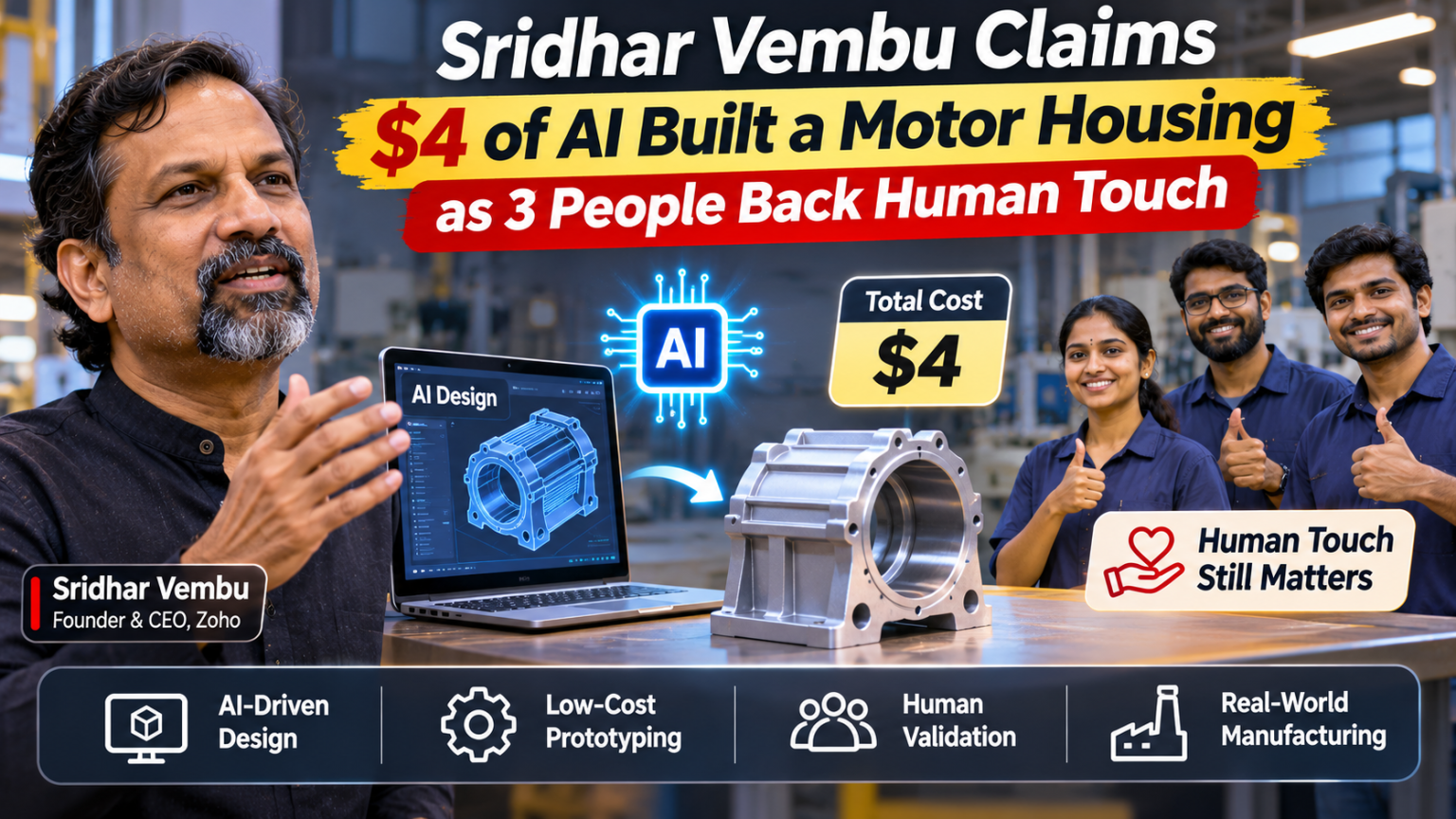
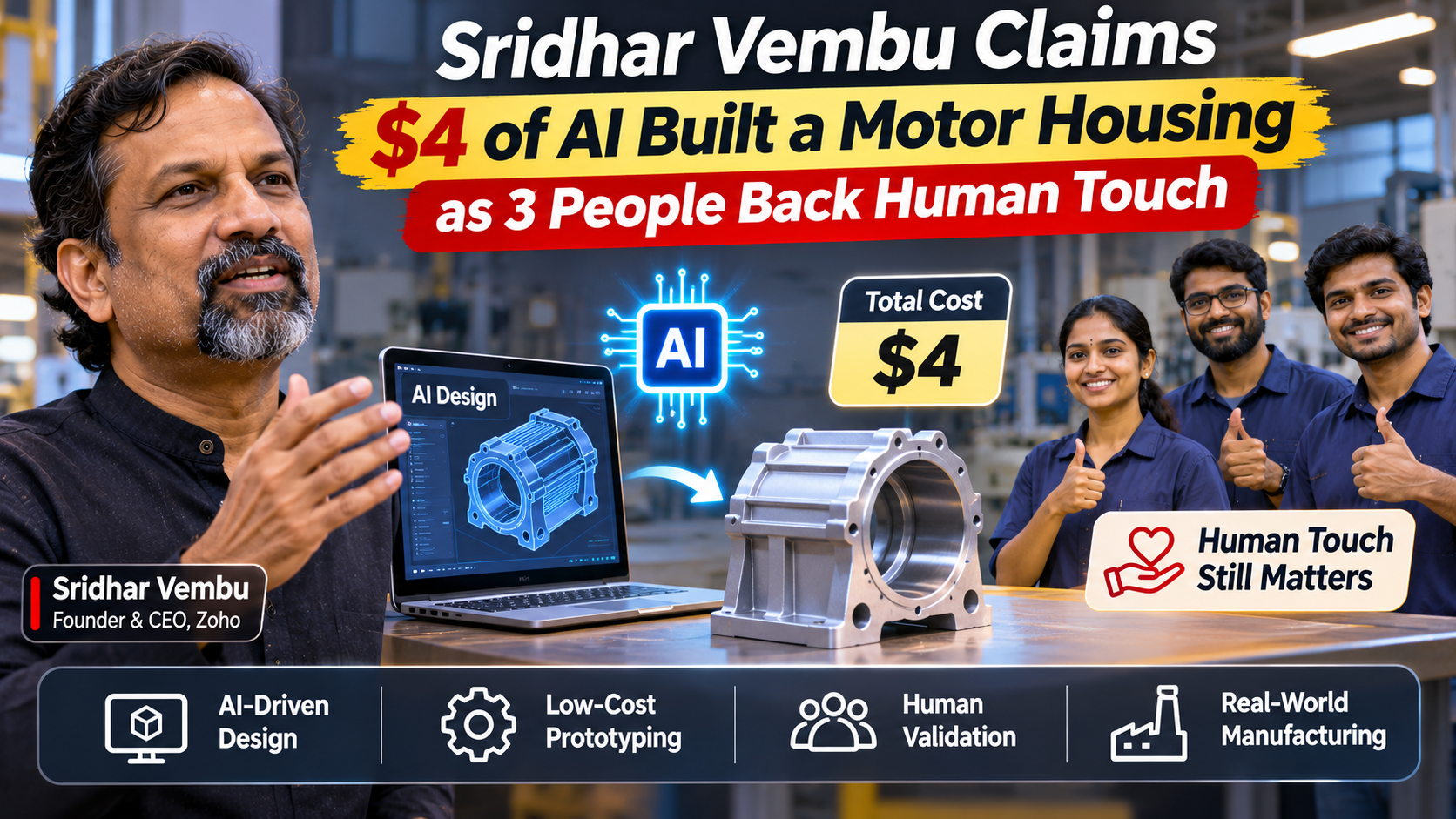
Could a person with no engineering background really use artificial intelligence to design a motor housing? Zoho founder and chief scientist Sridhar Vembu says a colleague of his did exactly that—with help from an AI tool and an inexpensive computer-aided design (CAD) application.
Vembu also shared a striking example from his own work: he said an AI system optimised a difficult piece of software code in about an hour, a task he believed could have taken a highly skilled programmer a month. The token bill, according to his post, was around $4.
Those two examples have sparked a wider conversation about what happens when AI moves beyond writing emails and generating images, and begins taking on work associated with engineering, programming and other specialist professions. But the story is not simply that machines are replacing people. It is also about how human curiosity, direction and judgement can become more powerful when paired with AI.
What did Sridhar Vembu actually claim?
In a post on X on 22 November 2026, Vembu described two experiences. First, he said he asked AI to optimise a complex piece of code while he was travelling. According to his account, the system understood his high-level objective, created a plan, implemented the changes and generated detailed test cases to check its work. He estimated that the task took about an hour and cost approximately $4 in tokens.
Vembu compared that with what he believed would have been at least a month’s work for a very capable programmer. That is his estimate based on the task he described—not an independently measured comparison or a universal claim about software engineering productivity.
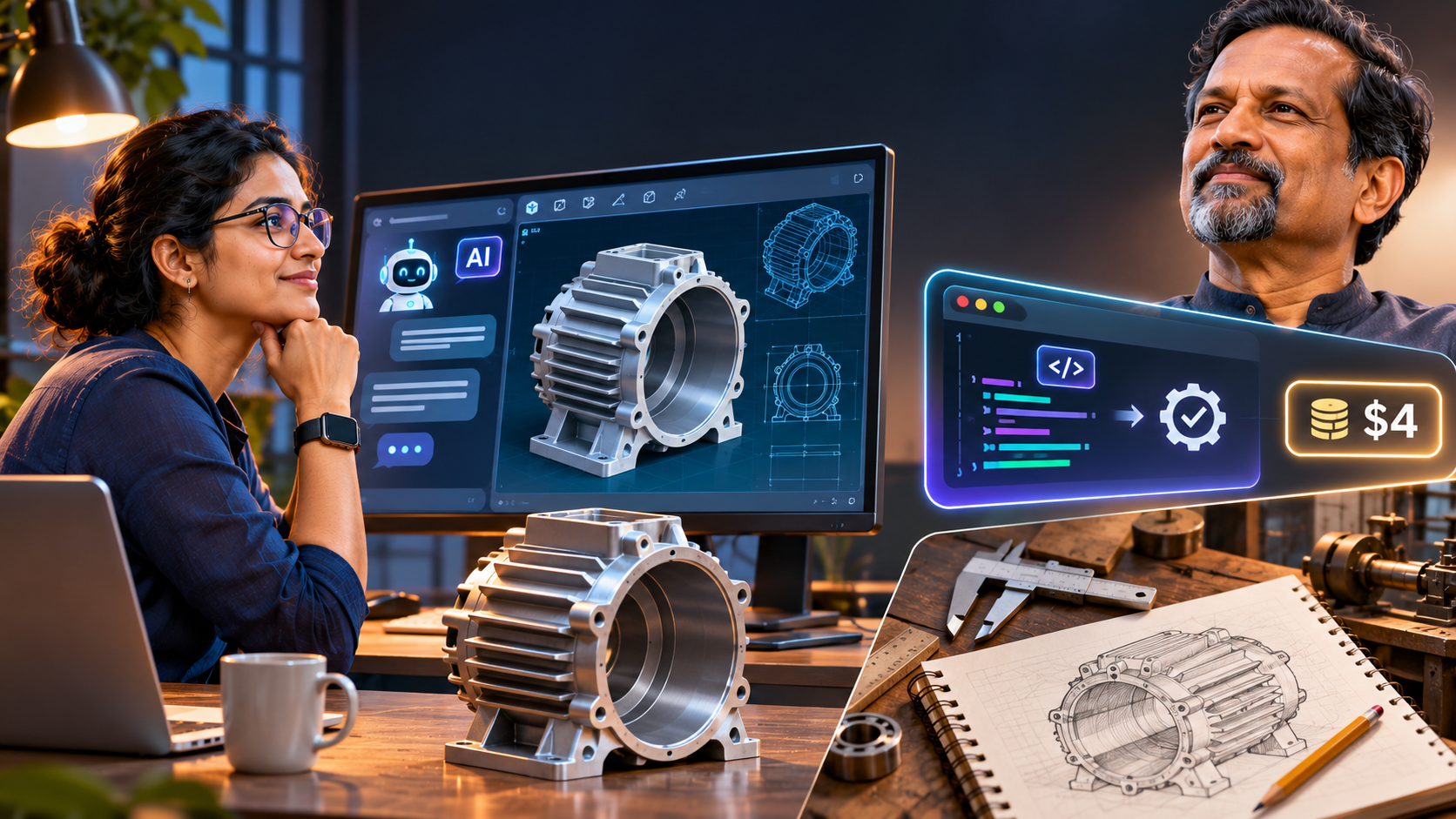
His second example was a colleague with no engineering background who used a personal AI account to create a detailed mechanical CAD design for a motor housing. The AI interacted with a newly released, low-cost CAD application installed on the colleague’s computer. Vembu said he doubted the AI had been trained specifically on that software.
The point that caught attention was not only that AI could produce a design. It was that someone without formal engineering training could use it to explore a technical field that might previously have felt inaccessible.
How can AI help design a motor housing?
A motor housing is more than a shape on a screen. It is a mechanical enclosure that may need to support bearings, protect internal components, manage heat, resist vibration and fit precisely with other parts. Depending on the motor and its application, the design may also need to meet requirements for material strength, electrical safety, ingress protection and manufacturing tolerances.
AI-assisted CAD workflows can help a user move through parts of the design process. A person can describe the intended component, provide dimensions and constraints, and ask an AI system to help create or modify a parametric model using the CAD application’s tools. The system may help generate geometry, adjust dimensions, create repeated features, produce drawings or explain how to use unfamiliar software.
This does not mean the AI automatically knows whether the finished housing is safe or fit for production. It means the barrier to creating an initial model can be much lower. A curious person can explore ideas, produce a prototype design and then work with an experienced engineer to validate it.
The $4 coding example may be just as significant
Vembu’s software example points to another shift. AI coding tools are increasingly able to work through a sequence of tasks rather than simply suggest a line of code. They can inspect a project, propose a plan, edit multiple files, run tests and revise their output based on errors.
For developers, that can change where time is spent. Instead of manually writing every routine function, a programmer may spend more time explaining the desired behaviour, reviewing the proposed approach, checking edge cases and deciding whether the implementation belongs in the system.
However, token cost is not the same as the total cost of a reliable software change. A real project also involves understanding the existing system, reviewing security implications, testing in realistic environments, maintaining the code and fixing problems that appear later. AI-generated tests can be useful, but independent tests and human review remain important.
Why this feels like another Industrial Revolution
Vembu compared the current shift to earlier waves of mechanisation that changed the lives of farmers, weavers, carpenters and ironsmiths. Machines made some forms of manual production faster and cheaper, reducing demand for certain traditional tasks while creating new industries and occupations.
His argument is that AI is now reaching a group that has often felt protected from automation: mathematicians, programmers and other knowledge workers. If a system can perform parts of complex intellectual work, professional expertise may no longer be measured simply by the ability to produce an output manually.
The comparison is not exact. Knowledge work is varied, and many jobs involve responsibility, context, relationships and decisions that cannot be reduced to a single task. But the historical parallel raises a useful question: when technology changes how work is done, how do people find new ways to contribute?
AI can open doors for people without specialist training
The motor-housing example has a positive side. A person who is curious about mechanical design can now ask questions, explore CAD tools and create an early model without first becoming an expert in every command or workflow.
Similar changes are happening in other fields. Small business owners can prototype software, marketers can analyse data, students can build interactive projects and technicians can automate repetitive tasks. AI can act as a translator between an idea and the specialist tools needed to explore it.
That does not make formal education or professional experience irrelevant. Instead, it can help more people reach the point where they can ask better questions, test ideas and collaborate with specialists.
Why the human touch still matters
A CAD model that looks correct on a computer screen is not automatically a production-ready motor housing. Engineers still need to check dimensions, tolerances, material properties, heat dissipation, vibration, structural strength, assembly and manufacturing methods. Depending on the application, simulation, physical prototyping and formal testing may be necessary.
The same principle applies to software. AI can generate code, but people remain responsible for understanding what the system does, protecting user data, reviewing security, meeting regulatory obligations and responding when something fails.
Human contribution is not limited to checking an AI’s mistakes. People define the problem, understand the environment, choose trade-offs, recognise when requirements are incomplete and decide what should be built in the first place. Those skills become more important when the volume of AI-generated output increases.
What skills will matter in an AI-powered workplace?
- Problem definition: turning a vague idea into clear requirements, constraints and success criteria.
- Domain knowledge: understanding engineering, software, finance, healthcare or the industry in which the AI output will be used.
- Critical review: spotting incorrect assumptions, missing edge cases and unsafe recommendations.
- Tool fluency: learning how to use AI systems alongside CAD, development, analytics and business applications.
- Communication: explaining goals clearly and collaborating with specialists and customers.
- Accountability: taking responsibility for the final product rather than treating an AI-generated result as automatically correct.
These are the meta-level skills that help people direct AI effectively. The advantage may go to those who combine curiosity with enough practical knowledge to guide and evaluate the system.
Is AI going to replace engineers and programmers?
Some tasks will become easier to automate, and some roles may change significantly. Entry-level work that consists mainly of routine drafting, basic coding or repetitive analysis could face pressure. Teams may also need fewer hours for certain tasks as AI tools improve.
But a motor housing is not approved for manufacturing just because a model has been generated, and a software feature is not safe simply because an AI agent says its tests passed. Real-world work includes constraints, failures, customers, regulations and consequences.
A more realistic near-term picture is a change in the mix of work: AI handles more drafting and execution, while people spend more time defining problems, reviewing outputs, integrating systems and making decisions. The size of that shift will differ by industry and by the reliability of the tools.
Final thoughts: AI makes curiosity more powerful, not less human
Sridhar Vembu’s two examples—the reported $4 code-optimisation task and the AI-assisted motor housing design—offer a glimpse of how quickly the boundaries of technical work are changing. They are personal accounts, not proof that every programmer’s month of work can be reduced to an hour or that anyone can safely design a production component with a prompt.
Still, the broader message is important. AI can give people access to tools and capabilities that once required years of specialised experience just to begin exploring. That is both an opportunity and a challenge for professionals.
The future may not belong to people who compete with AI at every task. It may belong to people who know what to ask, understand the answer, recognise its limits and use the technology to build something genuinely useful. AI can generate a design—but human judgement is what helps turn that design into something the world can trust.
Sources and further reading
- Mint: Sridhar Vembu says AI makes you work harder and shares his $4 coding example (27 November 2026)
- India Today: Sridhar Vembu on AI, coding and the future of human work (23 November 2026)
- The Times of India: Vembu compares AI’s impact on programmers with mechanisation’s impact on traditional trades (23 November 2026)
- ThePrint: Sridhar Vembu says the intellectual class is facing a loss of purpose with AI (23 November 2026)
- Sridhar Vembu’s public X posts, including the 22 November 2026 post
Editorial note: Published 28 November 2026. The $4 token cost, one-hour coding task and motor-housing CAD example are attributed to Sridhar Vembu’s public account. The article does not present them as independently verified performance benchmarks or as proof that an AI-generated design is production-ready.