WordPress Market Share Down to 40.7%: What It Means for Hosting Providers
WordPress is still the dominant CMS—but the web is becoming more fragmented. For hosting providers, that shift matters more than the headline percentage itself.
WordPress has dominated website publishing for more than a decade. Millions of businesses, publishers, agencies, developers and online stores continue to rely on it.
But its share of the overall web has been gradually changing.
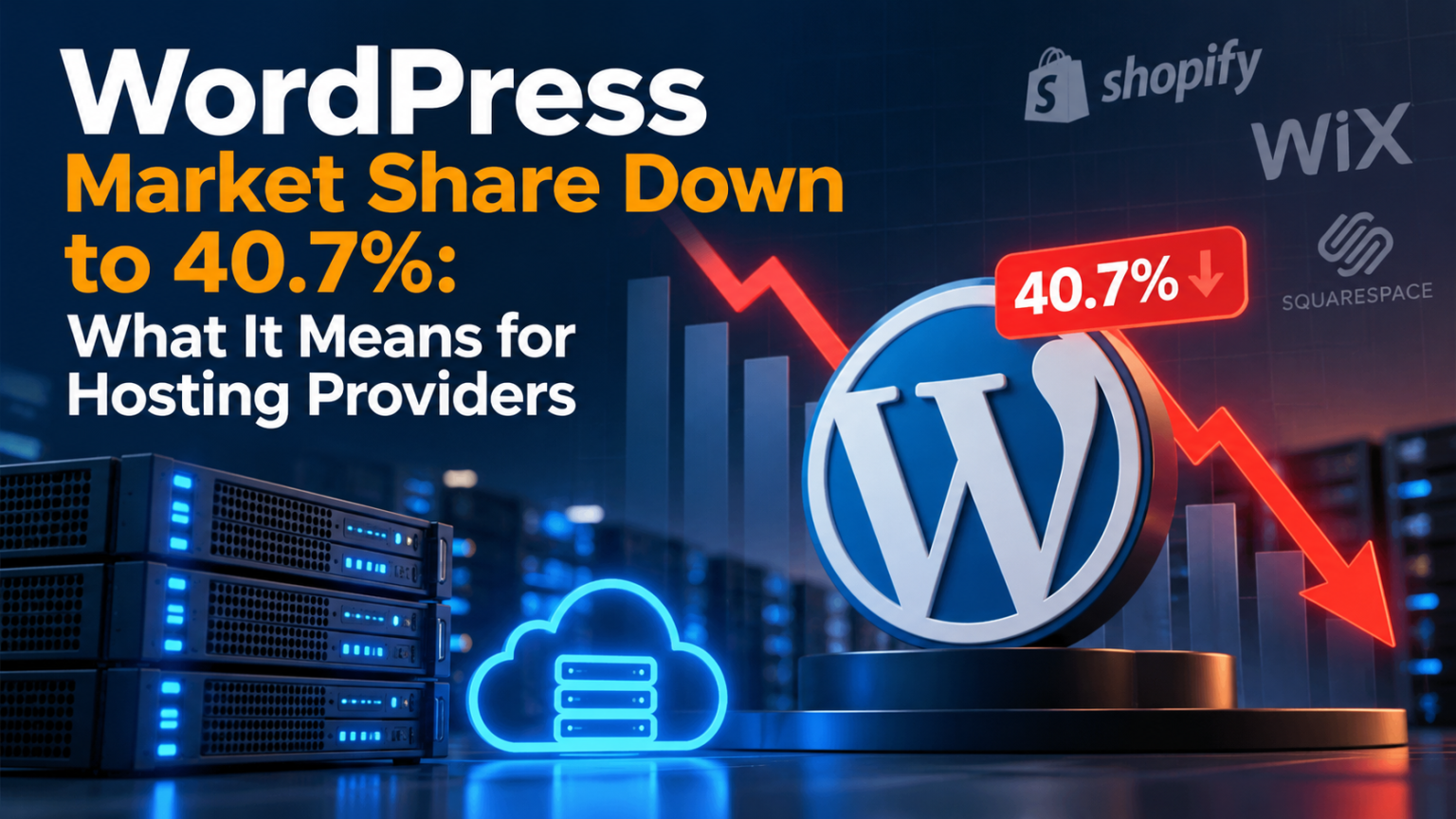
According to W3Techs, WordPress is currently used by around 40.1% of all websites, representing approximately 58.6% of websites whose content management system is known.
That distinction is important.
A decline in WordPress’s percentage of all websites does not mean that WordPress has suddenly lost its position in the CMS market. In fact, WordPress remains far ahead of individual competitors such as Shopify, Wix and Squarespace.
So what is actually happening?
And more importantly:
What does this shift mean for hosting providers?
WordPress Faces Noticeable Market Share Shifts
The most important change is not that WordPress has a single replacement.
There isn’t one.
Instead, website technology is becoming increasingly fragmented.
W3Techs currently reports WordPress at around 40.1% of all websites, followed by platforms such as Shopify at 5.4%, Wix at 4.2%, Squarespace at 2.4%, and many smaller platforms and website-building technologies.
This tells us something important:
WordPress isn’t necessarily losing customers to one competitor. The market itself is diversifying.
Businesses today have more choices:
- WordPress
- Shopify
- Wix
- Squarespace
- Webflow
- Managed website builders
- Headless CMS platforms
- Static site generators
- Custom application stacks
- AI-assisted website platforms
- Cloud-based application platforms
For hosting companies, this creates a much bigger strategic question than simply asking how many WordPress websites remain.
Why Should Hosting Providers Pay Attention?
For many hosting companies, WordPress has historically been the foundation of the shared-hosting business model.
A typical hosting customer might purchase:
Domain → Shared Hosting → WordPress → SSL → Email → Backup → Security → Support
WordPress made this model extremely scalable.
Hosting providers could standardize their infrastructure around:
- cPanel or similar control panels
- PHP
- MySQL/MariaDB
- Apache/Nginx
- WordPress installers
- WordPress backups
- Malware scanning
- Caching
- CDN integration
- WordPress-specific support
But customer expectations are changing.
A business owner today may not ask:
“Which WordPress hosting plan should I buy?”
They may instead ask:
“What is the fastest way to get my business website online?”
That is a fundamentally different question.
The hosting provider is no longer competing only against another hosting company.
It may be competing against a website platform.
The Competitors Aren’t Gaining Ground
This is one of the most interesting aspects of the current market.
If WordPress were simply losing its position because customers were migrating to one dominant competitor, we would expect to see another platform rapidly approaching WordPress.
That isn’t happening.
Shopify, for example, has a significant presence, particularly in ecommerce, but its overall website share remains far below WordPress. Wix and Squarespace are also much smaller individually.
The result is a fragmented market.
Instead of:
WordPress → Competitor X
we are seeing something closer to:
WordPress → Shopify + Wix + Squarespace + Webflow + custom applications + static sites + new AI-assisted platforms + other technologies
This distinction matters enormously for hosting companies.
The threat isn’t necessarily:
“WordPress is being replaced.”
The larger threat is:
“The traditional website-hosting model is being replaced by multiple specialized models.”
Security Risks Are Also a Concern for Hosting Providers
Security is another major reason hosting providers need to rethink their WordPress strategy.
WordPress itself is a mature platform. However, a typical WordPress installation can include:
- Core WordPress
- Themes
- Plugins
- Page builders
- Ecommerce extensions
- Forms
- Analytics integrations
- Payment gateways
- Third-party APIs
- Custom PHP code
Every additional component can introduce another potential attack surface.
For a hosting provider managing thousands of WordPress installations, this becomes an operational challenge.
One vulnerable plugin can potentially create problems beyond a single website.
Hosting companies therefore need to invest in:
Automated malware detection
Suspicious files, injected scripts and known malicious signatures should be detected quickly.
Vulnerability monitoring
Customers should be alerted when vulnerable WordPress versions, plugins or themes are detected.
Isolation
Compromised websites should be prevented from affecting neighboring accounts.
Backups
Backups need to be reliable, automated and recoverable—not simply advertised as a checkbox feature.
Web application protection
WAF, rate limiting, bot protection and other controls can reduce the impact of automated attacks.
Server-level security
The hosting environment itself needs protection through appropriate permissions, process isolation, firewalling, monitoring and patch management.
This changes the economics of hosting.
A low-cost hosting provider cannot simply sell disk space and bandwidth anymore.
Customers increasingly expect the provider to help protect the entire website environment.
The Hosting Business Is Changing
The traditional hosting business was relatively simple:
Sell server resources.
Modern hosting is increasingly becoming:
Sell a managed digital environment.
That environment can include:
- Infrastructure
- Website platform
- Security
- Performance optimization
- Backups
- Monitoring
- CDN
- DNS
- SSL
- Application management
- Automated updates
- Technical support
- AI-assisted website management
This is where hosting providers have an opportunity.
Instead of depending entirely on WordPress installations, providers can build a multi-platform hosting ecosystem.
For example:
WordPress Hosting
Optimized PHP, MariaDB, object caching, CDN, backups and WordPress security.
Ecommerce Hosting
Optimized environments for WooCommerce, Shopify-related services and other ecommerce applications.
Application Hosting
PHP, Node.js, Python and other application environments.
Managed VPS
For businesses that need more control and predictable resources.
Static / Headless Hosting
For modern frameworks and static-generated websites.
Managed Security
Security monitoring, malware removal, vulnerability scanning and incident response.
Business Website Management
Instead of selling hosting alone, providers can sell a complete website-management service.
What’s Actually Ending?
The most important conclusion is that WordPress is not ending.
The era of WordPress being the default answer for every website may be ending.
There is a difference.
WordPress remains enormously important. Its current 40.1% share of all websites still makes it one of the most significant technologies on the web by a very wide margin.
But customers now have more alternatives.
A small business may choose a website builder.
An ecommerce company may choose Shopify.
A developer may choose a headless CMS or static framework.
A startup may build its website directly on a cloud platform.
An enterprise may use a custom application stack.
And an agency may choose different technologies for different clients.
For hosting providers, this means one thing:
The future isn’t about abandoning WordPress.
The future is about not depending on WordPress alone.
Hosting companies that continue to think only in terms of “WordPress hosting” may eventually find themselves competing in a shrinking part of a much larger market.
The stronger strategy is to build a hosting platform capable of supporting WordPress, ecommerce, applications, modern web frameworks and managed services under one infrastructure.
What Hosting Providers Should Do Now
Hosting providers should consider five priorities.
1. Continue investing in WordPress
WordPress is still too large to ignore.
Performance, security, backups and managed WordPress services remain valuable.
2. Diversify the platform portfolio
Support more than one website technology.
3. Move from hosting to managed services
Infrastructure alone is becoming increasingly commoditized.
Security, optimization, monitoring and support create additional value.
4. Prepare for AI-driven website creation
AI is reducing the technical barrier to creating websites.
Hosting companies should consider how AI-generated websites, applications and content workflows will change their customers’ requirements.
5. Focus on business outcomes
Customers don’t ultimately want PHP, SSD storage or CPU cores.
They want:
A fast website.
A secure website.
A reliable website.
A website that generates business.
Hosting companies that understand this shift will have a better opportunity to remain relevant as the website ecosystem evolves.
Final Thoughts
The headline “WordPress market share is falling” sounds dramatic.
But the underlying story is more nuanced.
WordPress still powers around 40% of all websites and nearly 59% of websites with a known CMS.
The bigger change is that the web is becoming more fragmented.
For hosting providers, this should not trigger panic.
It should trigger adaptation.
The winners of the next phase of the hosting market may not be the companies that host the most WordPress websites.
They may be the companies that can provide customers with the right platform, infrastructure, security and management experience—regardless of what technology sits behind the website.
**WordPress isn’t disappearing.
The one-platform hosting model is what hosting providers should be watching.**