
Choosing an SEO plugin for WordPress can feel like choosing a hosting plan: the free option looks generous, the paid version promises a long list of extras, and it is not always obvious which features will make a real difference.
Rank Math SEO has become a popular choice because its free plugin already covers many of the everyday jobs a WordPress site needs. But Rank Math Pro adds tools for keyword tracking, deeper reporting, advanced schema and workflow automation. So, as we head into 2027, is upgrading worth the money—or is the free version still enough?

We looked at Rank Math’s published feature comparison, current plan information and the needs of a typical WordPress publisher. Our conclusion is straightforward: start with Free unless you can point to a specific Pro feature that will save time or help you make better decisions.
What is Rank Math SEO?
Rank Math is a WordPress SEO plugin that helps site owners control how pages appear in search results and manage several technical SEO tasks from the WordPress dashboard. It can help you write search titles and meta descriptions, set canonical URLs, generate XML sitemaps, add structured data, manage redirects and monitor 404 errors.
It does not guarantee higher Google rankings. An SEO plugin can make it easier to implement good technical and on-page practices, but rankings still depend on content quality, search intent, site performance, links, competition and many other factors.
Rank Math Free: more than a basic starter plugin
One of Rank Math’s biggest strengths is how much functionality is available without a paid licence. For many blogs, company websites and smaller publishers, the free version is a serious SEO toolkit rather than a short trial.
- On-page SEO: Set SEO titles, meta descriptions, focus keywords and social sharing metadata for posts and pages.
- XML sitemaps: Generate sitemaps to help search engines discover content.
- Structured data: Use built-in schema options for common content types.
- Redirects and 404 monitoring: Manage common redirects and identify URLs that return not-found errors.
- Canonical and robots controls: Set canonical URLs and indexing preferences where appropriate.
- Search integrations: Connect relevant Google services and use available reporting and analysis features.
- Content checks: Get suggestions for improving basic on-page optimisation.
That is enough to handle the core SEO setup for many sites. You do not need a Pro subscription simply to write a title and description, publish a sitemap or add common schema markup.
What does Rank Math Pro add?
Pro is less about unlocking the basics and more about adding visibility, scale and convenience. According to Rank Math’s current comparison, the paid plans add features such as keyword rank tracking, more detailed Google Analytics reporting, expanded schema capabilities, specialised sitemaps and additional automation.
Some of the most useful additions include:
- Keyword rank tracking: Pro currently includes tracking for up to 500 keywords, useful if you want to monitor search positions from inside WordPress.
- More performance reporting: Review SEO performance data for posts and keywords, including historical trends and winning or losing content.
- Advanced schema tools: Build and manage more specialised structured data, and use additional schema types.
- Google News and Video sitemaps: Useful for publishers whose content strategy genuinely includes news or video.
- Image SEO automation: Additional tools for managing image metadata at scale.
- Advanced local and ecommerce SEO: Pro-level tools for businesses with multiple locations or WooCommerce stores.
- AI and linking tools: Rank Math’s paid ecosystem includes newer AI-assisted and internal-linking capabilities. Check the exact entitlement and usage limits for the plan you are buying.
Feature names, limits and plan bundles can change. Always compare the current official plan table before paying, especially if you are purchasing for a client site or expecting a particular AI allowance.
Free vs Pro: the practical comparison
| Feature | Free | Pro |
|---|---|---|
| SEO titles and meta descriptions | Yes | Yes |
| XML sitemaps | Yes | Yes |
| Common schema types | Yes | Yes, with expanded options |
| Redirects and 404 monitoring | Core tools | More advanced workflow options |
| Focus keyword optimisation | Yes | Yes |
| Keyword rank tracking | Not included as the Pro tracker | Up to 500 keywords on Pro |
| Advanced reporting and history | Limited | Expanded |
| News and video sitemaps | Limited / plan dependent | Included in paid feature set |
| Advanced local and WooCommerce SEO | Basic needs | More specialised Pro tools |
This is a simplified guide, not a complete feature-by-feature licence table. Rank Math’s official comparison is the place to confirm the latest details.
Is Rank Math Pro worth the price in 2027?
The answer depends on what you need to do. Rank Math’s pricing page currently lists Pro at a monthly equivalent billed annually, with renewal pricing and taxes applying. The displayed price can vary by currency, region, promotions and billing terms, so check the checkout page for the amount you will actually pay. Do not make a decision based only on a promotional first-year price.
For a single blog that publishes a few useful articles each week, the free version may be all you need. If you are already using Google Search Console to monitor queries and positions, you may not need to pay for another rank tracker unless having that information inside WordPress genuinely improves your workflow.
Pro becomes easier to justify when you actively use its extra features: tracking hundreds of keywords, reviewing post-level performance, building more complex schema, managing a news or video publishing workflow, or handling a larger ecommerce or local SEO project.
Who should stay on Rank Math Free?
- Personal blogs and small technology websites.
- New WordPress websites that are still building their content library.
- Publishers who use Google Search Console and Analytics separately.
- Sites that only need standard titles, descriptions, sitemaps, schema and redirects.
- Website owners who would rather invest in better content, original images, hosting or technical improvements.
Who should consider Rank Math Pro?
- Established publishers: If you have a large archive and want keyword tracking and detailed post-level reporting.
- SEO professionals: If you manage optimisation as a regular service and will use the extra workflow tools.
- News and video publishers: If specialised sitemap features support a real publishing strategy.
- WooCommerce stores: If the additional product SEO controls solve needs that your current setup does not cover.
- Local businesses: If you manage multiple locations and need the relevant local SEO features.
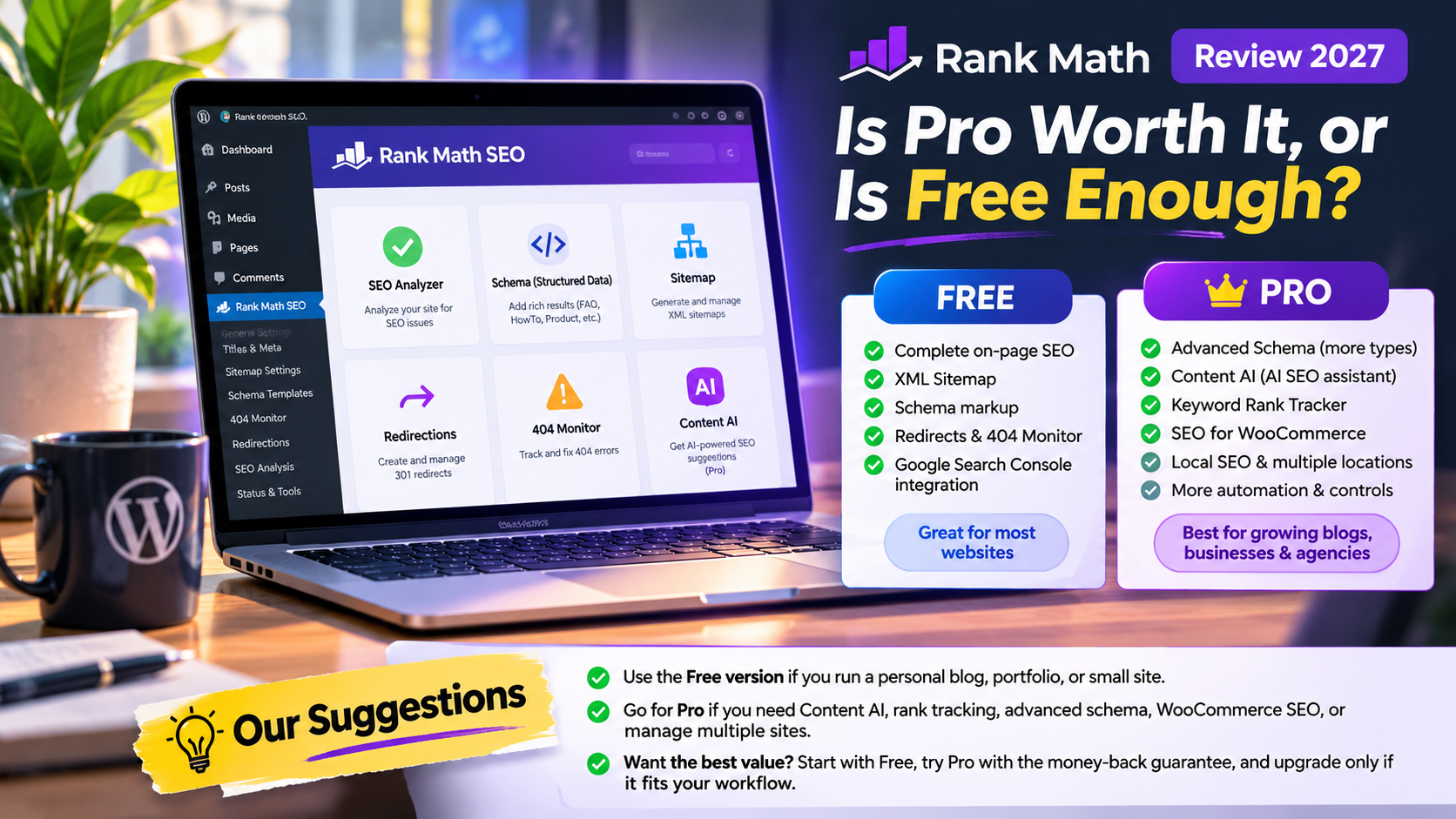
Our suggestions for WordPress website owners
Here is the approach we recommend for 2027. It avoids unnecessary subscription costs while leaving room to upgrade when your website grows.
- Install and configure Free first. Set your site identity, title separator, homepage description, sitemap, social metadata and indexing rules carefully.
- Connect Google Search Console. Use actual impressions, clicks, queries and landing-page data to decide what content needs attention.
- Fix technical problems before buying more tools. Check broken URLs, redirect chains, duplicate pages, missing image alt text, slow templates and indexing issues.
- Improve the content itself. Publish original, useful articles, keep facts current, add relevant internal links and use images that genuinely support the topic.
- Review your workflow after a few months. If you are repeatedly wishing for keyword tracking, advanced schema or automation, calculate whether Pro will save enough time to justify the renewal cost.
- Check the renewal price and licence scope. Pro is for websites you own under its personal-site terms; agencies and people managing client websites should compare Business or Agency licensing instead.
Our recommendation for Direct Cyber Tech
For Direct Cyber Tech, we recommend continuing with Rank Math Free for now. The site already has the essentials configured: XML sitemap, schema, homepage metadata, social previews and indexing controls. The next improvements should focus on content quality, internal linking, Search Console monitoring, broken URL checks and page speed.
We would reconsider Pro if the editorial team needs a built-in tracker for a substantial keyword list, more detailed post-level reporting, advanced schema workflows or automation that will be used regularly. Until then, paying for features that are not part of the daily workflow is unlikely to be the best use of the site’s budget.
If you manage several client websites, do not assume the personal Pro licence covers them. Rank Math lists separate Business and Agency plans for client-site use. Check the licence conditions before deploying it across customer projects.
Does Rank Math Pro improve Google rankings automatically?
No. A paid plugin does not give a website a ranking boost simply because it is Pro. It provides tools that may help you work more efficiently and implement certain SEO tasks. Those tools only matter when they are used correctly and support a sound content and technical strategy.
Likewise, a high Rank Math content score is not a Google ranking factor. Treat the score as a checklist, not a target. A clear, trustworthy article that answers the reader’s question is more valuable than a page stuffed with keywords to reach 100/100.
Final verdict: Free is enough for most websites
Rank Math remains a strong WordPress SEO option because the free edition already covers a lot of ground. Pro is useful, but it is not essential for every blog or small business website.
Our verdict: start with Free, measure what your site actually needs, and upgrade only when a Pro feature solves a clear problem. Spend your time and budget on helpful content, sound technical SEO, reliable hosting and a good reader experience. Those foundations matter far more than the badge on your SEO plugin.