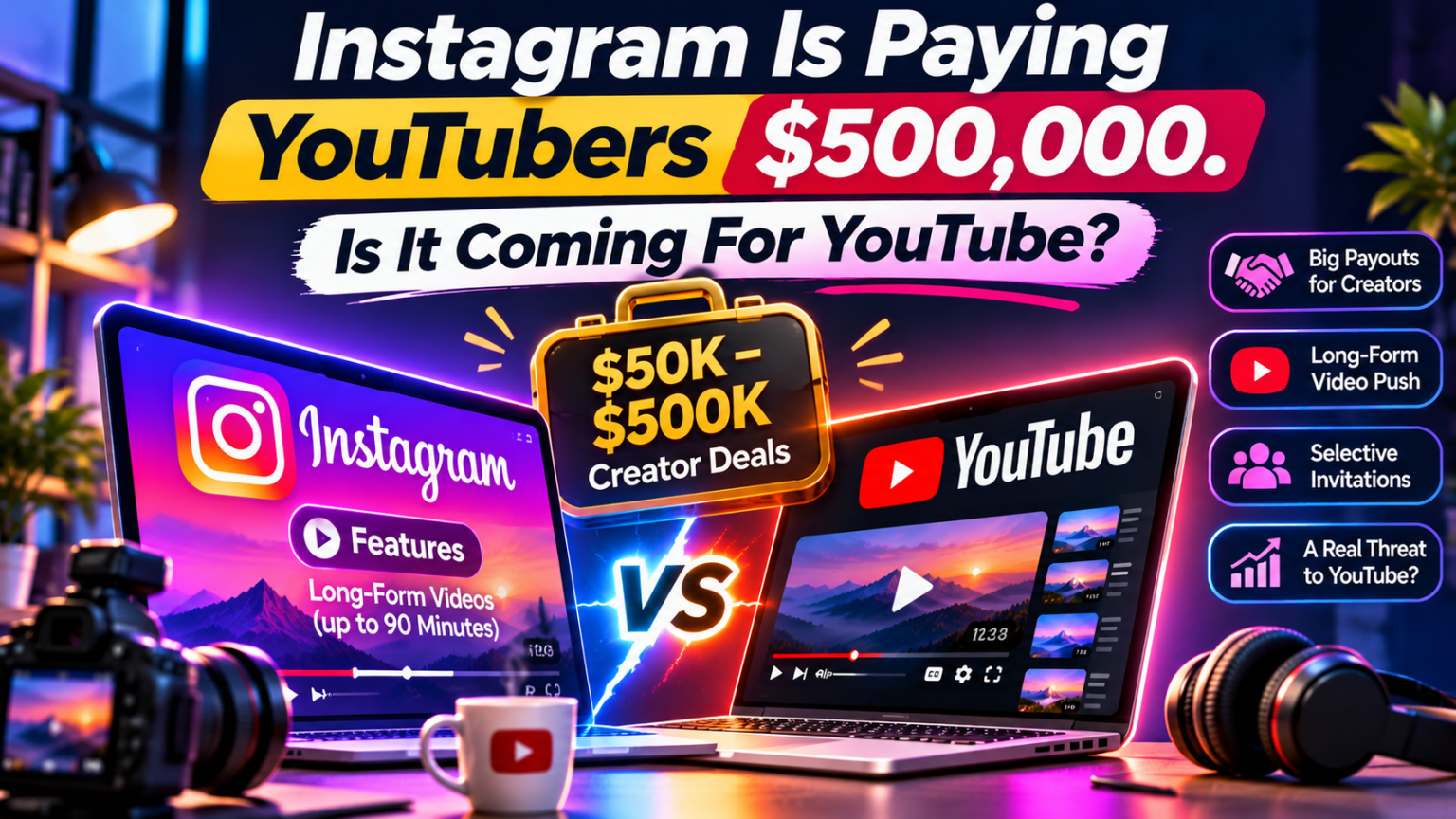
Instagram is reportedly offering some YouTube creators a deal that could reach $500,000 to bring their long-form videos to its new video format, Features. That is a headline-grabbing number—but the bigger story is what Meta is trying to build: a serious alternative to YouTube for podcasts, interviews, explainers and creator-led shows.
There is an important detail that often gets lost in the excitement. These are reported, selective deals—not a public programme promising every creator half a million dollars. The reported offers range from $50,000 to $500,000, and Meta has confirmed it is directly funding some Features content without confirming the individual figures.
So, is Instagram coming for YouTube? And what does this mean for creators in India and around the world? Let’s separate what is known from what is still speculation.
The $500,000 headline: what is Instagram actually offering?
Reports published in late October 2026 said Instagram had approached selected YouTube creators with payments reportedly starting around $50,000, with some offers reaching six figures and the largest reported amount hitting $500,000. The figures were reported by Business Insider, citing people familiar with the deals.
Meta confirmed that it is funding some creators to make content for Features, but said the details of those deals are confidential. That distinction matters: the company has confirmed the existence of direct funding, not publicly verified every reported amount or published a standard rate card.
According to reporting about the agreements, they are non-exclusive. Creators are not being asked to quit YouTube. Instead, some are reportedly being asked to publish their long-form video on Instagram Features on the same day it appears on YouTube.
There is also no public information confirming whether the reported sums are paid per video, per month, as a one-time fee or against a particular number of deliverables. Until contracts or official terms are published, creators should not treat $500,000 as a guaranteed per-video payment.
What is Instagram Features?
Features is Instagram’s move into longer, horizontal video. The format is designed for videos of up to 90 minutes, giving creators room for podcasts, interviews, documentaries, tutorials, comedy specials and other programmes that need more time than a Reel.
Instagram is also trying to connect short and long video instead of treating them as separate worlds. Its Clips as Reels concept lets creators turn parts of a longer Feature into short clips that can lead viewers back to the full video. In theory, a short clip can introduce a new viewer to a creator, while the longer upload gives that person a reason to stay.
The launch is being tested with selected creators and markets, including Brazil and a small group in the United States. This is not evidence that every Instagram account can upload 90-minute Features today. Availability and rollout can vary by account and region.
Why would Instagram pay YouTubers?
Because building a video platform is not just about building an upload button. It needs creators who can consistently make programmes people want to watch—and it needs viewers who come back for the next episode.
YouTube already has a deep library of established channels, loyal subscribers, search traffic and creator businesses. Instagram has a huge social audience and a strong short-video discovery engine, but it needs more long-form programming if it wants people to watch full episodes inside its app and on connected TVs.
Paying a small number of established creators can help seed that library. A known podcast host or video creator can bring an existing audience, attract attention from other creators and give Instagram’s recommendation system more long-form content to test.
These deals also help Instagram learn what viewers actually watch. Do people finish a 45-minute interview? Do they discover it through a Reel? Do they watch on a television? Do they return for another episode? Those answers are valuable while the format is still being developed.
Instagram Features vs YouTube: the creator money question
This is where the competition gets interesting. YouTube has a well-established advertising revenue-sharing model for eligible creators. Instagram, at the time of writing, has not announced an equivalent public ad-revenue share for Features.
| Area | YouTube | Instagram Features |
|---|---|---|
| Long-form video | Established core format | New format, up to 90 minutes in the test |
| Creator ad share | Eligible Partner Programme creators receive 55% of net watch-page ad revenue for long-form videos | No comparable public ad-revenue share announced |
| Reported direct deals | Creator funding and other programmes exist, but not the specific reported Features offer | Selected creators reportedly offered $50,000–$500,000 |
| Exclusivity | Depends on individual contracts and content rights | Reported Features deals are non-exclusive |
| Discovery | Search, recommendations, subscriptions and Shorts | Feed, Explore, Reels clips and developing long-form discovery |
| Audience relationship | Subscribers, memberships and a mature creator ecosystem | Followers, DMs, subscriptions, brand partnerships and social discovery |
YouTube’s 55% share applies to eligible watch-page ad revenue under its Partner Programme terms; it does not mean every video earns the same amount or that creators receive 55% of every type of YouTube income. Actual earnings depend on audience, geography, advertiser demand, content suitability and other factors.
Instagram’s position is different. Meta has said it is too early to share a long-term monetization model for Features and is exploring ways for creators to earn from brands, fans and Instagram, including performance-based incentives. Instagram head Adam Mosseri has also acknowledged that creator economics matter and that the company is exploring options.
Is Instagram really trying to replace YouTube?
It is more accurate to say Instagram is trying to compete for a larger share of video viewing and creator attention. Replacing YouTube completely is a much bigger challenge.
YouTube is not simply a place to upload long videos. It is also a search engine for tutorials, a recommendation system, a subscription destination, a television viewing habit and a monetization infrastructure. Creators can build libraries that continue to attract views long after the upload date.
Instagram has different strengths. People already use it to follow personalities, share clips with friends, discover trends and communicate directly. Features could make long-form video a natural extension of that behaviour, especially if a Reel clip makes it easy to find the full episode.
The platforms may end up competing for the same creator while serving different viewer needs. A creator could use YouTube as the main searchable library and Instagram as a discovery and community channel—or publish full episodes on both if the audience and economics make sense.
The IGTV lesson: paying creators does not guarantee success
This is not Instagram’s first attempt at long-form video. IGTV launched in 2018 with ambitions to make Instagram a home for longer creator programmes. Instagram later shut down the standalone IGTV app and folded video experiences into its broader product.
The lesson is not that Features must fail. The product, viewing habits and distribution options are different this time. Features sits within Instagram’s existing ecosystem and can connect to Reels, profiles, Explore and TV experiences. But the history is a reminder that a launch campaign and creator cheques are only the beginning.
For the format to last, viewers need a reason to return, creators need reliable ways to earn, and brands need measurement they can trust. A temporary payment can attract uploads; it cannot by itself create a sustainable video business.
What does this mean for YouTubers?
For creators who receive an offer, the opportunity may be worth considering. If a deal is genuinely non-exclusive and the creator retains the rights they need, posting the same programme on a second platform could bring additional income and reach.
But creators should read the actual contract rather than relying on a headline. Before agreeing, ask:
- Is the payment a one-time fee, a monthly amount, a per-video payment or a performance-based bonus?
- How many videos are required, and what length or format must they follow?
- Does same-day posting apply to every upload or only selected episodes?
- Who owns the original video, clips, edits, captions and other derivative material?
- Can the platform use the content for promotion, advertising or other purposes, and for how long?
- Are there restrictions on sponsors, music, third-party footage or existing distribution agreements?
- What reporting will be provided for views, watch time, audience retention and engagement?
- What happens if the feature changes, the test ends or the platform removes a video?
Do not assume that “non-exclusive” answers every rights question. It generally means the creator is not giving the platform exclusive distribution, but the exact licence, promotional rights and restrictions are defined by the contract.
What about small and mid-sized creators?
Most creators will not receive a six-figure offer simply because they upload a video. The reported deals are selective launch incentives intended to attract particular creators and help establish the new format. There is no public application page or universal $500,000 payment scheme.
That does not mean smaller channels should ignore Features. If the format becomes available to them, it may be useful as another distribution channel. The sensible approach is to test it with content they already own, measure the results and avoid spending heavily before the audience is proven.
What should Indian creators do?
India has a large and diverse creator community, from regional-language educators and tech reviewers to gaming channels, podcasters, entertainers and business explainers. For these creators, the question is not simply whether Instagram has a large audience. It is whether Features is available to their account, whether their viewers watch long videos there and whether the format can generate income.
As of 12 November 2026, the reporting describes a limited test and does not establish a general India-wide rollout or a public Indian creator payment programme. Indian creators should check in-app eligibility and official Instagram announcements rather than assuming that the reported US-dollar deals are available locally.
1. Keep YouTube as your dependable long-form base
If your channel already earns through YouTube, do not abandon a working revenue stream because of a headline. Keep publishing consistently and track your actual revenue per thousand views, audience retention and sponsorship income.
2. Use Instagram for discovery
Short clips, behind-the-scenes content and useful highlights can help new viewers discover your work. If Features becomes available, test whether a clip can move viewers into a full episode rather than simply generating a quick view.
3. Test with existing content first
Choose a video you have the rights to distribute, adapt it to the platform’s requirements and compare watch time, completion, shares, follows and audience quality. Avoid producing an entirely separate show until you know there is demand.
4. Build more than one source of income
Advertising is only one part of a creator business. Sponsorships, memberships, subscriptions, courses, consulting, affiliate income and direct products can make a channel less dependent on any single platform’s rules.
Could Instagram’s $500K move hurt YouTube?
It could increase competition, but a few large deals are not enough to prove that YouTube is losing its position. The immediate impact may be more visible in creator negotiations: established channels now have another platform interested in their long-form content, and that can improve their bargaining position.
YouTube still has several advantages: a mature ad-revenue share, strong search discovery, a familiar television experience and years of creator tools. Instagram has a large social graph, short-form discovery and the ability to connect clips with longer programmes. Each company has something the other wants.
The real test will come after the launch incentives. If Instagram introduces a transparent and sustainable way for ordinary creators to earn, Features could become a genuine competitor. If it relies mainly on occasional payments to a small group, the format may struggle to keep creators publishing once the special deals end.
Our verdict: creators should be platform-smart, not platform-loyal
Instagram’s reported $50,000–$500,000 offers are a significant signal. Meta wants established video creators, and it is willing to spend money to get long-form content onto Features while the format is new.
But the headline number should not distract from the bigger questions: who qualifies, what the contract requires, how viewers discover full-length videos, and how creators will earn when launch funding is no longer the story.
For now, creators do not need to choose one platform and abandon the other. Protect the audience and income you have already built, experiment where new opportunities make sense, and measure the results with real data.
Instagram may be coming for YouTube’s creators—but winning their uploads is only the first step. Winning their viewers, and giving creators a reason to stay, is the much harder challenge.
Frequently asked questions
Is Instagram really paying YouTubers $500,000?
Reports say selected YouTube creators have received offers ranging from about $50,000 to as much as $500,000 to publish long-form videos on Instagram Features. Meta confirmed that it is funding some Features creators, but has not publicly confirmed the individual amounts or published standard deal terms.
Do creators have to leave YouTube to accept an Instagram deal?
Reportedly, no. The deals have been described as non-exclusive, with some creators asked to publish the same long-form video on Instagram on the day it goes live on YouTube. The exact contract terms may differ.
What is Instagram Features?
Features is Instagram’s test of horizontal long-form videos of up to 90 minutes. It is intended for formats such as podcasts, interviews and other longer programmes, and can connect to short clips through the Clips as Reels experience.
Does Instagram Features pay creators ad revenue?
Instagram has not announced a public ad-revenue-sharing programme for Features. Meta says it is exploring ways for creators to earn from brands, fans and Instagram, but a long-term model has not been published.
Is Instagram Features available in India?
The reported rollout is limited to selected creators and test markets. As of 12 November 2026, there is no confirmed general India launch date or open Indian creator payment programme. Check the Instagram app and official announcements for account-specific availability.
Should small YouTubers upload their videos to Instagram?
If the feature is available, creators can experiment with content they already own and measure the results. Do not expect a $500,000 payment; focus on audience discovery, watch time and whether the additional platform brings meaningful value.
Can Instagram Features replace YouTube?
It is too early to say. YouTube has a mature monetization system and strong search and TV viewing habits. Instagram has social discovery and a large existing audience. Features will need sustainable creator earnings and repeat viewers to become a serious long-term alternative.
Sources and further reading
- Business Insider – Instagram’s reported creator deals
- TechCrunch – Instagram’s 90-minute Features format
- The Verge – Instagram’s long-form creator monetization plans
- Social Media Today – Instagram’s creator incentives and discovery push
- Net Influencer – Reported Features deal details
- YouTube Help – Partner earnings overview
Reporting cutoff: 12 November 2026. Payment amounts and contract conditions are described as reported where Meta has not publicly disclosed the details. Availability and monetization terms may change after publication.