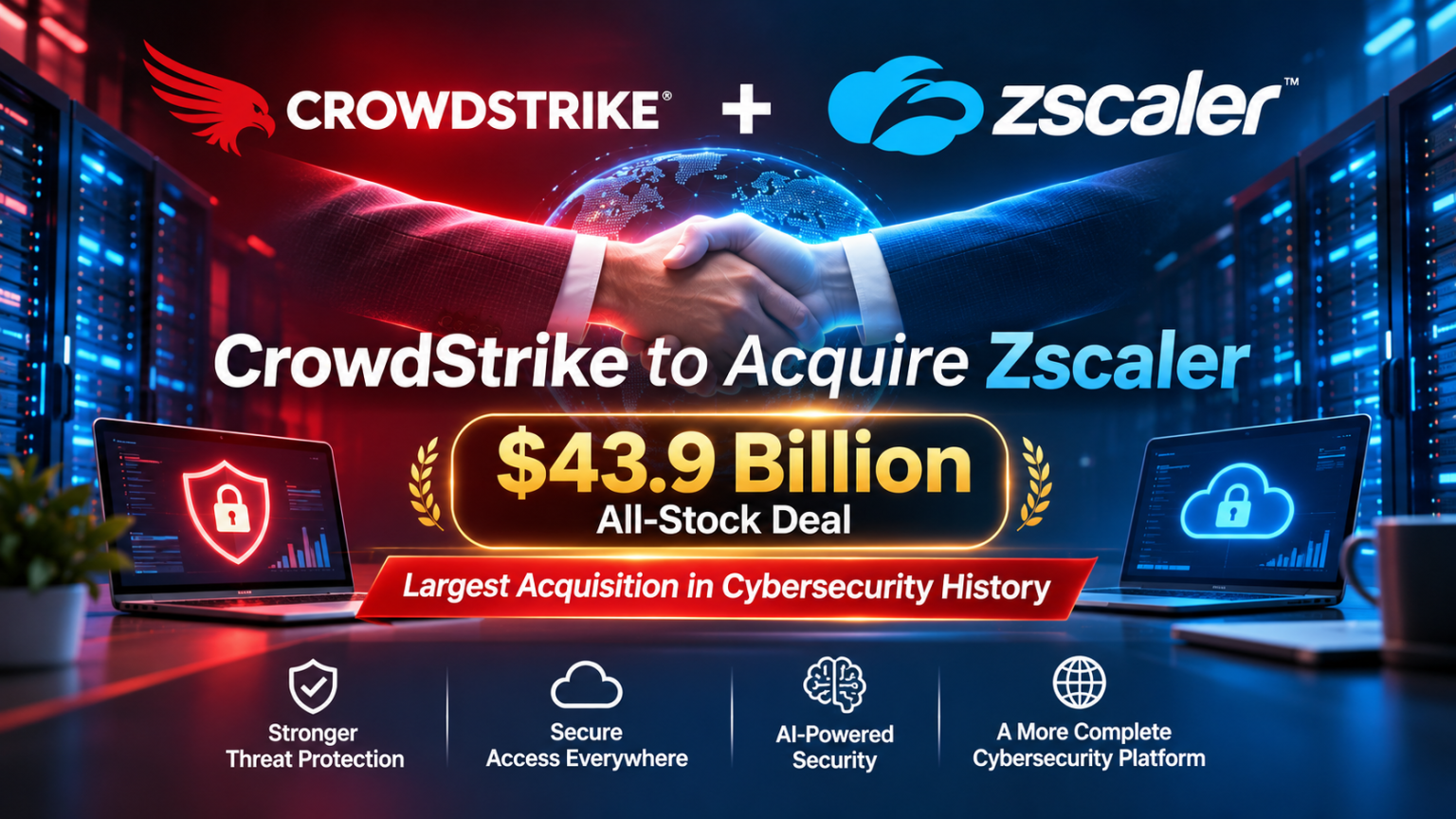
CrowdStrike has agreed to acquire cloud security company Zscaler in an all-stock transaction valued at approximately $43.9 billion. Announced on 23 November 2026, the deal is being described as the largest acquisition in cybersecurity history. It brings together two companies that protect different, increasingly connected parts of modern business technology.
CrowdStrike is best known for protecting endpoints, workloads, identities and data through its Falcon platform. Zscaler focuses on securing connections between users, devices, applications and cloud services through its Zero Trust Exchange. The companies believe that combining these capabilities could give customers a more complete way to defend against cyberattacks, including threats involving AI agents.
The headline figure is enormous, but the strategic logic is just as important. Businesses are moving applications and data beyond traditional office networks. Employees connect from anywhere, workloads run across multiple clouds, and AI agents are beginning to access company systems. Security products that operate in separate silos can leave gaps between them.
What exactly has CrowdStrike agreed to buy?
CrowdStrike will acquire Zscaler in an all-stock deal with an enterprise value of approximately $43.9 billion. Under the agreement, each Zscaler share will be exchanged for 1.135 shares of CrowdStrike common stock.
Based on CrowdStrike’s closing share price on 20 November 2026, the exchange ratio represented an implied value of approximately $260.41 per Zscaler share, a premium of about 34% to Zscaler’s closing price on that date. After closing, existing CrowdStrike shareholders are expected to own approximately 84.1% of the combined company, while Zscaler shareholders are expected to own around 15.9%.
The boards of both companies have unanimously approved the agreement. However, the transaction is not yet complete. It still requires Zscaler shareholder approval, regulatory clearances and other customary closing conditions. CrowdStrike expects it to close in the second half of its fiscal year 2028. Until then, both businesses will continue to operate independently.
Why does CrowdStrike want Zscaler?
The simplest way to understand the deal is to look at what each company protects.
CrowdStrike: protecting the device and workload
CrowdStrike’s Falcon platform is designed to protect endpoints such as laptops, desktops and servers, along with cloud workloads, identities and data. Its technology collects security telemetry and uses analytics and AI to identify suspicious behaviour, investigate threats and support response actions.
Zscaler: protecting the connection
Zscaler takes a different approach. Its Zero Trust Exchange sits between users, devices and applications, checking access and inspecting traffic rather than assuming a connection is safe because it comes from inside a corporate network. Its cloud-delivered security services include Secure Access Service Edge (SASE), Security Service Edge (SSE), secure web access, private application access and data protection.
The strategic fit is straightforward: CrowdStrike can help identify what is happening on a device, while Zscaler can help control where that device or user connects and what data moves across the connection.

Why the $43.9 billion price tag matters
This is not a small product acquisition. At approximately $43.9 billion, it is the largest cybersecurity acquisition on record, according to the companies’ announcement and Reuters reporting. The scale reflects the strategic value of Zscaler’s position in cloud and network security.
Zscaler says its platform protects 50% of the Fortune 500 and operates across more than 200 public service locations. It also has approximately 8,000 customers who are not yet CrowdStrike customers, creating a substantial opportunity for cross-selling.
CrowdStrike estimates that adding Zscaler will expand its total addressable market by more than $185 billion by calendar year 2029. That is the company’s market estimate, not guaranteed future revenue.
One platform, one data layer and one commercial relationship
One of the biggest ambitions is to bring endpoint and network security data together. CrowdStrike says its Falcon platform generates trillions of events each day from endpoints and cloud workloads. Zscaler’s Zero Trust Exchange processes more than 750 billion transactions per day, according to the companies.
Combining those signals could give security teams a broader view of an attack. For example, suspicious activity on a laptop might be linked to an unusual connection to a cloud application, an attempt to access sensitive data or activity involving an AI agent. Instead of investigating separate alerts across different consoles, a security team could potentially follow more of the attack path in one environment.
The benefit will depend on how well the products are integrated in practice. The companies also plan to bring Zscaler products into CrowdStrike’s Falcon Flex commercial model, allowing customers to purchase and expand their use of combined services through a more unified contract.
AI agents are a major part of the strategy
The timing of the acquisition is significant. Companies are beginning to deploy AI agents that can read documents, access applications, call APIs, move information and perform tasks on behalf of employees.
These agents introduce a new security challenge. An agent may have access to sensitive company data, and a compromised identity or poorly configured permission could allow it to do more than intended. Traditional endpoint protection alone cannot control every connection an agent makes to an application or external service.
That is where the companies see an opportunity. CrowdStrike brings endpoint, identity and workload security; Zscaler brings Zero Trust controls over connections between users, agents and applications. The combined platform is intended to help organisations adopt AI while keeping access and data movement under tighter control.
However, buying Zscaler does not automatically make AI agents safe. Customers will still need identity governance, least-privilege permissions, monitoring, data controls and clear approval rules for sensitive actions.
How much money does CrowdStrike expect to gain?
The companies expect the combined business to begin with more than $10 billion in annual recurring revenue (ARR) at closing. Zscaler reported approximately $3.9 billion in ARR as of its most recently completed fiscal quarter, according to the acquisition announcement.
CrowdStrike has outlined two major synergy targets:
- Revenue synergies: Approximately $1 billion in annualised run-rate revenue synergies by the end of the first 30 months after closing, through cross-selling, upselling and Falcon Flex.
- Cost synergies: Approximately $500 million in annualised run-rate cost savings within 18 to 24 months after closing, primarily through data-centre infrastructure, vendor and operational optimisation.
These are management targets, not guaranteed outcomes. Achieving them will depend on customer demand, successful product integration, employee retention and the ability to combine operations without disrupting service.
What happens to Zscaler CEO Jay Chaudhry?
Zscaler founder and CEO Jay Chaudhry is expected to continue leading the Zscaler business after the acquisition closes. He will also join the CrowdStrike board of directors. This arrangement may help preserve Zscaler’s customer relationships, product knowledge and company culture during the transition.
What could go wrong?
Regulatory approval
A deal of this size will receive regulatory scrutiny. Authorities may examine competition, market concentration, customer choice and the effect of combining two major cybersecurity providers. Shareholder and regulatory approvals remain outstanding.
Product integration
Combining security platforms is technically demanding. Customers will expect reliable integrations, consistent policies, clear licensing and a smooth user experience. If the combined products become difficult to manage, the promised simplicity could turn into additional complexity.
Customer choice and vendor lock-in
Some enterprises deliberately buy security products from different vendors to avoid depending on a single supplier. A broader platform may be attractive, but customers will want to know whether they can continue using Zscaler or Falcon independently and whether pricing remains competitive.
Employee and culture retention
Cybersecurity companies depend on specialised engineers, threat researchers and customer-facing experts. Retaining those teams will be important. Poorly handled organisational changes could weaken the products and relationships that made the acquisition valuable.
The all-stock structure
Because the purchase is being made with CrowdStrike shares, the value of the consideration can change with CrowdStrike’s share price before closing. Both sets of shareholders will also be exposed to the future performance of the combined business.
What does this mean for customers?
For now, customers should not expect an immediate change simply because the agreement has been announced. Both companies say they will continue to operate independently until the transaction closes.
Over time, customers may see more integrated endpoint and network security, a broader set of AI protection tools and new purchasing options. Enterprises should ask whether existing subscriptions and support arrangements will continue, how integrations will work with identity and SIEM platforms, whether individual products will remain available, how data residency requirements will be handled, and what happens to pricing and renewals.
Organisations should avoid rushed migration decisions before the companies publish detailed product and customer-transition plans.
How does this change the cybersecurity market?
The deal could accelerate consolidation across the industry. Large organisations are dealing with a growing number of security tools, overlapping alerts and complex vendor relationships. A provider that can protect devices, identities, cloud workloads and network connections through a coordinated platform has a strong sales proposition.
Competitors such as Palo Alto Networks, Microsoft and Cisco will face pressure to demonstrate how their own platforms connect endpoint, network, identity and cloud protection. The market is likely to focus increasingly on integrated security operations and protection for AI-driven workflows. Still, cybersecurity is not a market where one vendor can solve every problem. Organisations will continue to need independent testing, specialised products, skilled security teams and layered defences.
Final verdict: a defining deal for cybersecurity
CrowdStrike’s proposed $43.9 billion acquisition of Zscaler is a landmark moment for the cybersecurity industry. It combines two complementary approaches: protecting the devices and workloads where activity happens, and securing the connections through which users, applications and AI agents communicate.
If the companies execute well, the deal could give enterprises a more unified security platform and help CrowdStrike compete in a much larger market. The opportunity is substantial, especially as AI agents become part of everyday business operations.
But the announcement is only the beginning. Regulatory approval, product integration, customer confidence and the delivery of promised financial synergies will determine whether this becomes a successful transformation or an expensive integration challenge.
For now, one thing is clear: cybersecurity vendors are racing to build platforms that can protect not just computers and networks, but the growing web of people, cloud services and AI agents that now power modern organisations.
Sources and further reading
- CrowdStrike: Official acquisition announcement, 23 November 2026
- Reuters: CrowdStrike snaps up Zscaler in $44 billion deal
- Associated Press: CrowdStrike to acquire Zscaler in a $44 billion deal
- TechCrunch: CrowdStrike to acquire Zscaler for $44 billion
- SEC filing: CrowdStrike and Zscaler transaction announcement
Editorial note: This article reflects information available on 24 November 2026. The acquisition is an agreement announced by the companies and remains subject to shareholder and regulatory approvals. Financial synergy and market-size figures are company estimates.