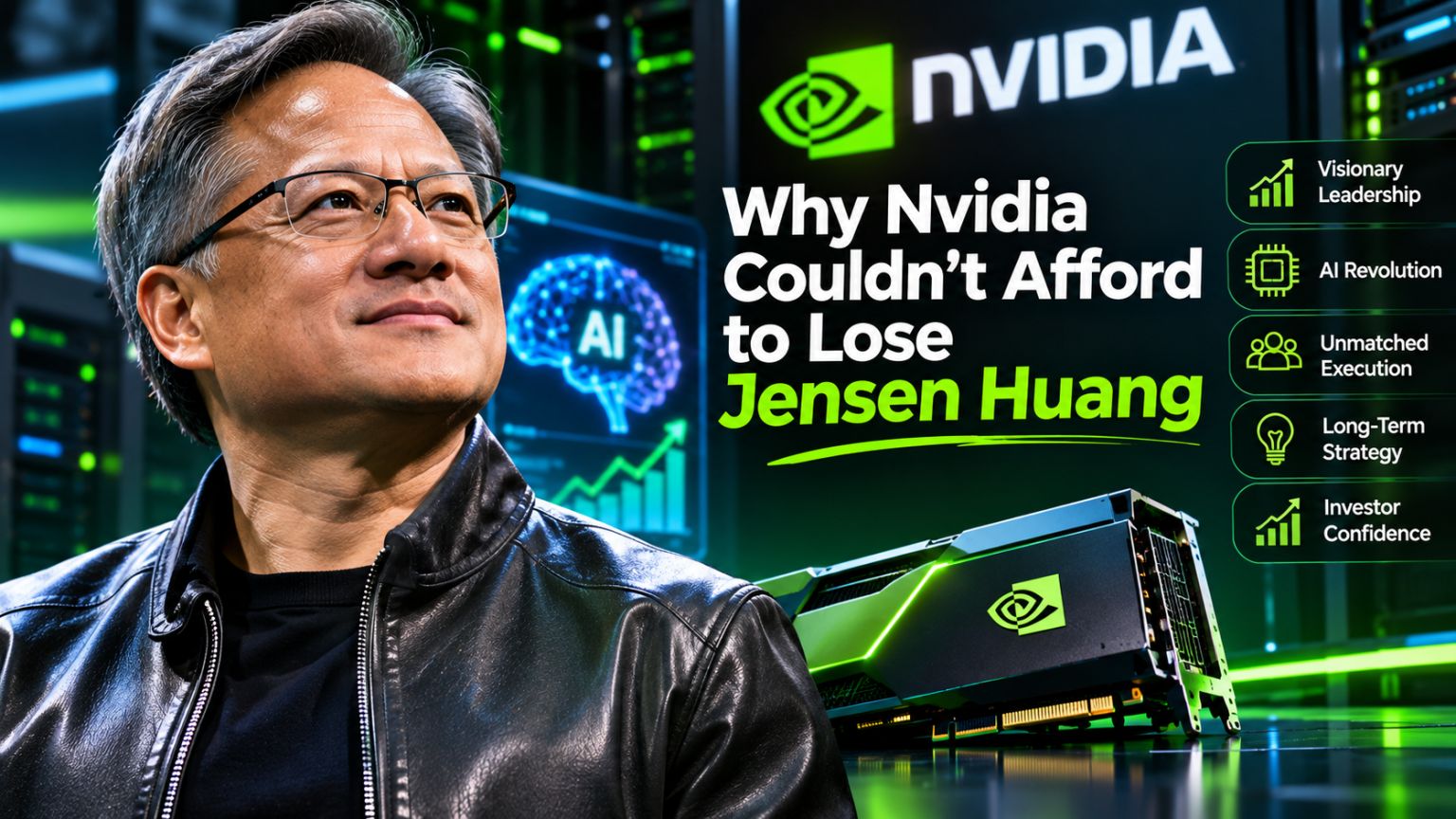
For more than three decades, Jensen Huang has been much more than the chief executive of NVIDIA. He has been its co-founder, chief product thinker, chief technology evangelist and, in many ways, the public face of the artificial intelligence revolution.
That is why the leadership turmoil that shook NVIDIA in November 2026 became bigger than an ordinary corporate succession story. When Huang stepped away from the CEO role, investors and technology leaders immediately began asking a difficult question: could the company that supplies so much of the world’s AI computing infrastructure really afford to lose the person who built it?
The story has since taken another turn. On 23 November, NVIDIA announced that its board had unanimously reinstated Huang as president and CEO. The board said it was satisfied after discussions with him and had received input from senior US government officials. The independent investigation into reports that Huang had been targeted by a foreign intelligence effort will continue, and the company says it is strengthening its compliance oversight.
His return settles the immediate leadership question. It does not remove the bigger issue the episode exposed: NVIDIA has become so closely associated with one individual that uncertainty about his future can become a concern for the entire AI industry.
From a graphics-chip company to the engine room of AI
NVIDIA was founded in 1993 by Jensen Huang, Chris Malachowsky and Curtis Priem. Its early business centred on graphics processing for computers and gaming. The GPU later proved useful for far more than rendering pixels. Its ability to perform many calculations in parallel made it valuable for scientific computing and, eventually, modern AI.
One of Huang’s most consequential strategic decisions was to build a broader computing platform around GPUs. CUDA, NVIDIA’s parallel computing software platform, gave developers a way to use the company’s hardware for general-purpose computing. Over time, libraries, frameworks, networking products and developer tools helped turn NVIDIA from a chip supplier into a deeply integrated AI infrastructure company.
That long-term bet took years to mature. When deep learning and generative AI demand accelerated, NVIDIA already had much of the hardware and software ecosystem that researchers and cloud providers needed.
Why Jensen Huang is difficult to replace
Most large companies can point to a leadership team and a succession process. NVIDIA’s structure has been unusually centred on Huang. Recent reporting described more than 60 executives reporting directly to him, giving him a remarkably wide view of the organisation and a direct role in many important decisions.
His responsibilities have extended well beyond approving quarterly plans. Reporting from Reuters and the Washington Post describes a leader who gets involved in product direction, technology decisions, recruiting, major partnerships and the company’s public message about AI.
That combination is rare. A successor may be an excellent engineer, operator or financial executive, but replacing all of those roles in one person is a much harder task. NVIDIA can distribute responsibilities across a leadership team, but it cannot instantly reproduce decades of personal relationships and institutional knowledge.
1. He helped shape NVIDIA’s long-term technology bets
Technology companies often fail not because they cannot build products, but because they make the wrong bets about what customers will need next. Huang repeatedly pushed NVIDIA to think beyond its immediate graphics business.
The move towards accelerated computing, CUDA and AI infrastructure required sustained investment before the market was fully ready. Those choices were not guaranteed to succeed. They demanded patience, engineering commitment and a willingness to invest in platforms that might take years to pay off.
That history is a major reason investors view Huang as more than a conventional CEO. He has been closely associated with the strategic decisions that placed NVIDIA at the centre of the AI boom.
2. NVIDIA sells an ecosystem, not just a GPU
It is tempting to describe NVIDIA’s success as a story about fast graphics processors. That misses the bigger picture. Customers buying AI infrastructure need a complete system: GPUs, networking, software libraries, development tools, server designs, support and a reliable supply of components.
CUDA is particularly important because developers have spent years building applications and workflows around it. Switching to another accelerator is not always as simple as replacing one card with another. Software compatibility, performance tuning and operational experience all matter.
Huang has consistently promoted this platform strategy. His public communication helps customers, developers and investors understand where NVIDIA is heading. A new CEO would inherit the ecosystem, but would still need to earn the confidence of the people who build and depend on it.
3. His relationships matter across the supply chain
Producing advanced AI chips requires close coordination with manufacturers, packaging suppliers, memory companies, server makers and cloud providers. NVIDIA depends on a complex global supply chain, including its long-standing manufacturing relationship with TSMC.
Reuters and other reporting have highlighted the importance of Huang’s personal relationships across the AI ecosystem. Those connections can help senior leaders resolve problems, align investment plans and secure cooperation when demand is high and manufacturing capacity is limited.
Such relationships are not permanently tied to one person. They can be institutionalised and maintained by teams. But when trust has been built over decades, a sudden leadership change can create uncertainty at exactly the moment when customers are competing for scarce capacity.

4. The AI industry has become dependent on NVIDIA’s direction
Major cloud companies, AI labs, enterprises and governments have made enormous investments in AI infrastructure. NVIDIA’s products are central to many of those plans. A sudden leadership vacuum at the company could therefore affect more than its own employees and shareholders.
Customers want predictable product roadmaps, reliable supply and long-term software support. Partners want to know that investment plans will remain on track. Governments also pay attention because advanced computing has become part of economic competitiveness and national security policy.
That does not mean NVIDIA is the only company capable of building AI chips. AMD, cloud providers developing their own accelerators and several specialist chip companies are competing for a share of the market. But NVIDIA’s scale and software ecosystem make it unusually influential.
5. The November leadership crisis exposed a governance weakness
In November, reports about Huang’s personal relationships and a possible foreign-intelligence targeting effort triggered scrutiny and raised questions about leadership continuity. These reports should be treated carefully: an investigation is not proof that an allegation is true. NVIDIA’s board said its independent investigation would continue even after Huang’s reinstatement.
The episode also drew attention to the company’s succession planning. When so much authority and external influence sit with a founder, the board must be prepared for the possibility that the founder may be unavailable, choose to leave or be unable to continue.
On 23 November, NVIDIA announced that it had created a National Security and Export Control Committee made up of independent directors. It also said it would recruit a Chief Compliance Officer who would report to the board’s Nominating and Corporate Governance Committee. Those steps matter because a company of NVIDIA’s importance needs oversight that is bigger than any one executive.
Why the board brought him back
NVIDIA’s 23 November announcement said the board voted unanimously to reinstate Huang after discussions and meetings. It said the board was satisfied with his candor and ability to lead, and that it had received input from senior US government officials on national-security concerns.
The decision reflects how much the board values Huang’s leadership at a critical moment for the AI industry. It also suggests that directors believed the company could address governance and compliance concerns while retaining the executive most closely associated with its technology strategy.
But reinstatement should not be confused with the end of the matter. NVIDIA said the independent investigation would continue to completion and that it would cooperate with ongoing government inquiries. The new compliance role and board committee will be important tests of whether the company can strengthen oversight while preserving its pace of innovation.
Could NVIDIA survive without Jensen Huang?
Yes. NVIDIA has tens of thousands of employees, experienced engineers, product leaders and a global partner network. Its technology, intellectual property, customer relationships and installed software ecosystem do not disappear if one executive leaves.
But surviving and continuing to lead are different challenges. A company can retain its products and still lose momentum if its strategic direction becomes unclear, key executives depart or customers begin to doubt its roadmap.
The best long-term outcome for NVIDIA is not permanent dependence on Huang. It is a company that can preserve the culture and ambition he helped create while building a credible leadership bench capable of making difficult decisions without him.
The bigger lesson for technology companies
The NVIDIA story is a reminder that founder-led leadership can be a competitive advantage—and a governance risk at the same time. A strong founder can make decisions quickly, attract talent and persuade teams to pursue difficult long-term goals. But if the company becomes too dependent on that individual, even a temporary absence can unsettle investors, partners and employees.
Good succession planning does not mean expecting a founder to leave tomorrow. It means ensuring that the company can keep operating, innovating and earning trust if that day arrives. For a business as important as NVIDIA, that is not simply an HR exercise. It is part of risk management.
Final thoughts: NVIDIA needed Jensen—but it also needs a future beyond him
Jensen Huang’s return gives NVIDIA continuity at a time when AI infrastructure demand remains intense. His technical vision, long relationships and ability to communicate the company’s ambitions are difficult to replace quickly.
That explains why NVIDIA’s board and the wider technology industry treated his departure as such a serious event. The company did not just risk losing a CEO; it risked losing a central source of strategic direction and confidence.
Still, the strongest NVIDIA would be one whose future does not depend on a single person. Huang helped build an extraordinary technology platform. The next challenge is to ensure that its leadership, governance and culture are strong enough to carry it forward for decades—whoever sits in the CEO’s chair.
Sources and further reading
- NVIDIA: Board reinstates Jensen Huang as President, CEO and Board Director (23 November 2026)
- Reuters: Why the AI race cannot do without NVIDIA’s Jensen Huang
- Reuters: NVIDIA’s numbers impress, but investors fret over CEO succession
- The Washington Post: NVIDIA faces a daunting challenge replacing Jensen Huang
- CSIS: What the NVIDIA controversy says about succession planning and national security
Editorial note: This article reflects developments reported through 24 November 2026. Allegations and investigations are described as reported matters, not established findings.