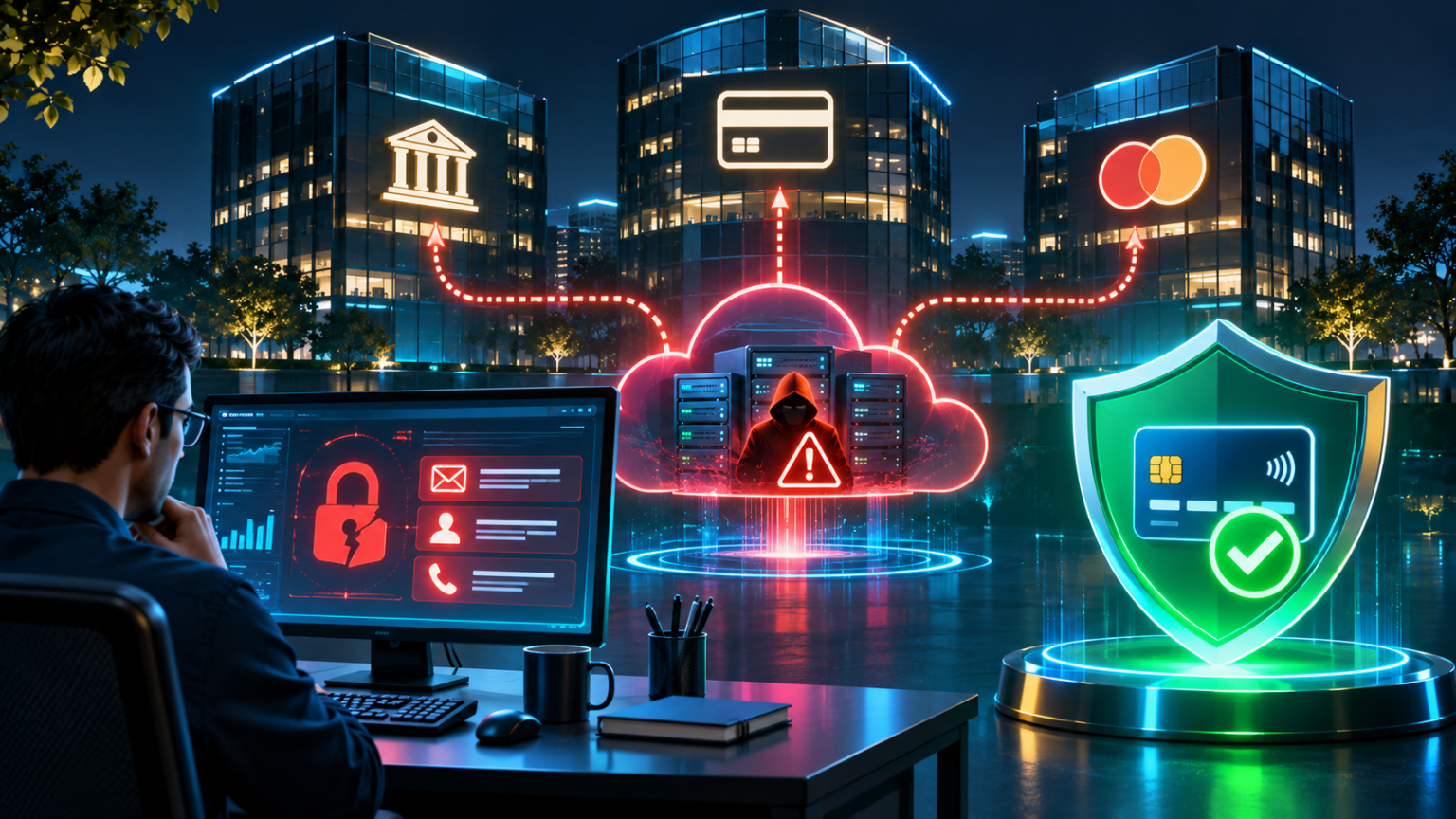
JPMorgan Chase, Visa and Mastercard have disclosed cyber incidents involving third-party service providers, raising a familiar but uncomfortable question for customers: how much personal information can be exposed when a company shares data with an outside vendor?
The disclosures emerged after a cyber extortion group calling itself n0n claimed it had obtained records connected to the three financial brands. The companies confirmed incidents involving vendors, but they drew a clear line between the affected information and their core payment infrastructure. They said payment networks and card-payment data were not compromised.
That distinction matters. This is not a confirmed story of criminals breaking into the Visa or Mastercard payment networks or stealing customers’ full card numbers. The information discussed so far is mainly contact and marketing data held by service providers. However, even a name, email address, phone number or benefit-program detail can help criminals create convincing phishing messages and impersonation scams.
What happened?
On 19 November 2026, JPMorgan Chase said third parties providing services to the bank had been targeted in a cyberattack. The bank said its investigation indicated attackers accessed certain marketing data held by those vendors, which may include customer names and email addresses. It said affected customers would be contacted directly and that the incident did not disrupt its services.
Visa said it was aware of claims connected to an incident involving a third-party service provider in the Asia-Pacific region. The company said its own systems were not involved or affected and that no payment data, such as card numbers, was exposed.
Mastercard also confirmed an incident at a third-party provider. It said a limited amount of email addresses belonging to a small subset of cardholders enrolled in a specific benefits programme had been exposed. Mastercard described the information as non-payment data and said the exposure had been contained. It said its payment network and customers’ ability to use their cards were unaffected.
What data was reportedly exposed?
The public picture comes from two different sources: statements made by the companies and files that the extortion group posted online. Those should not be treated as equally verified. Reuters reviewed some of the posted material but said it could not independently verify its authenticity.
| Company | Company-confirmed information | What appeared in posted data |
|---|---|---|
| JPMorgan Chase | Vendor-held marketing data that may include customer names and email addresses. | Reuters found more than 16,000 apparent customer email addresses and 124 apparent employee email addresses. Some customer records also appeared to contain phone numbers and postal codes. |
| Visa | An incident involving an Asia-Pacific third-party provider; Visa said payment data and its own systems were unaffected. | Posted files appeared to contain customer contact details and marketing campaign information across several Asia-Pacific markets, including email addresses and phone numbers. |
| Mastercard | A limited number of email addresses from a small subset of cardholders in a specific benefits programme. | Posted material appeared to include marketing records from North America, the Middle East and Africa, as well as a small number of employee email addresses. |
Important: The figures and extra fields in the final column come from journalists’ reviews of material posted by the extortion group. They are not a complete, independently confirmed count of affected customers. The companies have not publicly named the vendors or provided a full record-by-record account of the exposure.
Were credit card numbers, passwords or bank accounts stolen?
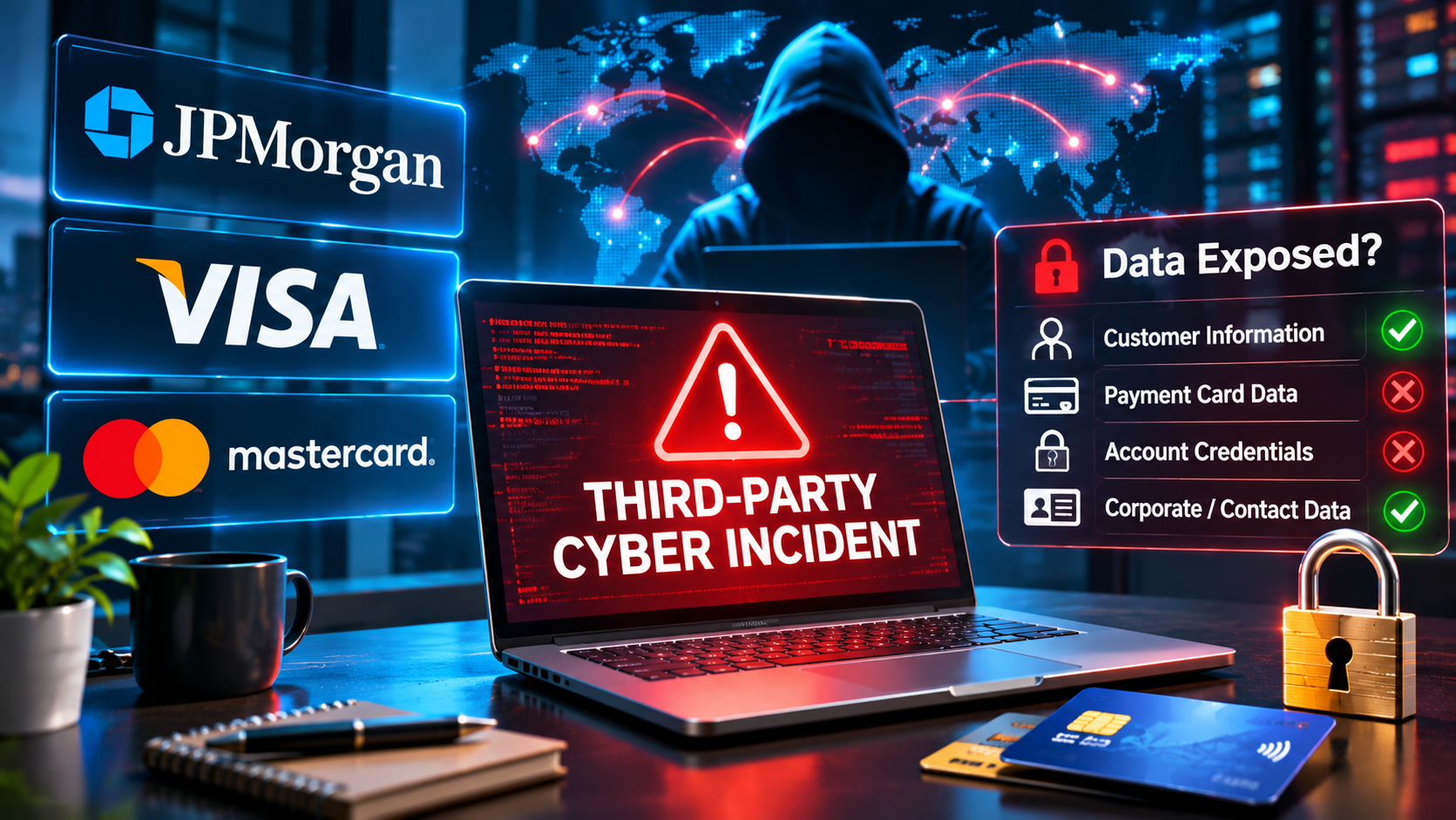
Based on the companies’ public statements, there is no confirmation that full payment card numbers or payment-network data were exposed in these incidents. Visa explicitly said no payment data such as card numbers was affected. Mastercard said the exposed information was non-payment information and that its payment network was not affected. JPMorgan described the information as marketing data.
The companies have not publicly confirmed that online banking passwords, card security codes, PINs or account credentials were part of the exposed information. It would therefore be inaccurate to claim that those details were stolen. Equally, customers should not assume that every detail in the extortion group’s online posts is authentic or complete.
Who is the group called n0n?
The cyber extortion group calling itself n0n claimed on 16 November that it had obtained data related to JPMorgan, Visa and Mastercard. It posted sample material and threatened to release information. Reuters reported that the group had claimed roughly 200 incidents since emerging in September, according to cybercrime research platform eCrime.ch.
Researchers and security publications have linked some activity attributed to the group with compromised credentials and remote-access tools. But attribution and individual claims need careful handling. A criminal group’s claim that it breached a major brand does not, by itself, prove that it accessed that brand’s internal network.
In these cases, the companies described incidents at outside providers. Cybersecurity researchers have also cautioned that some data associated with major brands may have originated from marketing, loyalty or concierge vendors rather than from the brands’ own core systems.
Why third-party vendors are an attractive target
Large financial companies work with many external businesses: marketing agencies, customer-engagement platforms, loyalty-program operators, travel and concierge services, call centres, analytics providers and technology suppliers.
Those vendors may hold information that helps them deliver a service, such as a customer’s name, email address, phone number, preferences, campaign history or benefit-program activity. A single provider may serve multiple organisations. Compromising that provider can therefore expose records connected to several well-known companies at once.
This is a supply-chain security problem. A bank may invest heavily in protecting its own network, but it cannot treat customer information as safe simply because it has been sent to a partner. The security of the data also depends on how that partner stores it, who can access it, how long it is retained and whether subcontractors receive copies.
Why email addresses and phone numbers still matter
Some people may look at an exposed email address and think it is harmless. In reality, contact details can make fraud attempts much more convincing.
If criminals know that someone is enrolled in a premium card benefit, has used a concierge service or received a particular marketing offer, they can write a message that appears to come from a familiar company. A phone call that mentions a real programme or a recent interaction may also sound more believable.
That information can be used to support:
- Targeted phishing: Emails that use a person’s name or refer to a real card benefit.
- Impersonation calls: Callers pretending to be bank fraud teams, card support or concierge staff.
- Account-recovery scams: Attempts to persuade someone to reveal one-time passwords or verification codes.
- Social engineering: Messages that use known customer details to create urgency and gain trust.
- Follow-on profiling: Combining exposed contact information with data from other breaches to build a more detailed picture of a person.
What should JPMorgan, Visa and Mastercard customers do?
There is no need to panic or cancel a card solely because of these reports. The companies have said their payment systems were not affected. But it is sensible to be alert to unusual messages and calls, especially those that claim there is an urgent problem with a card or account.
- Be cautious with unexpected messages. Do not click links in emails or texts claiming to offer breach support, refunds or account protection.
- Never share one-time passwords. A legitimate bank or card company should not ask you to read out an OTP, PIN or full password to an unsolicited caller.
- Verify callers independently. End the call and contact the company using the official app or the phone number printed on your card.
- Review account activity. Check recent transactions and alerts through the official banking app or website.
- Use strong, unique passwords. Enable multi-factor authentication wherever it is available, especially for email and financial accounts.
- Be wary of fake breach notices. Criminals often exploit real incidents by sending fraudulent messages that imitate official customer support.
If you receive a genuine notification from a company, follow the instructions in that verified communication. JPMorgan said it would contact affected customers directly and offer support, including complimentary credit monitoring where appropriate. Mastercard said it was working with impacted cardholders and its provider.
What businesses should learn from these incidents
The lesson is not simply that vendors need better passwords. Financial institutions and other organisations should know exactly what information each supplier holds and why it needs it.
Security teams should maintain an inventory of third-party data flows, review vendor access regularly, require strong authentication, assess subcontractors and set clear deletion periods. Contracts should require prompt incident notification and evidence of security controls. Organisations should also test whether they can identify affected customers quickly when a supplier reports a breach.
Most importantly, businesses should avoid sending a vendor more customer information than it needs. If a marketing campaign can operate with an email address and a campaign identifier, it may not need a phone number, postal code or detailed customer profile as well.
Are these incidents connected to the recent banking service outage?
No connection has been established. JPMorgan said the third-party cyber incident was unrelated to the transaction-processing disruption some customers experienced earlier in the same week. The bank attributed that separate disruption to a software bug in on-premises hardware systems, not a cyberattack.
Keeping these events separate is important. A service outage caused by a software fault is not automatically evidence of a hack, and a vendor data exposure does not mean that the bank’s payment network has been compromised.
The bottom line
The JPMorgan, Visa and Mastercard disclosures show how customer information can be exposed through the wider network of companies that support financial services. The information publicly confirmed by the companies is more limited than some of the claims circulating online: mainly marketing or contact details, with Mastercard specifically describing a limited number of email addresses from a benefits programme.
There is no public confirmation from these companies that payment card numbers or core payment networks were compromised in these incidents. However, names, email addresses, phone numbers and programme details can still be valuable to scammers.
The bigger warning is for the entire financial industry. Protecting customer data means securing not only the bank, card issuer or payment network, but also every outside provider that handles information on its behalf.
Sources and further reading
- Reuters: JPMorgan, Visa and Mastercard say third-party vendors were targeted
- Associated Press: Cyberattack may have exposed Chase customer emails and phone numbers
- Cybersecurity Dive: JPMorgan and Visa confirm customer data taken in third-party vendor hacks
- eSecurity Planet: Chase, Visa and Mastercard disclose vendor cyber incidents
- The Washington Post: Cyberattack may have exposed Chase and Mastercard customer data
Editorial note: This article reflects company statements and reporting available as of 24 November 2026. Details from extortion-group leak posts are identified as unverified where appropriate. The three companies have not published a complete list of affected vendors or customers.