Jev Explained: Why It’s Not Just Another AI
The AI industry has spent years making language models better at writing, reasoning, coding, and answering questions. But a new company called TypeSafe AI is exploring a different idea: what if AI did not need to generate paragraphs of text to make software smarter?
Meet Jev, a new AI model designed to make fast, structured decisions that applications can use directly.
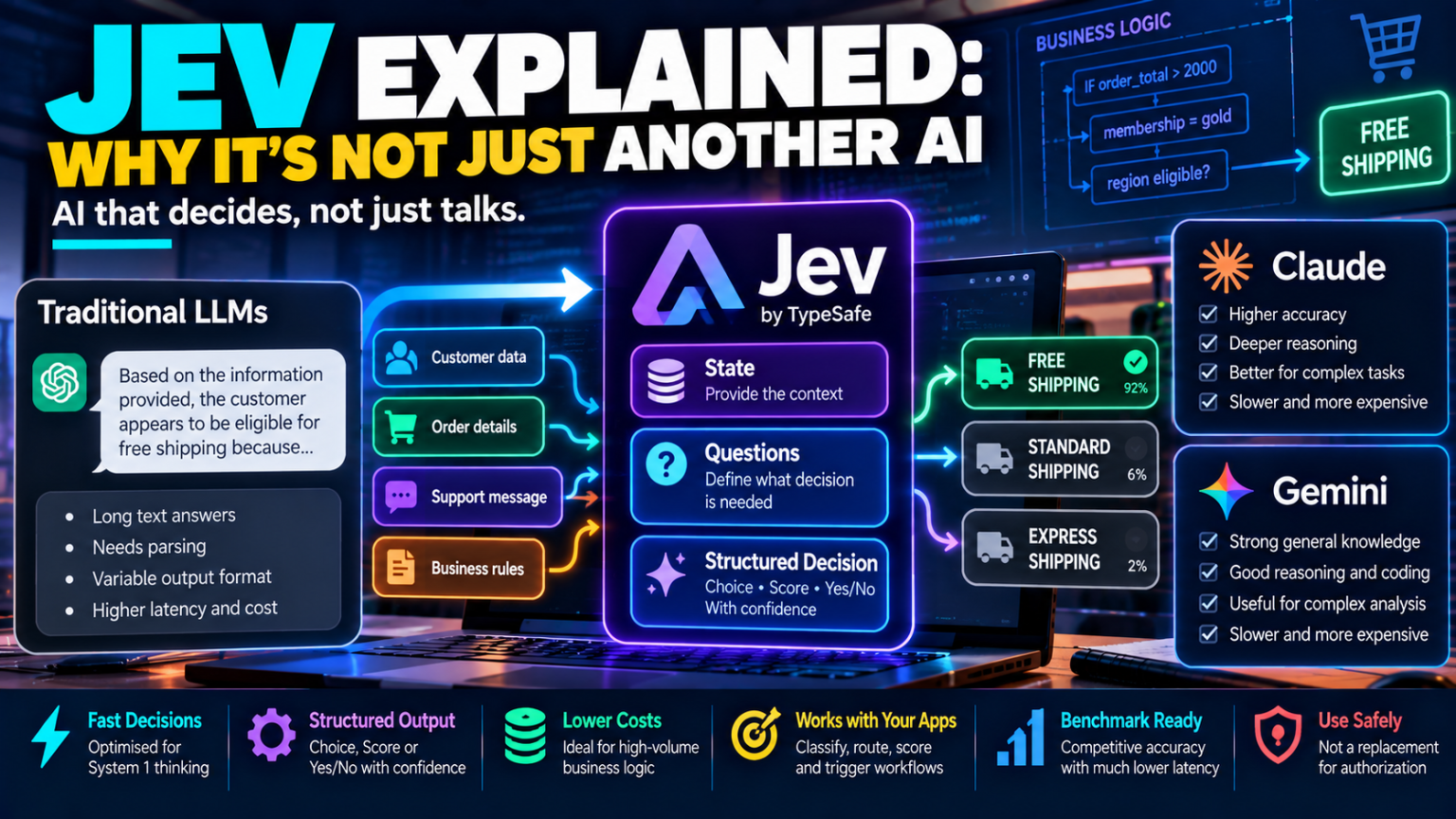
Instead of writing a response and asking your software to interpret it, Jev accepts information about a situation and returns a decision in a predefined format. It is designed for tasks such as classifying support tickets, routing requests, scoring risk, and deciding which workflow should run next.
TypeSafe calls this approach a System One model. Its central idea is simple: not every software decision needs a long reasoning process or a generated paragraph.
But does this approach actually work, and could it change how businesses build AI-powered applications?
1. The Problem With Using LLMs for Business Logic
Large language models (LLMs) are excellent at handling open-ended tasks. They can understand natural language, write code, summarize documents, and interpret complicated instructions.
However, integrating them into business software creates a challenge.
Applications generally need predictable outputs, not creative answers.
Imagine an online store that uses an AI model to categorize customer requests. The application expects one of three values:
REFUNDSHIPPINGTECHNICAL_SUPPORT
A conventional LLM might return something like:
“Based on the customer’s message, this appears to be a shipping-related issue.”
That answer may be correct, but the application must still extract the intended category. If the model changes its wording, adds an unexpected explanation, or produces an invalid value, additional parsing and validation are required.
This creates more code, more latency, and more opportunities for errors.
Jev takes a different approach. You define the possible answers in advance, and the model selects from that answer space.
The output is designed for software consumption rather than human conversation.
This makes Jev particularly interesting for applications that repeatedly make small decisions at scale. It does not replace a general-purpose LLM; it targets a different part of the problem.
2. A Simple Example: Free Shipping Rules
Consider an online store that offers free shipping to selected customers.
Its rules might depend on several factors:
- The order total.
- The customer’s membership level.
- Whether the destination is eligible.
- Whether the order contains restricted products.
Traditional software handles clearly defined rules well. For example, if free shipping applies to all orders above ₹2,000, a simple conditional statement is sufficient.
But real business decisions can become less straightforward.
Suppose the store also wants to understand whether a customer qualifies for a special shipping promotion based on a campaign description, a support message, or an ambiguous exception.
A conventional LLM could interpret the context, explain its reasoning, and return a proposed decision. The application would then need to validate that response.
With Jev, the developer could provide the order and customer information as the state, then ask a structured question such as:
Which shipping option best matches the applicable promotion?
The available answers might be FREE_SHIPPING, STANDARD_SHIPPING, and EXPRESS_SHIPPING.
Jev returns a structured choice and associated probability information. The application can then decide what to do.
There is an important distinction here: Jev should not replace ordinary deterministic rules when those rules are already clear.
The better design is to use conventional code for exact requirements, Jev for ambiguous classification or judgment, and server-side validation before applying the final decision.
For example, even if Jev recommends free shipping, your application should independently verify the order value, promotion dates, customer eligibility, and other mandatory conditions.
That combination can make business logic more flexible without surrendering control to an AI model.
3. Thinking Fast and Slow: System 1 vs System 2
Jev’s name for its approach comes from the distinction between fast and slow thinking popularized by psychologist Daniel Kahneman in Thinking, Fast and Slow.
The comparison is useful, although it is an analogy rather than a literal description of how an AI model thinks.
System 1-style AI is intended for quick, focused judgments. Examples include:
- Classifying a support ticket.
- Choosing an appropriate workflow.
- Scoring the urgency of an incident.
- Selecting a category from a predefined list.
- Evaluating whether a request should be escalated.
System 2-style AI represents the more deliberate reasoning workflows commonly associated with advanced LLMs. These can be useful for writing software, analyzing complex documents, planning multi-step tasks, or explaining a difficult decision.
The distinction is not that one is intelligent and the other is not. It is that they are optimized for different jobs.
A useful architecture could combine both:
- Jev classifies an incoming request.
- Your application checks the returned decision and its confidence signals.
- Straightforward requests follow an existing workflow.
- Uncertain or complicated requests go to a more capable LLM or a human reviewer.
This approach could reduce unnecessary calls to expensive models while preserving access to deeper reasoning when needed.
4. How Jev Actually Works: State and Questions
Jev’s design revolves around two main concepts: state and questions.
State: What is happening?
The state contains the information the model needs to evaluate. It could include a customer message, an order record, an incident report, or a structured JSON object containing several relevant fields.
Questions: What decision is needed?
Instead of requesting a free-form answer, the developer defines questions with a specific response type.
Jev supports structured question types such as:
- Choice: Select from a predefined set of options.
- Score: Evaluate something against an ordered scale.
- Noul: Answer a yes-or-no-style question using a probability signal.
The application defines the answer space and the criteria used to interpret the question. Jev evaluates the supplied state and returns structured results.
Multiple questions can be submitted together, allowing an application to evaluate related decisions in a single request rather than chaining many independent calls.
TypeSafe also describes a specialized training approach called Reinforcement Learning for Calibrated Decisions (RLCD), alongside an inference stack designed for efficient decision-making.
This is the architectural difference that makes Jev interesting: it does not need to generate a long explanation when the application only needs a category, score, or bounded decision.
For technical details, see TypeSafe’s official introduction to Jev.
5. Benchmarking Jev Against Claude and Gemini

Speed and cost matter, but they mean little if a model makes too many incorrect decisions.
A useful comparison must consider at least three factors:
- Accuracy: How often does the model select the correct answer?
- Latency: How long does each decision take?
- Cost: How much does the workload cost at realistic volume?
One published independent comparison comes from OpenRouter’s Jev vs. Claude Opus 5 benchmark.
The test used 3,080 customer-support utterances from the Banking77 dataset, classifying them into 77 banking intents.
| Metric | Jev 1.13 | Claude Opus 5 |
|---|---|---|
| Accuracy | 81.0% | 84.4% |
| Macro-F1 | 80.5% | 83.6% |
| Median latency | 175 ms | 2,266 ms |
| 95th-percentile latency | 270 ms | 3,004 ms |
| Cost per 1,000 requests | $0.11 | $2.42 |
Source: OpenRouter’s published benchmark. Costs and latency reflect its particular test setup, including prompt caching for Claude Opus 5.
The results show a real trade-off. Claude Opus 5 was more accurate on this dataset, leading by 3.4 percentage points in the reported accuracy figures, while Jev was approximately 13 times faster at the median and cost roughly 22 times less per thousand requests.
The benchmark also explored a hybrid approach: accept Jev’s decisions when its confidence signal exceeds a chosen threshold and send uncertain cases to Claude. In that test, a threshold of 0.90 achieved 84.0% accuracy at $0.69 per thousand requests—close to Opus’s 84.4% at a much lower cost.
What about Gemini?
There is no single meaningful accuracy number for comparing Jev with Gemini across every task. Results depend on the Gemini model, prompt, dataset, answer format, and evaluation method.
TypeSafe publishes its own workflow evaluations, but those should be distinguished from independent, task-specific comparisons. Its launch article and evaluation notes explain the methodology and acknowledge limitations in its comparisons.
The sensible conclusion is not that Jev universally beats Claude or Gemini. It is that a specialized decision model may offer a compelling speed-and-cost advantage on well-defined tasks, while general-purpose models can retain an accuracy or reasoning advantage on particular workloads.
Before choosing a model, test all candidates on representative examples from your own application.
6. Calibration: What Does 80% Confidence Actually Mean?
Confidence is one of Jev’s most important features, but it is also easy to misunderstand.
In a perfectly calibrated system, predictions assigned an 80% probability would be correct approximately 80% of the time across a sufficiently large, representative set of comparable cases.
That does not mean an individual prediction is guaranteed to be correct, nor does it mean every output labelled with 80% confidence has an 80% chance of success in every business environment.
The distinction between probability and confidence matters. Jev can return probability distributions for choices, while its confidence signal describes aspects of the model’s certainty. These values should not automatically be treated as interchangeable.
OpenRouter’s benchmark found that Jev’s confidence was useful for ranking predictions by reliability, but was not a perfectly calibrated probability of correctness in that particular evaluation.
For example, high-confidence predictions were substantially more accurate in the test, making confidence-based routing useful. However, the appropriate threshold will vary with the task, the data, and the cost of making a mistake.
A practical implementation should:
- Test confidence against labelled examples from your own business.
- Measure accuracy separately for different categories.
- Choose thresholds based on the consequences of errors.
- Route uncertain cases to a stronger model or human reviewer.
- Re-evaluate performance when customer behaviour or business rules change.
Confidence is a signal to validate—not a guarantee.
7. OpenRouter’s Benchmark: Jev vs. Claude Opus 5
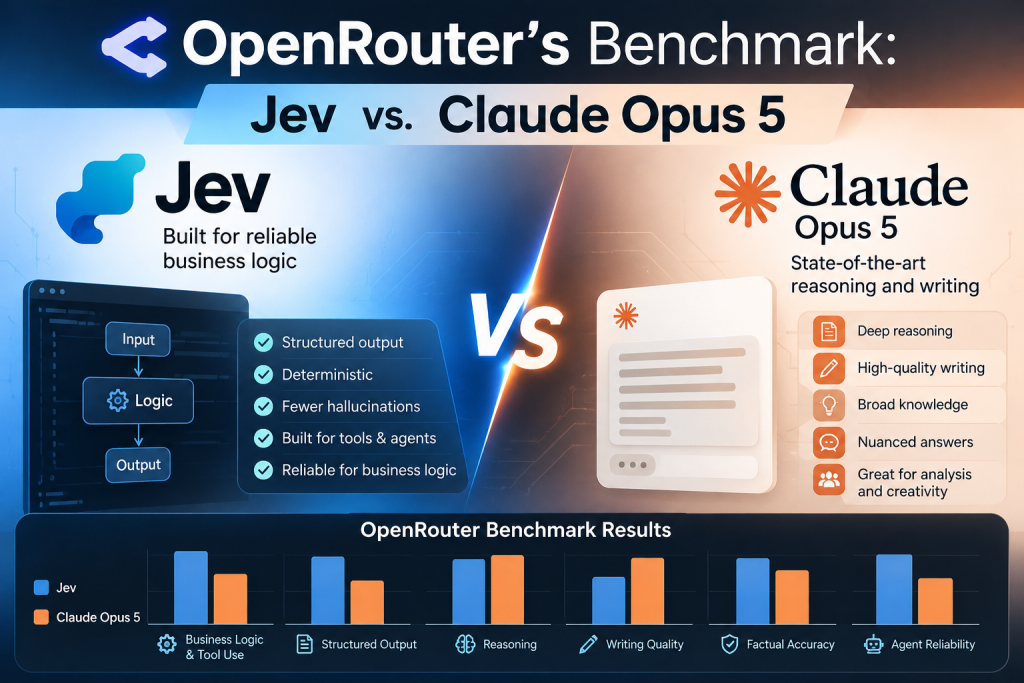
The OpenRouter results provide a useful example of why specialized models deserve attention.
On the Banking77 classification task, Jev classified 3,080 customer-support messages at a cost of $0.34 for the complete run. Claude Opus 5 cost $7.44 under the benchmark’s cached-prompt configuration.
That is a meaningful difference for workloads that process thousands or millions of requests.
However, accuracy still matters. Jev achieved 81.0%, compared with 84.4% for Opus. Neither model was perfect, and the benchmark recorded incorrect labels rather than malformed responses.
The hybrid strategy is particularly interesting because it allows an application to use Jev for easy cases and escalate uncertain cases to Opus. In OpenRouter’s test, this brought the final accuracy close to the more expensive model while reducing cost.
This is potentially more useful than asking which model is universally best. Businesses can build systems where a fast model handles routine decisions and a more capable model is reserved for difficult ones.
The results should still be interpreted within their scope. They do not prove that Jev will be cheaper or more accurate for every classification problem, and they do not establish performance on unrelated tasks such as complex reasoning or authorization.
Read the full methodology and results in OpenRouter’s benchmark report.
8. The Safety Warning: Don’t Use Jev as Authorization
Jev can help a software system evaluate a request, classify risk, or recommend an action. That does not make it a replacement for an authorization system.
Consider a banking application that asks an AI model whether a transaction looks suspicious. The model might return a low-risk classification with high confidence.
The application must still enforce account permissions, transaction limits, identity verification, fraud controls, and applicable regulatory requirements.
The same principle applies to other systems:
- A model can classify a user as eligible for a promotion, but code must enforce the actual eligibility rules.
- A model can assess whether a tool call looks safe, but the application must enforce tool permissions.
- A model can recommend approving a request, but the relevant policy and approval workflow must determine whether it can proceed.
- A model can flag content for review, but the surrounding system must implement moderation policy and escalation.
Why? Because structured output does not equal correct output. A response can be perfectly valid according to its schema and still be factually wrong or inappropriate for the situation.
For sensitive operations, keep authorization in deterministic application code, use least-privilege permissions, validate every action server-side, and require human approval where the consequences justify it.
Jev’s structured decisions may help applications make better-informed choices. They should not become the sole authority controlling money, access, security, or other high-impact actions.
Conclusion: Jev Is a Different Way to Use AI
Jev is interesting because it challenges the assumption that every AI task needs a model that generates text.
Many software workflows need decisions more often than they need explanations. Classifying a ticket, selecting a queue, scoring urgency, or choosing a next step may be better served by a model designed specifically for structured outputs.
The early benchmark results suggest that Jev can deliver substantial speed and cost advantages on certain decision tasks, although accuracy remains task-dependent and the model is not a universal replacement for Claude, Gemini, or other general-purpose LLMs.
The strongest architecture may combine the approaches: conventional code for hard rules and permissions, Jev for fast structured judgments, and a general-purpose LLM or human reviewer for complex cases.
The bigger idea is simple: the future of AI software may not depend on making every model talk more. It may depend on making the right decisions faster, then giving applications the controls to act safely.