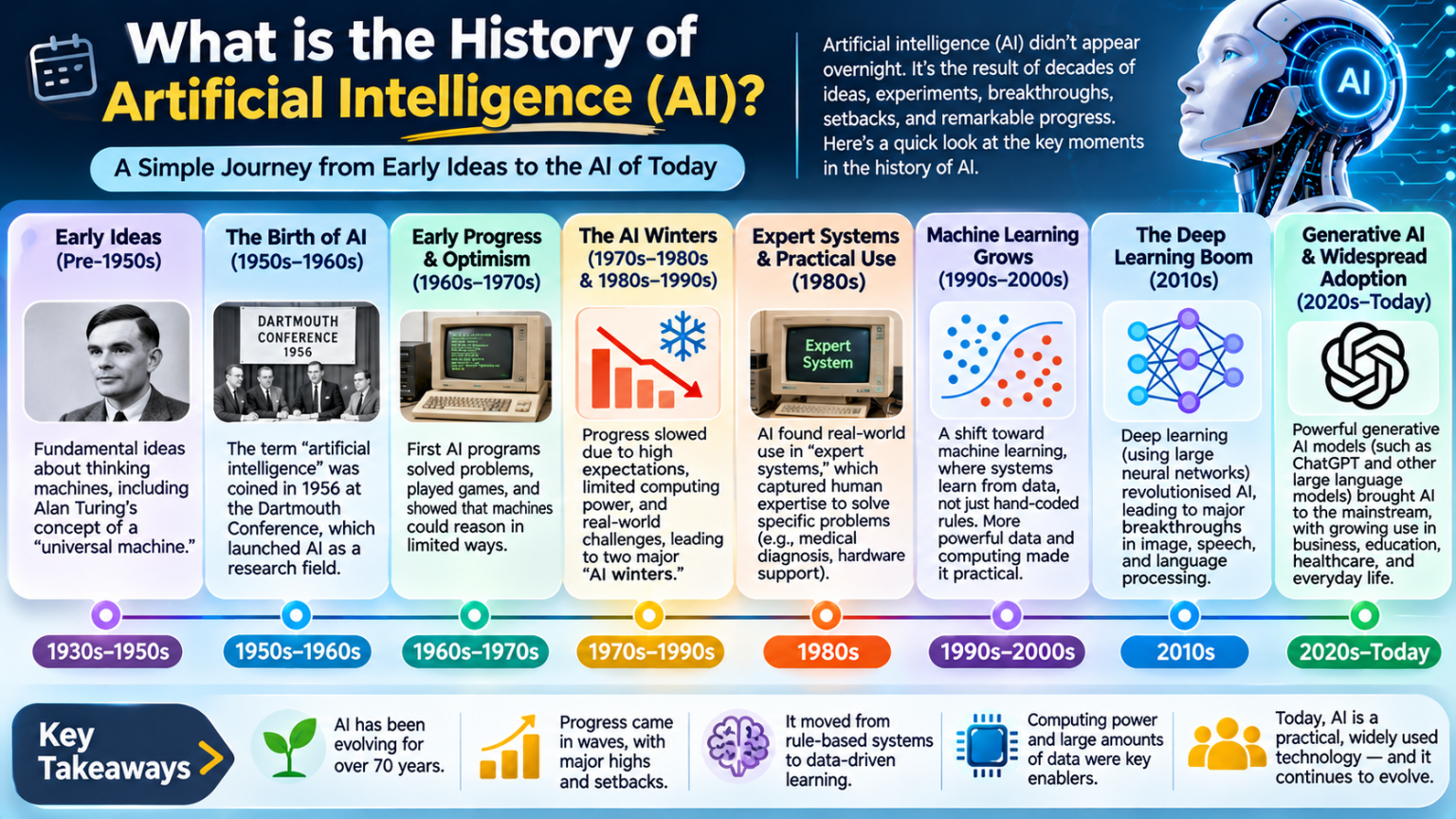
What Is the History of Artificial Intelligence (AI)? A Journey from Early Ideas to Modern AI
Introduction
Artificial intelligence (AI) has become one of the most talked-about technologies in the world. From ChatGPT and AI image generators to self-driving vehicles and intelligent business automation, AI is changing how people work, communicate, and solve everyday problems.
But AI did not appear overnight.
The idea of creating machines that can imitate human intelligence goes back much further than today’s chatbots. Researchers have spent decades trying to teach computers how to reason, learn from experience, recognise patterns, understand language, and make decisions.
Some experiments succeeded. Others failed because computers were too slow, data was limited, or the technology was not mature enough.
Over time, improvements in computing power, algorithms, and access to large amounts of data transformed AI from an experimental research subject into a technology used around the world.
In this article, we explore the history of artificial intelligence, the people behind its major breakthroughs, the rise and fall of early AI research, and how these developments eventually led to modern generative AI.
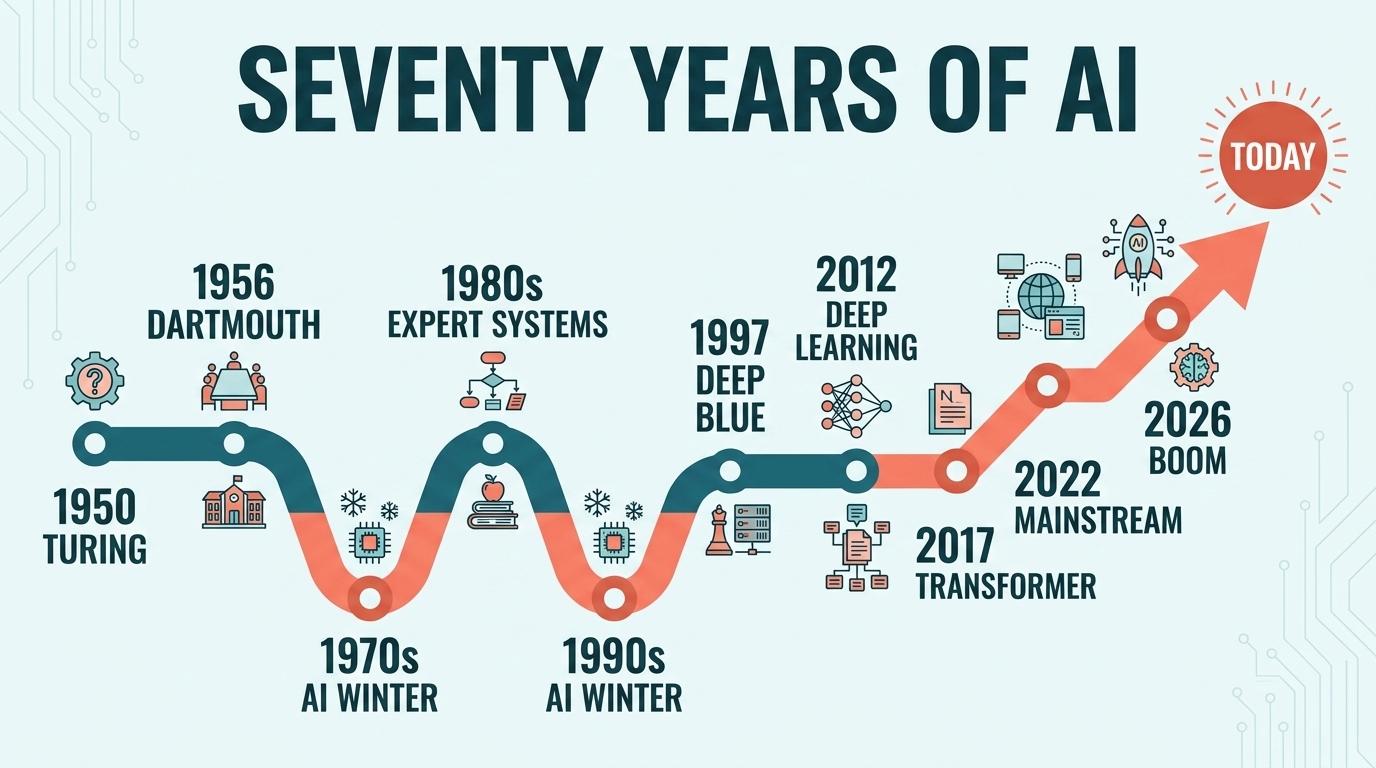
What Is Artificial Intelligence?
Artificial intelligence is a field of computer science focused on creating systems that can perform tasks commonly associated with human intelligence.
These tasks include:
- Understanding and generating language.
- Recognising images and objects.
- Learning from data.
- Solving problems.
- Making predictions.
- Identifying patterns.
- Supporting decisions.
- Planning and completing tasks.
For example, when a smartphone recognises your face, a navigation application predicts traffic, or an AI assistant answers a question, artificial intelligence is being used.
However, not all AI works in the same way. Some systems follow predefined rules, while others learn patterns from large datasets using machine-learning algorithms.
Modern AI combines several fields, including machine learning, deep learning, neural networks, natural language processing, computer vision, and generative models.
1. Before Artificial Intelligence: The Early Ideas
<text> </text>
Long before computers existed, humans imagined machines that could imitate intelligent behaviour.
Ancient stories described artificial beings, mechanical servants, and devices that could perform tasks automatically. Inventors also developed mechanical machines capable of carrying out predefined movements.
These inventions were not artificial intelligence in the modern sense, but they reflected an important ambition: creating machines that could perform activities normally associated with people.
The foundations of modern AI became more realistic during the development of mathematics, logic, neuroscience, and electronic computing.
The importance of mathematical logic
Mathematicians and philosophers explored whether human reasoning could be represented through formal rules.
If a machine could manipulate symbols and follow logical instructions, perhaps it could solve problems that previously required human reasoning.
This idea became one of the foundations of early artificial intelligence.
The development of electronic computers
During the 1940s, electronic computers demonstrated that machines could process information and perform complex calculations much faster than manual methods.
Researchers began considering whether these machines could do more than calculate numbers.
Could computers recognise patterns? Could they learn? Could they make decisions?
These questions helped prepare the ground for artificial intelligence research.
2. The 1940s: The Foundation of Artificial Neural Networks
One of the important early milestones came in 1943.
Researchers Warren McCulloch and Walter Pitts published a mathematical model describing how simplified artificial neurons could perform logical operations.
Their work helped establish the idea that networks of artificial neurons could potentially model aspects of biological brain activity.
This was an important foundation for artificial neural networks, which later became central to modern machine learning and deep learning.
Another influential contribution came from Donald Hebb, whose 1949 book The Organization of Behavior introduced ideas about how learning could occur through changes in connections between neurons.
These early theories were not modern deep-learning systems, but they helped researchers think about how machines might learn rather than simply follow fixed instructions.
3. 1950: Alan Turing Asks, “Can Machines Think?”
<text> </text>
One of the most important moments in AI history came in 1950, when British mathematician and computer scientist Alan Turing published his paper Computing Machinery and Intelligence.
Turing explored a fundamental question:
Can machines think?
Instead of trying to define thinking directly, he proposed an experiment known as the imitation game, which later became widely known as the Turing Test.
The idea was simple.
A human evaluator communicates with a human and a machine through text. If the evaluator cannot reliably distinguish the machine from the human based on their responses, the machine may be considered successful in the test.
The Turing Test became an important concept in discussions about machine intelligence and human-like conversation.
It also helped establish a direction for future AI research.
Turing’s contribution was not that he built a modern intelligent computer. Rather, he helped turn the question of machine intelligence into a serious scientific and philosophical subject.
4. 1956: The Birth of Artificial Intelligence
<text> </text>
The year 1956 is widely recognised as the beginning of artificial intelligence as a formal research field.
John McCarthy, Marvin Minsky, Nathaniel Rochester, and Claude Shannon proposed a summer research project at Dartmouth College in the United States.
The event became known as the Dartmouth Summer Research Project on Artificial Intelligence.
It brought together researchers interested in exploring whether aspects of learning and intelligence could be described precisely enough for machines to simulate them.
John McCarthy is credited with introducing the term artificial intelligence in the proposal.
The Dartmouth workshop helped establish AI as a distinct research discipline and inspired generations of computer scientists.
Why was the Dartmouth conference important?
Before this period, researchers were already exploring mathematical logic, neural networks, and computer-based problem-solving.
The Dartmouth project helped bring these ideas together under a shared research direction.
Researchers believed computers might eventually:
- Solve mathematical problems.
- Understand natural language.
- Recognise objects.
- Play strategic games.
- Learn from experience.
- Perform logical reasoning.
Some of these goals proved much harder than expected, but the research laid the foundation for the modern AI industry.
5. The 1950s and 1960s: Early AI Experiments
Following the Dartmouth conference, researchers began developing programs designed to demonstrate machine intelligence.
Some early systems focused on mathematics, while others explored games, language, and problem-solving.
The Logic Theorist
Allen Newell, Herbert Simon, and Cliff Shaw developed the Logic Theorist in the 1950s.
It was designed to prove mathematical theorems using symbolic reasoning.
The program demonstrated that computers could perform certain tasks associated with logical thinking.
Arthur Samuel’s Checkers Program
Arthur Samuel developed a checkers-playing program that could improve its performance through experience.
His research helped popularise the term machine learning.
Instead of relying entirely on manually written strategies, the program could use experience to improve its gameplay.
This was an important early example of a computer system learning from data and feedback.
ELIZA: An Early Chatbot
In the 1960s, Joseph Weizenbaum developed ELIZA, a computer program that simulated conversations with users.
One of its best-known conversational scripts imitated a psychotherapist by responding to statements with questions.
Although ELIZA did not understand language like a modern AI model, it demonstrated how simple language-processing rules could create the impression of a conversation.
It also raised important questions about how people interact with machines that appear intelligent.
6. The 1970s: The First AI Winter
Early AI researchers made ambitious predictions about how quickly machines would achieve human-like intelligence.
However, progress was slower than expected.
Computers had limited processing power and memory. Researchers also struggled with problems involving uncertainty, complex environments, and real-world knowledge.
Some AI systems worked well in small demonstrations but failed when faced with larger and more complicated problems.
Funding agencies and research organisations began questioning whether AI could deliver the promised results.
This period became known as the first AI winter.
An AI winter refers to a period when enthusiasm, funding, and investment in artificial intelligence research decline because progress does not meet expectations.
The first major AI winter developed during the 1970s, with reduced support in several research programmes.
However, AI research did not completely stop. Scientists continued working on algorithms, knowledge representation, and machine learning.
7. The 1980s: Expert Systems Bring AI into Business
During the 1980s, artificial intelligence gained renewed attention through the development of expert systems.
Unlike general-purpose intelligent machines, expert systems were designed to solve specific problems using knowledge and rules provided by human experts.
For example, an expert system could help:
- Diagnose certain medical conditions.
- Identify technical faults.
- Support financial decisions.
- Analyse industrial processes.
- Recommend equipment configurations.
A well-known example was MYCIN, an early expert system developed to assist with diagnosing bacterial infections and recommending treatments.
Expert systems demonstrated that AI could provide practical value in specialised areas.
Businesses and organisations began exploring ways to use AI for decision support and automation.
Why did expert systems become popular?
They offered a practical way to capture specialist knowledge and make it available through computer systems.
Instead of asking a human expert to solve every problem, an organisation could encode relevant knowledge and rules into software.
However, expert systems also had limitations.
They depended heavily on manually maintained rules and could struggle when information was incomplete, unexpected, or outside their original design.
The cost of developing and maintaining these systems eventually became a major challenge.
8. The Late 1980s and Early 1990s: The Second AI Winter
As the excitement surrounding expert systems grew, expectations once again became too high.
Some commercial AI projects were expensive and difficult to maintain. Specialised hardware markets weakened, and several ambitious research projects failed to meet their objectives.
Investment and interest declined.
This period is commonly referred to as the second AI winter.
Despite these setbacks, research continued in machine learning, neural networks, probability, statistical methods, and computer vision.
These developments would later become important building blocks for modern AI.
9. 1997: IBM Deep Blue Defeats Garry Kasparov
<text> </text>
One of the most famous milestones in AI history occurred in May 1997.
IBM’s Deep Blue computer defeated world chess champion Garry Kasparov in a six-game match.
Deep Blue could evaluate enormous numbers of possible chess positions and use specialised chess-search techniques to select its moves.
The victory demonstrated the power of specialised computing systems in solving complex strategic problems.
However, Deep Blue was not a general-purpose intelligent system. It was designed specifically to play chess.
Its achievement showed that computers could outperform top human players in a highly structured task.
The event also brought artificial intelligence into the public spotlight.
10. The 2000s: More Data and More Computing Power
The early 2000s marked an important period of development.
The internet expanded rapidly, digital information became more widely available, and computer hardware continued improving.
Researchers gained access to larger datasets and more powerful processors.
These developments made it increasingly practical to train machine-learning models for tasks such as:
- Spam detection.
- Search engine ranking.
- Recommendation systems.
- Speech recognition.
- Image classification.
- Fraud detection.
- Predictive analytics.
AI became part of everyday digital services, even when users did not realise they were interacting with it.
For example, recommendation systems could suggest videos, products, or music based on user behaviour.
Email services could identify spam, and search engines could improve the relevance of their results.
AI was becoming a practical technology rather than only an academic research subject.
11. 2011: IBM Watson Wins Jeopardy!
In February 2011, IBM Watson competed against former champions on the television quiz show Jeopardy!.
Watson won the competition, demonstrating its ability to process natural-language questions, search information, evaluate possible answers, and respond under time pressure.
The achievement was significant because the questions involved wordplay, clues, and contextual understanding.
Watson was not a modern conversational AI model, but it demonstrated how several AI techniques could be combined to solve complex information-processing problems.
It also attracted attention from industries interested in using AI for knowledge discovery and decision support.
12. 2012: Deep Learning Changes AI Research
<text> </text>
One of the most important turning points in modern AI occurred in 2012.
A deep-learning system known as AlexNet achieved a major result in the ImageNet Large Scale Visual Recognition Challenge.
Developed by Alex Krizhevsky, Ilya Sutskever, and Geoffrey Hinton, AlexNet used a deep convolutional neural network to classify images.
Its performance demonstrated the potential of deep neural networks when combined with large datasets and powerful graphics processing units (GPUs).
This breakthrough helped accelerate research in deep learning.
What is deep learning?
Deep learning is a branch of machine learning that uses artificial neural networks with multiple layers.
These networks can learn increasingly complex patterns from data.
For example, an image-recognition system may learn to identify:
- Basic edges and shapes.
- Textures and patterns.
- Parts of objects.
- Complete objects and scenes.
Deep learning became especially important in image recognition, speech processing, natural language processing, and other AI applications.
13. 2016: AlphaGo Defeats Lee Sedol
In March 2016, DeepMind’s AlphaGo defeated professional Go player Lee Sedol in a five-game match.
Go is a board game with an enormous number of possible positions, making it difficult to solve using traditional brute-force approaches alone.
AlphaGo combined neural networks, search techniques, and reinforcement learning.
Its victory was an important demonstration of how machine-learning systems could develop strategies for complex problems.
The achievement showed that AI was progressing beyond traditional rule-based programming.
14. 2017: The Transformer Architecture
Another major milestone came in 2017 with the research paper Attention Is All You Need.
The paper introduced the Transformer architecture, which uses an attention mechanism to process relationships between elements in a sequence.
Transformers made it more practical to train large language models and process long sequences of text efficiently.
This architecture became the foundation for many modern AI systems.
It influenced the development of models used for:
- Text generation.
- Language translation.
- Summarisation.
- Question answering.
- Code generation.
- Conversational AI.
Without the Transformer architecture, the development of today’s large language models would likely have followed a very different path.
15. 2018–2020: Large Language Models Become More Powerful
The late 2010s and early 2020s saw rapid progress in large language models.
OpenAI introduced GPT-1 in 2018, demonstrating the potential of generative pre-training for language tasks.
GPT-2 followed in 2019, showing improved abilities in generating coherent text.
In 2020, GPT-3 attracted significant attention because of its scale and ability to perform a wide range of language tasks using prompts.
These developments helped establish large language models as an important direction in AI research.
Other organisations, including Google, Meta, and various research groups, also developed increasingly capable language models.
The focus was shifting from systems designed for one specific task towards more general models that could perform many different language-related activities.
16. 2022: ChatGPT Brings Generative AI to the Mainstream
<text> </text>
A major public turning point occurred on November 30, 2022, when OpenAI released ChatGPT as a research preview.
Unlike traditional software interfaces, ChatGPT allowed people to interact with an AI system through ordinary conversation.
Users could ask questions, request explanations, write emails, generate code, summarise documents, and explore ideas.
Its accessible interface helped introduce generative AI to millions of people.
ChatGPT was built on the GPT family of large language models and used conversational training techniques to make interactions more useful.
Its popularity also encouraged businesses to explore AI-powered applications.
What is generative AI?
Generative AI refers to AI systems that can create new content based on patterns learned from training data.
Depending on the model, this content may include:
- Text.
- Images.
- Audio.
- Video.
- Computer code.
- Music and other media.
Generative AI changed the public perception of artificial intelligence because people could directly interact with systems capable of producing useful and creative content.
17. 2023–2024: The Generative AI Competition Accelerates
Following ChatGPT’s success, technology companies rapidly expanded their AI products and research.
Google introduced Gemini, Anthropic developed Claude, Meta released Llama models, and Microsoft expanded its AI-powered services.
Image-generation tools also became increasingly popular.
Examples included:
- OpenAI’s DALL·E.
- Midjourney.
- Stable Diffusion.
- Adobe Firefly.
These tools allowed users to generate images from written descriptions.
AI coding assistants also became more capable, helping developers write, explain, and troubleshoot code.
Businesses began integrating AI into customer support, document processing, marketing, software development, analytics, and productivity applications.
The conversation was no longer limited to whether AI could generate text. Organisations were increasingly interested in how AI could become part of their everyday workflows.
18. 2025–2026: Reasoning Models, AI Agents, and Connected Tools
The development of AI continued beyond conversational systems.
Modern AI applications increasingly combine language models with reasoning capabilities, external tools, retrieval systems, and automation.
Several important trends are shaping this period.
Reasoning-focused AI models
Newer model architectures and training methods aim to improve performance on complex problems involving mathematics, programming, analysis, and multi-step reasoning.
These systems can spend additional computation on difficult tasks rather than simply producing an immediate response.
AI Agents
AI Agents can use tools, plan tasks, and coordinate multiple steps to achieve a goal.
For example, an AI Agent might investigate a server alert, retrieve monitoring information, consult technical documentation, and prepare a troubleshooting report.
Model Context Protocol (MCP)
MCP provides a standard way for compatible AI applications to connect to external tools and services.
It can help AI applications interact with databases, APIs, files, and business systems through MCP servers.
Retrieval-Augmented Generation (RAG)
RAG allows AI applications to retrieve relevant information from external knowledge sources before generating an answer.
This is useful when an AI assistant needs access to company documents, product information, internal policies, or other specialised data.
Multimodal AI
Modern AI models increasingly work with multiple types of information, including text, images, audio, and video.
This makes AI more useful for tasks such as visual analysis, voice interaction, document understanding, and media generation.
These developments suggest that AI is becoming more than a tool for generating answers. It is increasingly becoming part of software applications that interact with real business systems.
19. A Complete Timeline of Artificial Intelligence
Here is a quick overview of some of the most important milestones in AI history.
| Year / Period | Important milestone |
|---|---|
| 1943 | McCulloch and Pitts publish their mathematical model of artificial neurons |
| 1949 | Donald Hebb publishes influential ideas about learning and neural connections |
| 1950 | Alan Turing publishes Computing Machinery and Intelligence |
| 1956 | Dartmouth conference helps establish AI as a research field |
| 1950s–1960s | Early AI programs explore logic, games, and language |
| 1960s | ELIZA demonstrates early conversational software |
| 1970s | First major AI winter |
| 1980s | Expert systems gain commercial attention |
| Late 1980s–early 1990s | Second AI winter |
| 1997 | IBM Deep Blue defeats Garry Kasparov |
| 2000s | Machine learning becomes increasingly practical |
| 2011 | IBM Watson wins Jeopardy! |
| 2012 | AlexNet accelerates the deep-learning revolution |
| 2016 | AlphaGo defeats Lee Sedol |
| 2017 | Transformer architecture is introduced |
| 2018 | OpenAI introduces GPT-1 |
| 2020 | GPT-3 demonstrates powerful language-generation capabilities |
| 2022 | ChatGPT brings generative AI to mainstream users |
| 2023–2024 | Generative AI adoption expands rapidly |
| 2025–2026 | Reasoning models, AI Agents, MCP, and multimodal AI continue developing |
This timeline highlights an important point: modern AI is the result of decades of research rather than a sudden technological invention.
20. Why Did Artificial Intelligence Take So Long to Develop?
If researchers began exploring AI in the 1950s, why did it take so many decades for modern AI tools to become widely available?
There are several reasons.
Limited computing power
Early computers were expensive, large, and slow compared with today’s hardware.
Training sophisticated AI models requires substantial processing resources.
Modern CPUs, GPUs, specialised AI accelerators, and cloud infrastructure have made much larger experiments possible.
Lack of large datasets
Many early AI systems had limited access to digital information.
Modern AI benefits from enormous collections of text, images, audio, video, and other data.
Improvements in algorithms
Research into neural networks, backpropagation, deep learning, attention mechanisms, and reinforcement learning gradually improved the capabilities of AI systems.
Better storage and networking
The growth of the internet and cloud computing made it easier to store, process, and access large datasets.
Increased investment
As AI began demonstrating practical commercial value, businesses, governments, and technology companies invested more heavily in research and infrastructure.
Together, these developments helped transform AI from a specialised research field into a widely used technology.
21. How Artificial Intelligence Is Used Today
Artificial intelligence is now part of many industries.
Healthcare
AI can assist with medical image analysis, clinical research, administrative work, and decision-support systems.
It supports healthcare professionals but does not replace the need for qualified medical judgement.
Education
AI-powered applications can explain difficult subjects, support language learning, create study materials, and help teachers prepare educational content.
Banking and finance
Financial institutions use AI for fraud detection, risk analysis, customer support, and transaction monitoring.
E-commerce
Online stores use AI for product recommendations, customer service, demand forecasting, and inventory analysis.
Web hosting and IT infrastructure
Hosting companies can use AI to analyse monitoring alerts, investigate unusual server behaviour, summarise logs, and support technical teams.
Software development
AI coding assistants can help developers generate code, understand unfamiliar projects, write tests, and investigate errors.
Marketing and content creation
Businesses use AI to brainstorm ideas, prepare content drafts, analyse customer trends, and create marketing visuals.
The applications continue to expand as models and supporting technologies improve.
22. What Can We Expect from the Future of AI?
Artificial intelligence is still developing, and its future will depend on research breakthroughs, computing infrastructure, regulation, safety, and how organisations choose to use it.
Some important areas to watch include:
More capable AI Agents: Systems that can complete longer workflows using tools and external applications.
Improved reasoning: Better performance on complex technical, scientific, and analytical tasks.
Multimodal systems: AI that can understand and work with text, images, speech, and video together.
Personalised AI assistants: Applications that can adapt to individual workflows and preferences while respecting privacy.
AI in robotics: Systems that combine perception, planning, and physical movement.
Enterprise AI: More businesses connecting AI to internal databases, applications, and knowledge systems.
However, AI also raises important challenges involving privacy, copyright, misinformation, security, bias, employment, and accountability.
The future of AI will depend not only on making models more powerful but also on making them reliable, transparent, and safe.
Frequently Asked Questions About the History of AI
When was artificial intelligence invented?
AI developed over several decades. Its mathematical and computing foundations emerged earlier, but 1956 is widely recognised as the formal beginning of artificial intelligence as a research field because of the Dartmouth Summer Research Project.
Who is considered the father of artificial intelligence?
John McCarthy is frequently called the father of artificial intelligence because he coined the term and helped organise the 1956 Dartmouth conference. However, AI was developed through contributions from many researchers, including Alan Turing, Marvin Minsky, Claude Shannon, Allen Newell, Herbert Simon, and others.
What was the first AI program?
There is no single universally agreed first AI program because early research included different kinds of systems. The Logic Theorist, developed by Allen Newell, Herbert Simon, and Cliff Shaw in the 1950s, is widely recognised as one of the earliest significant AI programs.
What was the first AI chatbot?
ELIZA, created by Joseph Weizenbaum in the 1960s, is one of the earliest and most famous conversational computer programs.
What is an AI winter?
An AI winter is a period when funding, investment, and interest in artificial intelligence research decline because the technology fails to meet expectations.
When did machine learning become popular?
Machine learning developed over many decades, but its practical adoption expanded significantly during the 2000s and 2010s as computing power, data availability, and algorithms improved.
When did generative AI become popular?
Generative AI became widely known among the public following the launch of ChatGPT in November 2022, although the underlying research and technology existed much earlier.
Is modern AI the same as human intelligence?
No. Modern AI systems can perform impressive tasks, but their capabilities and limitations differ from human intelligence. They can generate incorrect information, misunderstand context, and make mistakes.
Conclusion
The history of artificial intelligence is a story of curiosity, experimentation, setbacks, and technological breakthroughs.
From Alan Turing’s question about whether machines could think to the Dartmouth conference in 1956, early AI researchers laid the foundations for a field that would eventually transform modern computing.
The first AI winters showed that ambitious promises were not enough. Progress required better algorithms, more powerful computers, larger datasets, and practical applications.
Breakthroughs such as IBM Deep Blue, AlexNet, AlphaGo, the Transformer architecture, and modern large language models helped move AI into the mainstream.
Today, artificial intelligence is used in everything from smartphones and online shopping to software development, healthcare, education, and business automation.
What began as an ambitious research idea has become one of the most important technologies of our time.
The history of AI is not finished. We are still watching the next chapter unfold.
Further Reading and References
- IBM: The History of Artificial Intelligence
- OECD: Artificial Intelligence in Society
- Alan Turing: Computing Machinery and Intelligence
- Dartmouth: Artificial Intelligence Project
- Cloudflare: History of Artificial Intelligence
- Google Research: Attention Is All You Need
- OpenAI: Introducing ChatGPT
This article is an educational overview of the history and development of artificial intelligence. Dates and milestones are presented as a simplified timeline; AI research developed through many overlapping contributions rather than a single sequence of inventions.