Data Centre Industry in India Till 2026: Growth, Investments, AI and Future Opportunities
India’s data centre industry is experiencing one of its most significant growth periods in 2026. Rapid cloud adoption, artificial intelligence (AI), digital payments, online services and enterprise digital transformation are driving demand for the infrastructure that stores, processes and protects data.
With global technology companies announcing major investments and the government introducing incentives for cloud infrastructure, India is positioning itself as an important destination for data centres in Asia. However, power availability, water consumption, land costs and environmental concerns remain major challenges.
1. India’s data centre industry in 2026: Market overview
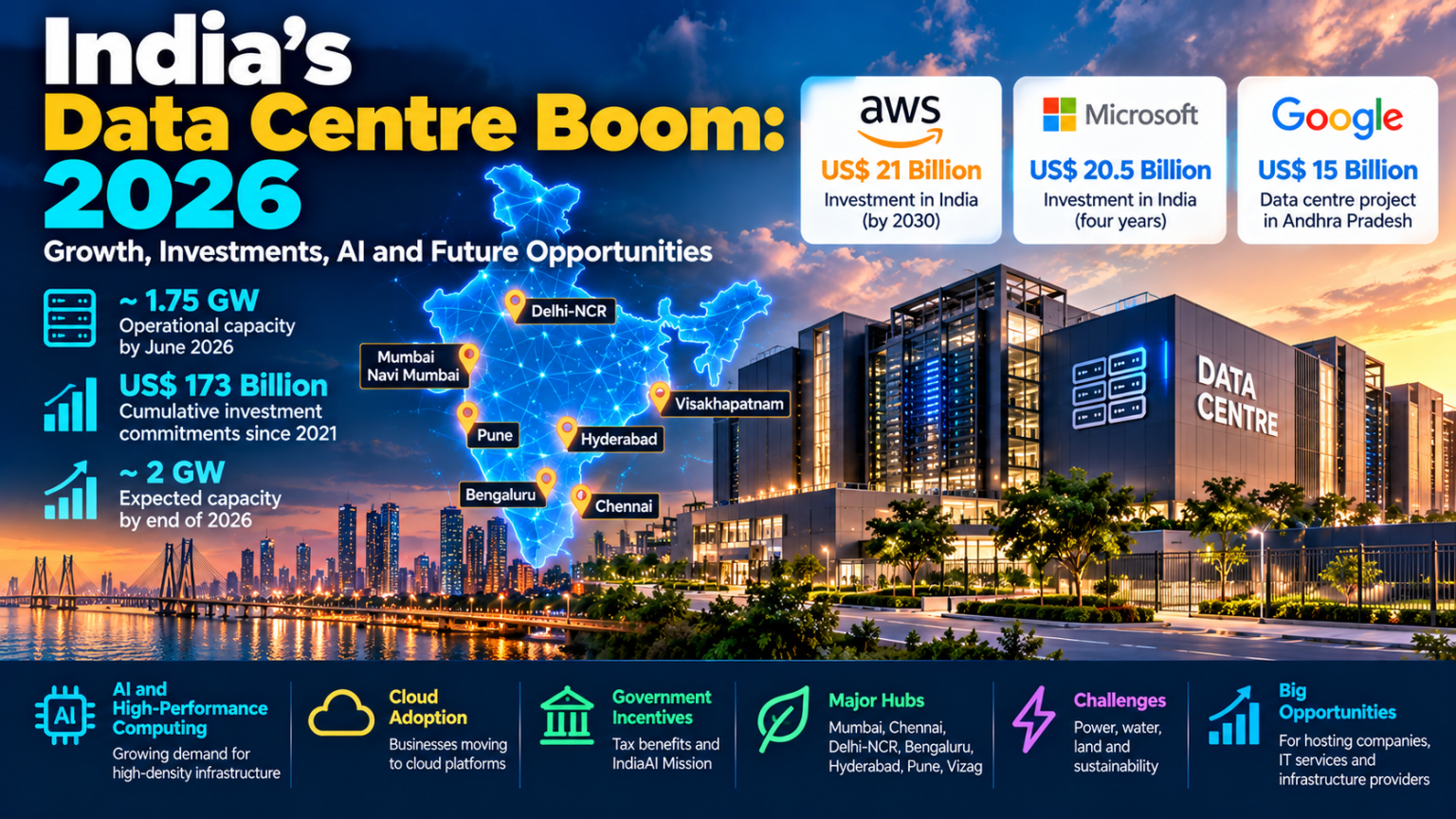
India’s operational data centre capacity reached approximately 1.75 GW by the end of June 2026, according to CBRE’s mid-year market update. The country added around 130 MW during the first half of the year, and further capacity additions could take the market to approximately 2 GW by the end of 2026.
CBRE also reported that cumulative data centre investment commitments since 2021 had reached approximately US$173 billion by the end of the first half of 2026, including about US$38 billion announced during H1 alone.
These figures highlight strong investor interest, but investment commitments should not be confused with money already spent or facilities already operational.
According to CBRE’s 2026 India Data Centre Market Monitor, India has moved into the leading-market category in Asia-Pacific, reflecting the expansion of its operating capacity and development pipeline.
2. What is driving the growth?
Several technology and business trends are creating demand for additional data centre capacity.
Artificial intelligence and high-performance computing
AI applications require substantial computing power, fast networking and specialised hardware such as GPUs. Training and running AI models can require far more power and cooling than traditional enterprise workloads.
As Indian companies adopt AI and global providers expand their infrastructure, demand is growing for high-density server racks, advanced cooling systems and facilities designed for large computing workloads.
Cloud computing
Businesses increasingly use cloud platforms instead of operating all their IT infrastructure on-premises. Banking, e-commerce, healthcare, software development and enterprise applications depend on reliable cloud infrastructure.
This creates opportunities for hyperscale cloud facilities, colocation providers and companies supplying servers, storage, networking and managed services.
Digital India and data-intensive services
UPI payments, streaming platforms, online education, digital government services and connected devices generate continuous demand for data processing and storage.
The National Informatics Centre operates national data centres in locations including Delhi, Pune, Hyderabad and Bhubaneswar, supporting government digital services.
3. Major data centre hubs in India
India’s market is concentrated in a few established locations, although new investment is expanding the geographic footprint.
- Mumbai and Navi Mumbai: India’s principal data centre hub, benefiting from connectivity, subsea cable access, financial services and an established operator ecosystem. CBRE estimates Mumbai accounts for around 52% of operational capacity.
- Chennai: An important connectivity hub with international subsea cable links, making it attractive for cloud platforms, network operators and businesses requiring international connectivity.
- Delhi-NCR: Supports government, enterprise, financial services and domestic cloud requirements.
- Bengaluru: Benefits from India’s technology industry, software companies, startups and demand for cloud and AI services.
- Hyderabad: Attracts large infrastructure developments and benefits from its technology ecosystem and state-level investment policies.
- Pune: An established enterprise and technology market with potential for additional computing infrastructure.
- Visakhapatnam: An emerging location attracting attention for its coastal connectivity potential and large-scale infrastructure proposals.
Location decisions depend on more than land prices. Power availability, fibre routes, latency, disaster risk, water access, renewable energy and proximity to customers all influence whether a project is commercially viable.
4. Major investments and global technology companies
Global technology companies are making substantial commitments to India’s digital infrastructure.
Recent announcements reported by Reuters include:
- Amazon: A planned US$21 billion investment in India through 2030, with a significant focus on AI infrastructure.
- Microsoft: A four-year US$20.5 billion investment plan for India, largely earmarked for AI data centres.
- Google: A US$15 billion data centre project in Andhra Pradesh.
These figures represent company investment plans or announced projects, not necessarily completed data centre construction. Their scope may also include supporting cloud and AI infrastructure.
Read the Reuters report on India’s AI data centre expansion for more details about these investments and the local concerns surrounding some projects.
Alongside international hyperscalers, domestic developers, colocation operators, telecommunications companies, construction firms and power infrastructure providers are important participants in the market.
5. Government policies and incentives
Government policy is helping position India as a destination for global cloud and AI infrastructure.
The Union Budget 2026–27 announced a tax-holiday framework through 2047 for eligible foreign companies providing global cloud services using data centre infrastructure located in India. The framework includes conditions, including requirements concerning eligible entities and the use of Indian resellers for domestic services.
The government has also supported the wider technology ecosystem through the IndiaAI Mission and semiconductor and electronics manufacturing initiatives.
These measures may improve India’s competitiveness by lowering the effective cost of eligible operations and supporting the supply chain needed for advanced computing.
However, tax incentives alone cannot guarantee success. Investors still need reliable electricity, clear regulatory approvals, strong connectivity, skilled workers and commercially sustainable operating costs.
For details, consult the government’s Budget 2026–27 overview of cloud and AI infrastructure.
6. Power, water and sustainability challenges
The biggest challenge facing India’s data centre expansion is ensuring that infrastructure can grow without placing excessive pressure on local resources.
Electricity demand
Data centres operate continuously, and AI facilities can have particularly high power requirements. Operators need dependable grid connections, backup systems and sufficient electrical capacity for future expansion.
Power availability can determine whether a proposed facility becomes operational on schedule.
Water consumption and cooling
Traditional cooling systems can require significant quantities of water, depending on the design and operating conditions. This is especially important in regions that already face water stress.
In October 2026, Reuters reported growing community opposition to some projects near Mumbai and in Andhra Pradesh, with residents raising concerns about electricity, water, noise and environmental impacts.
Renewable energy and efficient cooling
Operators are increasingly considering renewable electricity procurement, efficient cooling designs, advanced monitoring and, where suitable, liquid cooling for high-density computing.
Sustainable development will require more than energy-efficient equipment. Project planning must also consider local water availability, land use, community engagement and the environmental impact of supporting infrastructure.
7. Opportunities for hosting companies and IT businesses
The data centre boom creates opportunities beyond the companies that own large facilities.
Hosting and cloud providers can offer virtual private servers, dedicated servers, managed cloud services, backup and disaster recovery.
System integrators and IT service companies can provide server deployment, networking, cybersecurity, migration, monitoring and infrastructure management.
Hardware and infrastructure suppliers can serve demand for servers, storage, racks, UPS systems, power distribution, cooling equipment, fibre connectivity and security systems.
For smaller hosting businesses, the opportunity is not necessarily to build a physical data centre. Leasing capacity from a reputable colocation provider and adding managed services can be a more practical route to market.
Customers should compare uptime commitments, network quality, support response times, backup arrangements, security controls, data protection obligations and total operating costs before selecting a provider.
8. What comes next?
India’s data centre industry is expected to continue expanding as cloud services and AI workloads increase. JLL’s 2026 mid-year report projects capacity could grow from around 1.6 GW in mid-2026 to 6 GW by 2029, alongside substantial investment in computing and supporting infrastructure.
That is a forecast, not a guaranteed outcome. Actual growth will depend on construction schedules, demand, electricity availability, financing, policy execution and the ability to secure suitable sites.
The most competitive facilities will combine reliable power, strong connectivity, efficient cooling, security and operational expertise. India also needs to ensure that the economic benefits of new infrastructure are balanced against local environmental and community concerns.
Conclusion
By 2026, India’s data centre industry has moved beyond a niche real estate and hosting segment to become an important part of the country’s digital and AI strategy.
Operational capacity is approaching 2 GW, investment commitments are substantial, and global cloud companies are expanding their presence. Mumbai and Chennai remain central to the market, while Hyderabad, Bengaluru, Delhi-NCR and emerging locations offer additional opportunities.
The next phase will depend on execution. India must turn announced investments into operational facilities while addressing power, water, sustainability and connectivity challenges.
For hosting companies, IT service providers and infrastructure suppliers, this expansion creates opportunities to serve the growing demand for secure, reliable and scalable digital services.