$2.5 Billion Later, PDG Targets 1 GW in India. The Hosting Market Will Feel It.
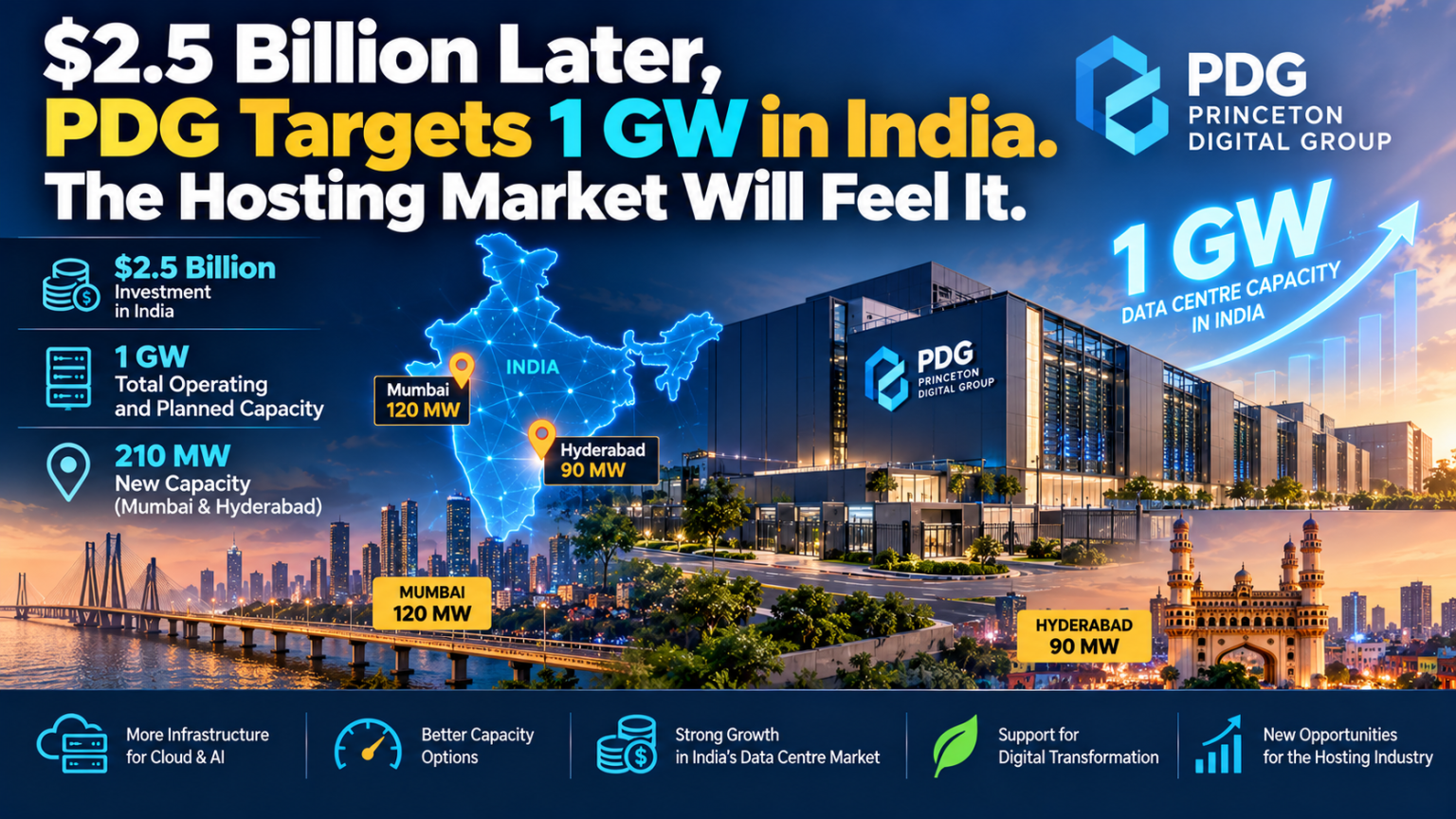
India’s data centre market is entering a new phase of expansion. Princeton Digital Group (PDG), a Singapore-headquartered data centre operator, has committed approximately $2.5 billion to India and expanded its operating and planned portfolio to around 1 gigawatt (GW).
The latest move came on March 24, 2026, when PDG announced a multi-site acquisition adding 210 megawatts (MW) of capacity across Mumbai and Hyderabad. The expansion strengthens its ability to serve hyperscalers, cloud platforms, and businesses demanding large amounts of computing infrastructure.
For hosting providers, the significance goes beyond another large investment announcement. More wholesale data centre capacity can influence where cloud infrastructure is built, how quickly providers can expand, and which markets attract the next wave of AI and enterprise workloads.
What Is Princeton Digital Group?
PDG develops and operates hyperscale data centres across Asia-Pacific. Rather than primarily selling shared hosting plans or domain registrations to individual customers, it provides large-scale infrastructure for hyperscalers and enterprise clients.
These facilities supply the physical foundations for cloud computing, AI services, data storage, and digital platforms. Customers need secure buildings, reliable electricity, cooling systems, network connectivity, and enough space to deploy thousands of servers.
PDG entered India in 2022. In September 2024, it announced an approximately $1 billion India expansion programme covering Mumbai and Chennai. Its March 2026 acquisition increased its total operating and planned Indian capacity to approximately 1 GW and its India investment commitment to around $2.5 billion.
The 210 MW Expansion: Mumbai and Hyderabad
The March acquisition adds capacity across two important data centre markets.
| Market | Planned development | Why it matters |
|---|---|---|
| Mumbai | 120 MW campus in Navi Mumbai | Access to a major financial, enterprise, and connectivity hub |
| Hyderabad | 90 MW campus | Additional capacity for cloud and AI infrastructure |
The project details were reported by Data Center Dynamics following PDG’s announcement. The company said the sites have secured power and key land approvals, helping establish a path toward delivery.
The distinction between planned and operational capacity matters. A 1 GW portfolio does not mean that all 1 GW is already built, commissioned, and available to customers. Data centre construction requires power infrastructure, cooling equipment, network connectivity, regulatory approvals, and staged commissioning.
Nevertheless, securing sites and power early can give operators an advantage when hyperscale customers need capacity on tight deployment schedules.
Why Does 1 GW Matter?
One gigawatt equals 1,000 megawatts. It is a measure of power capacity, not the amount of electricity consumed over a year.
At this scale, data centre development becomes a major infrastructure undertaking. Operators must coordinate land, grid connections, substations, backup systems, cooling, fibre connectivity, and long-term capital financing.
PDG’s India expansion also reflects a wider shift in demand. Cloud adoption, enterprise digitalisation, AI training, and inference workloads are increasing the need for facilities capable of supporting high-density computing.
For customers, more available capacity can create additional options for deploying infrastructure in India. For operators, the challenge is delivering that capacity reliably and at a competitive cost.
What Does This Mean for the Hosting Market?
PDG is primarily a wholesale infrastructure operator, not a direct replacement for conventional web hosting companies. Its expansion is therefore more likely to affect the hosting ecosystem through infrastructure availability, competition, and investment than through an immediate change in shared-hosting prices.
1. More room for cloud and enterprise growth
Additional data centre capacity can help cloud providers and large enterprises deploy infrastructure closer to Indian users. Local deployment can support latency-sensitive applications, data-management requirements, and regional expansion strategies.
Hosting providers may benefit indirectly when their upstream infrastructure partners gain access to more capacity and connectivity options.
2. AI infrastructure is changing the requirements
Traditional web hosting and high-density AI computing have different infrastructure needs. AI deployments can require specialised accelerators, higher rack power densities, advanced cooling, and substantial electrical capacity.
Operators that can support these requirements may attract customers with large and rapidly growing workloads. This also creates opportunities for networking, power-management, cooling, and server suppliers.
3. Competition will extend beyond server prices
As more infrastructure enters the market, hosting businesses will still need to compete on uptime, support, security, network quality, and predictable pricing.
A large data centre investment does not automatically reduce retail hosting prices. The effect depends on how much capacity becomes available, where it is located, its cost structure, and whether providers pass savings on to customers.
For smaller hosting companies, the practical opportunity is to evaluate infrastructure partners carefully rather than assume that hyperscale expansion will immediately make every hosting service cheaper.
The Biggest Challenge: Power, Cooling, and Delivery
Building data centres at this scale is not simply a matter of constructing server halls. Electricity availability, grid reliability, cooling efficiency, water management, and local approvals can determine whether projects meet their delivery schedules.
PDG says its approach includes renewable energy procurement, green financing structures, and facilities certified under the Indian Green Building Council’s Platinum rating. These measures are relevant as operators face growing expectations around sustainability and resource use.
However, sustainability claims must be evaluated alongside actual operating performance. Renewable energy procurement, efficient cooling, and responsible water management all matter, particularly as AI workloads increase demand for power-dense infrastructure.
The ability to secure electricity and deliver commissioned capacity on schedule may ultimately be as important as the amount of capital committed.
What Should Hosting Providers Watch Next?
Hosting companies, cloud resellers, and managed service providers should monitor three developments:
- Capacity becoming operational: Watch for commissioning milestones rather than relying only on announced gigawatt targets.
- Wholesale pricing and availability: Track how new capacity affects colocation, dedicated-server, and cloud infrastructure options.
- AI-ready infrastructure: Assess whether providers can support higher-density workloads, stronger network requirements, and changing cooling needs.
For Indian hosting businesses, the strongest strategy is to compare infrastructure partners on reliability, total cost, network performance, support, and expansion flexibility—not just headline capacity.
Final Thoughts
PDG’s $2.5 billion commitment and 1 GW Indian portfolio mark a significant expansion of hyperscale infrastructure ambitions in the country. The 210 MW acquisition in Mumbai and Hyderabad strengthens its position in two important markets while supporting demand from cloud and AI customers.
The hosting market will feel the effects, but not necessarily through an immediate price war. The more important changes may be increased infrastructure availability, new options for cloud deployment, stronger demand for AI-ready facilities, and greater competition among data centre operators.
For hosting providers, the message is clear: India’s infrastructure market is scaling up, and the companies that choose reliable partners and plan for changing workloads will be better positioned to benefit.