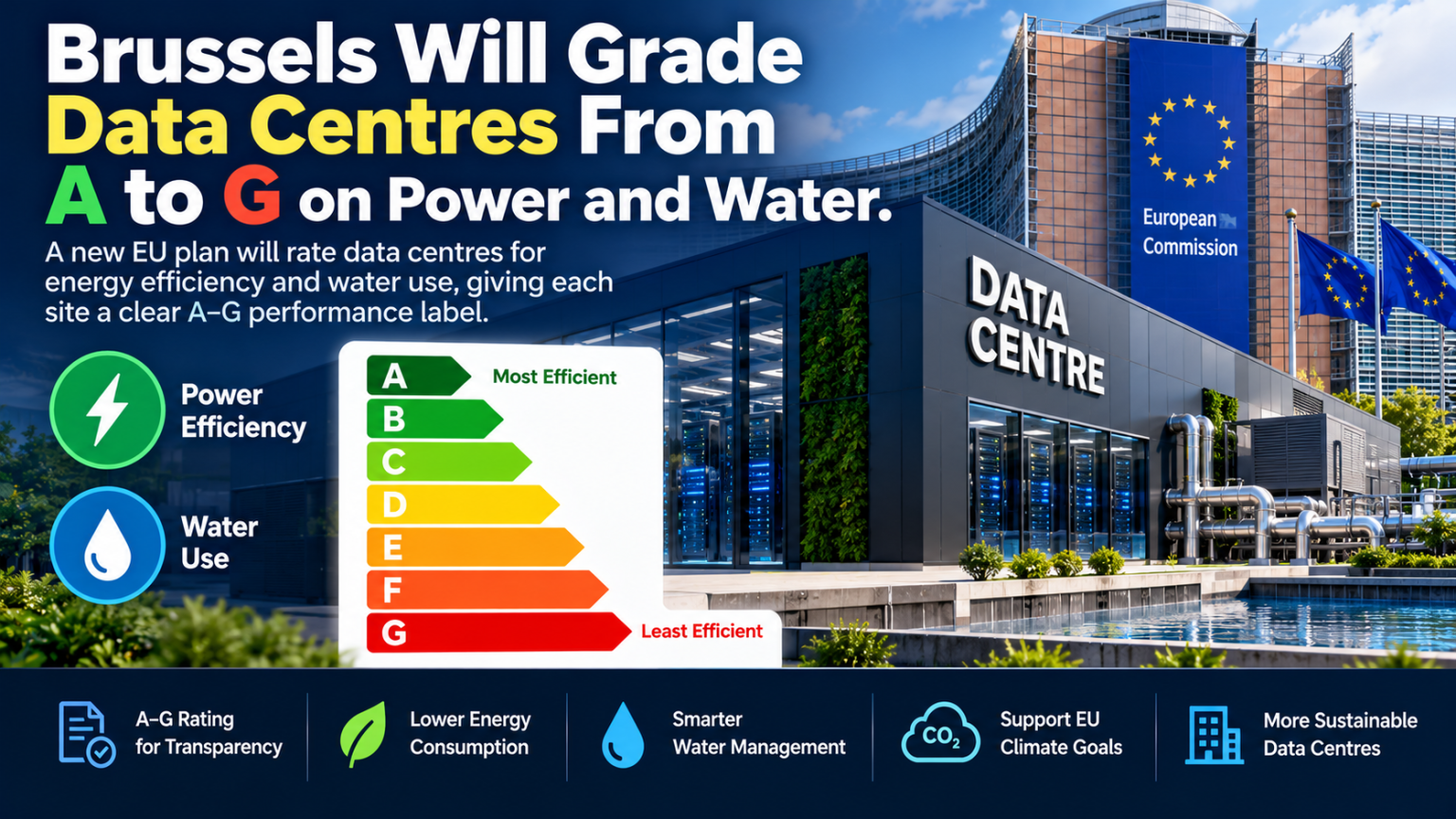
Brussels Will Grade Data Centres From A to G on Power and Water
Europe is preparing to make data centre efficiency easier to understand. Under a new European Union rating scheme, data centres will receive A-to-G efficiency labels covering electricity use and water efficiency, giving businesses, regulators, and customers a clearer way to compare digital infrastructure.
The European Commission adopted the common rating scheme on September 21, 2026, with the first labels expected in 2027. The initiative comes as demand for cloud computing, AI infrastructure, and data storage continues to grow across Europe.
For data centre operators and hosting providers, the change could make energy efficiency and water management more visible when customers choose where to host their applications.
Why Is Brussels Introducing Data Centre Ratings?
Data centres power websites, cloud platforms, business applications, streaming services, and artificial intelligence. But running servers around the clock requires electricity, cooling infrastructure, and, in some facilities, significant quantities of water.
The EU wants to expand its data centre capacity while reducing unnecessary energy consumption and environmental impact. Its broader ambition is to triple data centre capacity by 2035, making efficient infrastructure increasingly important.
Until now, customers have often needed technical knowledge to interpret data centre efficiency figures. A common rating system could make comparisons easier and encourage operators to improve cooling, power distribution, and resource management.
How Will the A-to-G Rating System Work?
The scheme uses two main performance indicators: Power Usage Effectiveness (PUE) and Water Usage Effectiveness (WUE).
1. Electricity efficiency: PUE
PUE measures the total energy consumed by a data centre relative to the energy used by its IT equipment. A lower number generally means less energy is being spent on supporting infrastructure such as cooling and power distribution.
| Energy rating | PUE |
|---|---|
| A | 1.15 or lower |
| B | Above 1.15 to 1.25 |
| C | Above 1.25 to 1.35 |
| D | Above 1.35 to 1.50 |
| E | Above 1.50 to 1.70 |
| F | Above 1.70 to 1.90 |
| G | Above 1.90 |
These thresholds come from the EU rating scheme.
For example, a PUE of 1.20 means that for every 1 kWh consumed by IT equipment, the facility uses 1.20 kWh in total. The remaining 0.20 kWh supports other data centre operations.
A lower PUE can indicate more efficient facility infrastructure, although it does not by itself measure the computing performance or overall environmental impact of a server.
2. Water efficiency: WUE
Electricity is only part of the picture. Cooling systems can also require water, making water efficiency particularly important in areas facing water stress.
The EU scheme uses WUE to assess water efficiency. Its rating thresholds are:
| Water rating | WUE |
|---|---|
| A | 0.1 or lower |
| B | Above 0.1 to 0.2 |
| C | Above 0.2 to 0.4 |
| D | Above 0.4 to 0.6 |
| E | Above 0.6 to 0.8 |
| F | Above 0.8 to 1.0 |
| G | Above 1.0 |
The scheme defines the calculation methodology through the existing EU data centre reporting framework.
In practical terms, lower water use relative to IT energy consumption produces a better rating. Operators may respond by improving cooling controls, using suitable recycled or alternative water sources, or deploying air-cooling systems where operationally appropriate.
However, a water rating should be interpreted alongside local conditions: the same quantity of water can have different consequences in a water-abundant region and a drought-prone one.
What Will the Labels Tell Customers?
The rating is designed to make performance information more accessible. The label framework includes details such as the facility’s name, operator, location, size category, reporting period, and efficiency classes. It also includes information about energy sources and other aspects of environmental and energy-system performance.
This could help businesses evaluate data centre locations before purchasing hosting, cloud, colocation, or AI infrastructure services.
For example, a company comparing two facilities may be able to see that one has better power efficiency while another performs better on water efficiency. The label would help expose that difference rather than reducing the comparison to price and uptime alone.
An A rating should not automatically be interpreted as proof that a facility is superior in every respect. Reliability, security, network connectivity, renewable energy sourcing, workload performance, and cost still matter.
What Does This Mean for Hosting Providers?
The new framework could influence how hosting providers present their infrastructure and sustainability credentials.
More transparent infrastructure choices. Customers may increasingly ask which data centre hosts their websites, applications, and virtual machines, and how efficiently that facility operates.
Greater pressure to improve cooling. Operators may examine airflow management, containment, cooling controls, and alternative cooling technologies to reduce overheads.
Better energy and water reporting. Providers may need clearer access to operational data from their data centre partners to answer customer questions accurately.
Potential commercial differentiation. Facilities with strong efficiency performance may be better positioned to serve customers with sustainability requirements, provided they can also meet their technical and commercial needs.
For smaller hosting companies that rent servers or rack space rather than operate their own facilities, the practical first step is to ask their data centre provider what information will be available and how it can be shared with customers.
Is the EU Also Planning Minimum Efficiency Standards?
Yes, but this is a separate policy process.
On September 21, 2026, the Commission also launched a public consultation on minimum performance standards for data centres. That work is intended to support a possible legislative proposal planned for the second quarter of 2027. The rating scheme itself focuses on transparency and comparison; it should not be confused with minimum performance limits that may be introduced later.
The distinction matters. A rating label tells customers how a facility performs against defined criteria. A minimum standard could eventually establish requirements that certain facilities must meet.
Operators should monitor the policy process rather than assume that receiving a low rating automatically means a data centre will be prohibited from operating.
Final Thoughts
The EU’s A-to-G data centre rating scheme represents a shift toward greater transparency in the infrastructure behind the digital economy.
By making power and water efficiency easier to compare, Brussels wants to encourage more efficient data centre design and better-informed purchasing decisions as demand for cloud and AI services expands.
For hosting providers, preparation means understanding the efficiency of the facilities they use, improving access to reliable sustainability data, and treating resource efficiency as part of infrastructure planning.
In the coming years, choosing a data centre may involve more than comparing server specifications, uptime, and monthly prices. Energy and water efficiency could become increasingly important parts of the hosting conversation.