Running a Domain Costs About a Dollar a Year. Here Is What Eight Registries Charge for It.
Every website starts with a domain name, but the amount customers pay to register one can be very different from what it costs to operate the registry behind it.
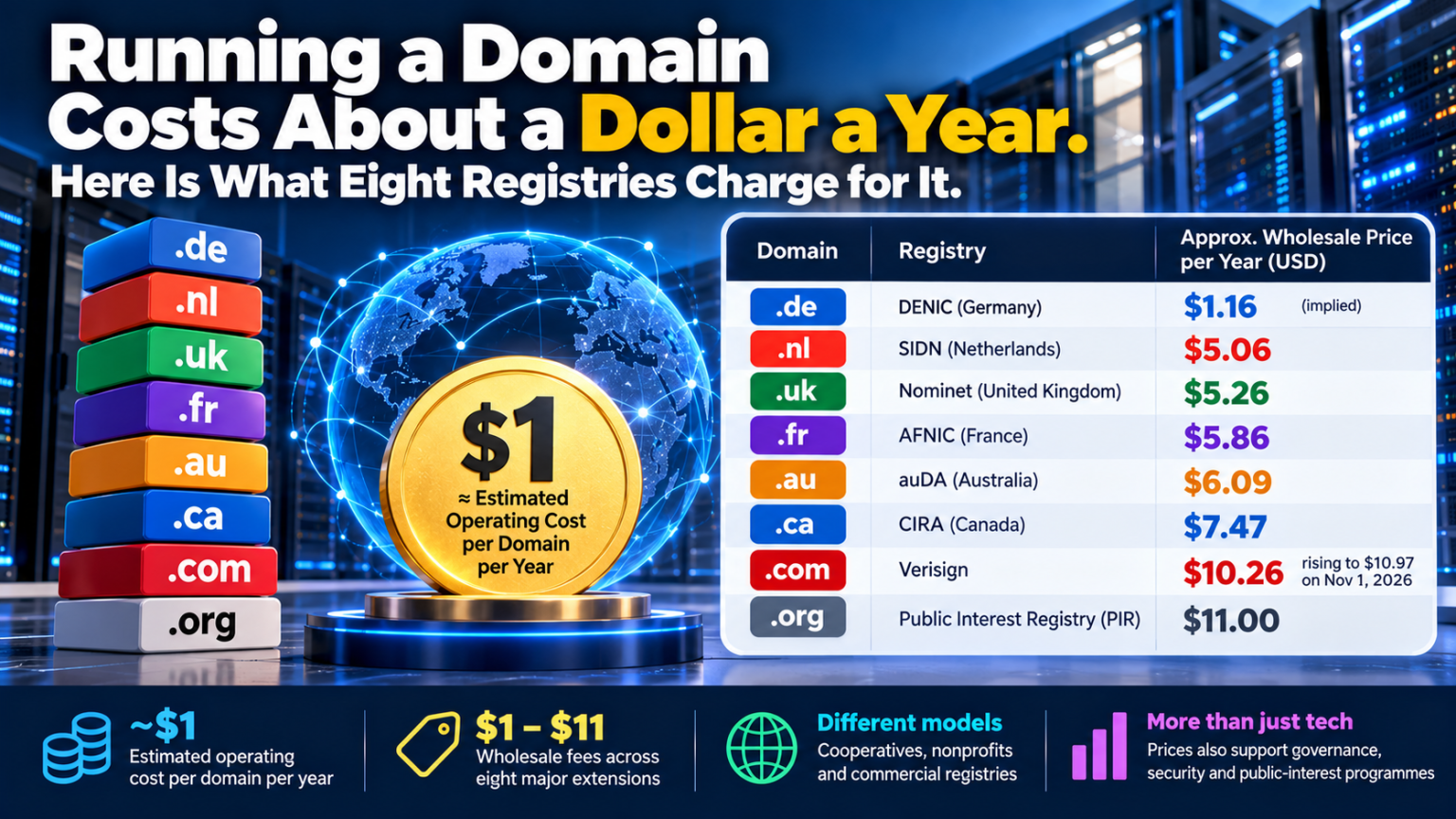
Public financial reports from eight major domain registries reveal a striking contrast. Operating a registry at scale can cost around US$1 per domain per year, yet wholesale registration fees range from roughly US$1 for Germany’s .de to US$11 for .org.
For hosting providers, domain resellers, and businesses managing large domain portfolios, this raises an important question: what exactly are customers paying for when they renew a domain?
Eight Registries, Eight Different Prices
The following comparison uses published registry fee schedules and the latest financial information available to the industry analysis in August 2026. Currency conversions are approximate, and the figures are not perfectly comparable because the organisations use different operating and funding models.
| Domain | Registry | Approx. wholesale price per year (USD) |
|---|---|---|
.de |
DENIC, Germany | $1.16 implied |
.nl |
SIDN, Netherlands | $5.06 |
.uk |
Nominet, United Kingdom | $5.26 |
.fr |
AFNIC, France | $5.86 |
.au |
auDA, Australia | $6.09 |
.ca |
CIRA, Canada | $7.47 |
.com |
Verisign | $10.26, rising to $10.97 on November 1, 2026 |
.org |
Public Interest Registry (PIR) | $11.00 |
Sources and methodology: registry pricing and financial comparison. The .de figure is an implied member-revenue-per-domain measure, not a directly equivalent retail or wholesale tariff.
The gap is substantial. A registrar managing thousands of domains can pay very different amounts depending on the extensions in its portfolio.
What Does It Actually Cost to Run a Registry?
A domain registry maintains the authoritative database for a top-level domain and operates the systems that allow registrars to register, renew, transfer, and update domain names.
The infrastructure includes DNS operations, databases, security controls, redundancy, abuse management, technical support, and business administration. Registry operators must maintain availability and accuracy even when systems experience failures or face malicious activity.
Three different financial measures help illustrate the cost of this operation.
1. DENIC: A cooperative model
DENIC operates Germany’s .de domain. Its 2025 activity report records approximately €17.79 million in member revenue and nearly 17.7 million registered domains.
Dividing those figures gives an implied revenue of about €1.01 per domain. DENIC reported an annual surplus of approximately €31,000, suggesting that its revenue and expenditure were closely balanced that year.
This is not a universal cost benchmark: member revenue does not include every possible cost allocation, and the calculation is not a directly comparable wholesale tariff. It nevertheless illustrates how a cooperative registry can operate close to cost.
Source: DENIC 2025 Activity Report.
2. PIR: The backend contract behind .org
Public Interest Registry operates .org, a domain used by nonprofits, communities, businesses, and other organisations.
Its published financial information shows that it paid approximately $10.5 million to Identity Digital for registry backend services in 2024. Compared with a domain base of more than 12 million, that contract provides a rough benchmark of less than $1 per domain annually for the backend service alone.
But backend operation is not the same as the total cost of running PIR. The organisation also funds administration, security, policy work, and other activities.
Source: Public Interest Registry.
3. Verisign: The economics of .com
Verisign operates .com and .net, two of the internet’s largest domain registries.
Its 2025 Form 10-K reported $1.6566 billion in revenue and $196.3 million in cost of revenues. That cost line is broader than a pure per-domain technical operating cost, so dividing it by the number of registered domains provides only an approximation.
The same filing reported operating income of $1.121 billion. This illustrates how a large commercial registry can generate substantial operating profit while maintaining the infrastructure used by hundreds of millions of domain names.
Source: Verisign 2025 Form 10-K.
Why Do Wholesale Prices Differ So Much?
A registry fee does not simply reflect the cost of keeping a domain in a database. The organisation’s legal structure, contract, pricing policy, and wider responsibilities influence what it charges.
Cooperatives, nonprofits, and public-interest organisations
DENIC operates as a cooperative. Other registries, including SIDN, Nominet, AFNIC, auDA, and CIRA, have different legal structures and public-interest responsibilities.
Their revenues may support cybersecurity initiatives, internet infrastructure, research, grants, or community programmes in addition to technical operations.
For example, CIRA funds its Net Good programme, while SIDN supports security research and related initiatives. These activities mean that a wholesale fee may finance more than registry technology alone.
Commercial pricing and contractual flexibility
.com and .org illustrate a different part of the market.
Verisign’s registry agreement permits price increases within specified contractual limits. Its wholesale .com fee increased from $10.26 to $10.97 per year effective November 1, 2026.
PIR raised the .org wholesale price from $9.93 to $11.00 effective June 1, 2026, its first increase since 2016.
These are wholesale registry prices, not the final amounts paid by customers. Registrar fees, services, taxes, and reseller pricing can increase the total.
What Does This Mean for Hosting Providers?
For hosting companies and domain resellers, the registry fee is a direct input into the cost of domain registration and renewal.
Consider a business managing 10,000 domains.
At a wholesale cost of $1.16 per domain, the annual registry cost would be approximately $11,600. At $10.97, it would be $109,700. The difference is $98,100 per year, before registrar fees and other costs.
This is an illustrative comparison using the listed prices, not a recommendation to replace one extension with another. Different domains serve different markets, and .de, .com, and .org are not interchangeable for every customer.
Providers should therefore:
- Calculate the real cost of each extension. Include registry fees, registrar charges, payment processing, support, and currency exposure.
- Review renewal pricing. A domain sold cheaply in its first year may have a different margin at renewal.
- Audit free-domain bundles. If a hosting plan includes a free domain, confirm that the wholesale cost remains covered by the package price.
- Compare reseller agreements. Volume discounts and partner arrangements may change the economics.
- Explain price increases clearly. When registry fees rise, customers should understand the difference between a wholesale change and a registrar’s own pricing decision.
For Indian hosting businesses, exchange-rate movements and GST treatment can also affect the final rupee cost, even when the underlying registry price is quoted in euros, pounds, Australian dollars, Canadian dollars, or US dollars.
Final Thoughts
The economics of domain registration are more complicated than the price displayed on a checkout page.
Financial reports suggest that registry operations can cost around a dollar per domain annually at scale, but wholesale fees vary widely. Some registries price close to cost, others fund wider public-interest activities, and commercial operators can earn substantial margins under their contractual arrangements.
That difference does not automatically prove that a higher fee is unjustified. Reliability, security, governance, investment, and public programmes all matter. But publishing comparable financial information makes it easier for registrars and customers to ask informed questions.
For hosting providers, the practical lesson is simple: know your wholesale costs, understand what each registry fee funds, and calculate domain profitability across the full customer lifecycle—not just the first registration year.