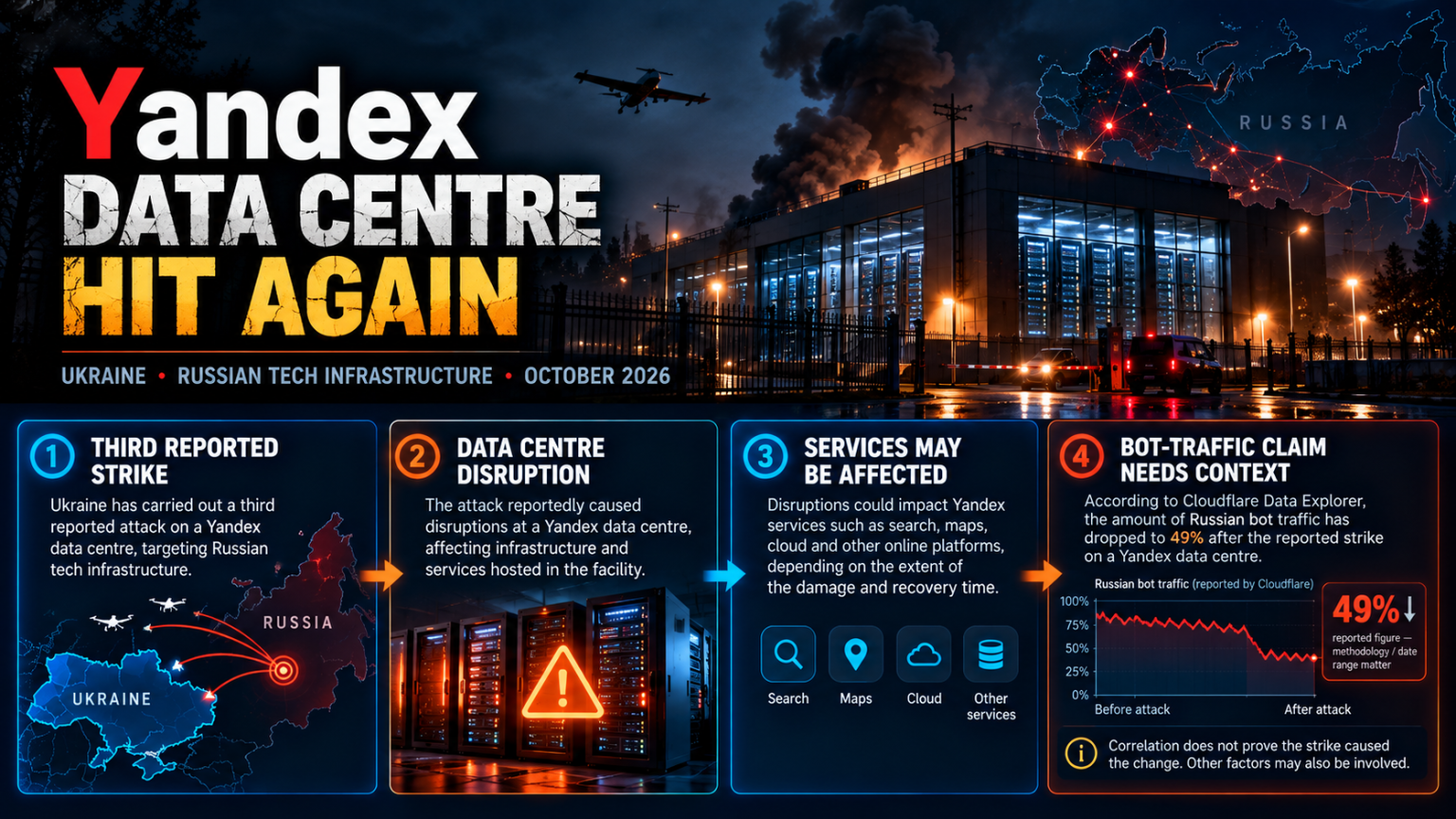
Ukraine Strikes Yandex Data Centre for Third Time: What It Means for Russian Tech and Bot Traffic
Ukraine’s reported drone campaign against Russian technology infrastructure has put one of the country’s biggest internet companies in the spotlight. On October 11, 2026, Russian technology giant Yandex reported that a drone attack had forced the shutdown of its data centre in the Vladimir region. The incident followed attacks affecting other Yandex facilities in recent days, according to Reuters.
At the same time, a claim based on Cloudflare Data Explorer has drawn attention online: Russian bot traffic reportedly fell to 49% after a Yandex data centre was struck.
If confirmed for the relevant dataset and time period, that figure could indicate a notable change in the traffic Cloudflare observes. But does it mean the attack directly reduced Russian bot activity? And how much can a data-centre strike really tell us about a country’s internet infrastructure?
Let’s examine the reported attacks, the role of Yandex, and what the traffic figure can—and cannot—prove.
Ukraine’s Third Reported Strike on Yandex Infrastructure
Yandex is one of Russia’s most important technology companies, with services spanning search, maps, cloud infrastructure, online marketplaces, payments, and artificial intelligence.
According to Reuters’ October 11 report, a drone attack damaged Yandex infrastructure in the Vladimir region and caused the facility to shut down. The company said no one was injured, although some services were unavailable.
The incident followed two other reported attacks:
- Sasovo: An earlier attack affected a Yandex data hub that houses two of the company’s three AI supercomputers, according to Reuters.
- Kaluga: A subsequent drone strike reportedly put parts of another Yandex data centre out of action.
- Vladimir region: The October 11 incident led to the shutdown of another facility.
Together, the incidents illustrate the vulnerability of physical infrastructure supporting modern digital services. A data centre is not merely a building full of computers. It depends on power, cooling, networking, storage, security, and other systems working together.
Damage to a facility can interrupt workloads and reduce available capacity. The actual impact depends on which systems were affected, how much traffic they handled, and whether services can fail over to other locations.
Why Yandex Data Centres Matter
Yandex is often described as Russia’s equivalent of Google because of its search and internet services. However, its business extends beyond search.
Its technology infrastructure supports a range of digital activities, including cloud computing, data storage, online services, and AI development.
A disruption at a major data centre can have several potential consequences:
Service interruptions: Applications relying on affected infrastructure may become unavailable or respond more slowly.
AI computing disruption: If specialised servers or AI supercomputers are affected, training and other compute-intensive jobs may be delayed.
Reduced capacity: Moving workloads to other facilities may be possible, but replacement capacity is not always immediately available.
Recovery costs: Operators may need to inspect hardware, restore systems, recover data, and reroute workloads.
Operational uncertainty: Repeated incidents can complicate maintenance, capacity planning, and service reliability.
These are potential effects, not confirmation that every Yandex service experienced every type of disruption. The scale of the impact depends on the damage and the company’s recovery arrangements.
For wider context, see Tom’s Hardware’s report on the earlier Yandex data-centre strike in Kaluga.
The Cloudflare Data Explorer Claim: Russian Bot Traffic Falls to 49%
Another part of the story concerns internet traffic rather than physical infrastructure.
Cloudflare Radar provides public insights into internet traffic, bot activity, security events, and other network trends. Its Bot Traffic from Russian Federation dashboard shows bot-traffic data for Russia, while its Data Explorer allows users to investigate datasets using selected filters.
A figure circulating alongside the Yandex attack reports says Russian bot traffic dropped to 49% after the strike.
That number needs context before it can be interpreted correctly.
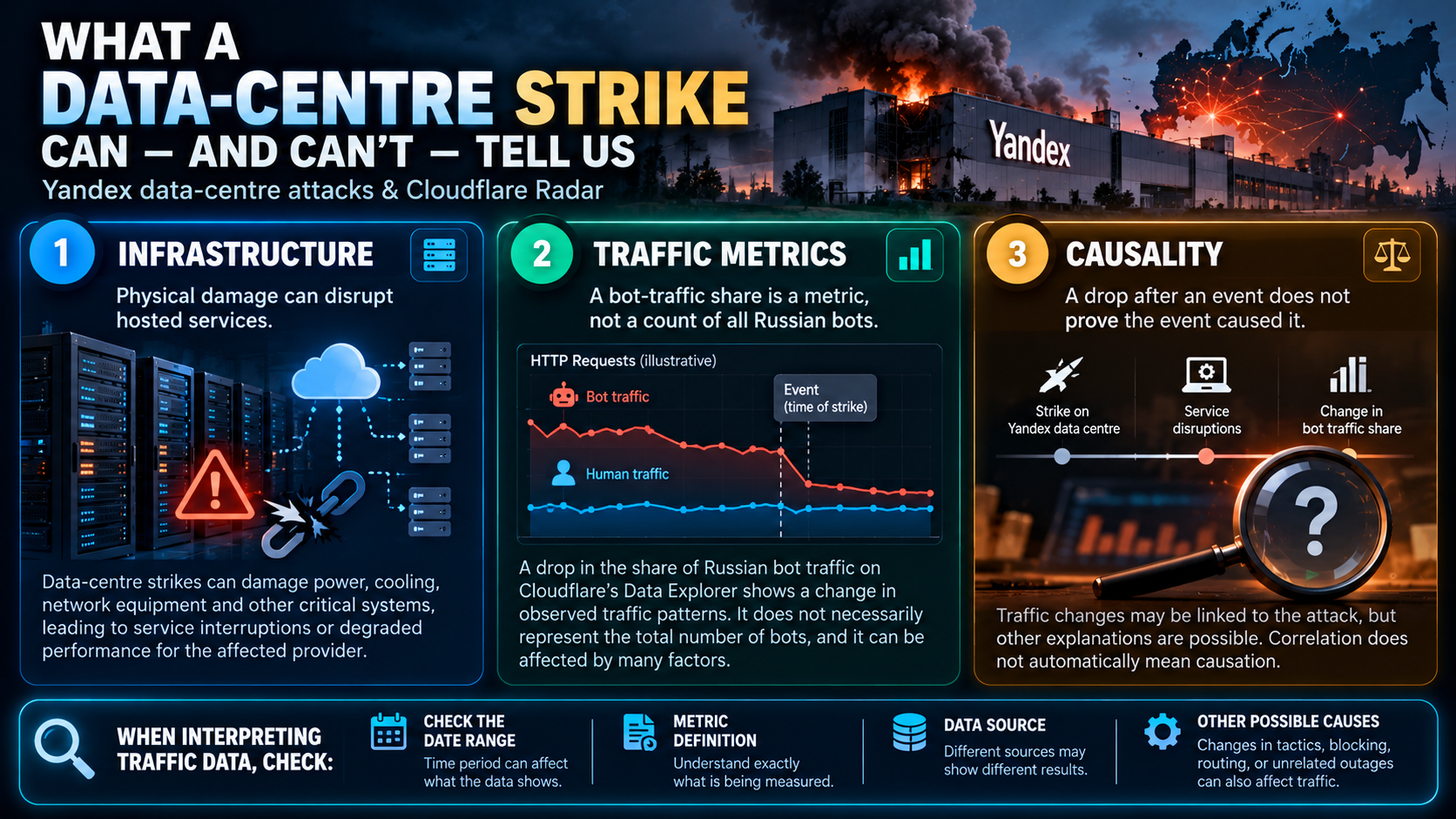
First, the precise dataset, date range, selected filters, and comparison period must be confirmed. A percentage can represent a share of observed requests, a change from a previous period, or another metric. Those measurements are not interchangeable.
Second, Cloudflare’s observations reflect the traffic visible to its network and the particular dataset being queried. They should not automatically be treated as a complete count of every bot operating across Russia.
Third, a change occurring after an attack does not by itself establish that the attack caused the change.
To verify the 49% figure, readers should compare the relevant Cloudflare chart before and after the incident, check its metric definition, and preserve the exact query or screenshot used.
What Is Bot Traffic, and Why Does It Matter?
A bot is software that performs tasks automatically over the internet. Bots are not all malicious.
Common examples include:
- Search-engine crawlers that discover and index web pages.
- Monitoring bots that check whether websites and services are working.
- Automated business systems that retrieve information or interact with APIs.
- Security scanners that look for vulnerabilities.
- Malicious bots used for scraping, credential attacks, spam, fraud, or other abusive activity.
Cloudflare explains bot classification and traffic measurement in its Radar documentation.
Because automated traffic has many legitimate and harmful uses, a decline in bot traffic does not necessarily mean that cybercrime has fallen. The meaning depends on which bot categories are measured and how the data is collected.
For example, a reduction in observed automated requests could reflect service outages, changes in routing, changes in the traffic reaching Cloudflare, altered bot behaviour, or changes in the measurement period. More evidence is needed to distinguish among these possibilities.
Could a Data-Centre Strike Reduce Bot Traffic?
It is technically possible for damage to a data centre to affect some automated internet activity.
Consider a simplified scenario: a bot operates on a server hosted at a facility that loses power or network connectivity. If the server cannot move to another location, its automated requests may stop. A similar effect could occur if the affected infrastructure supports a service used by automated applications.
However, several conditions must be met before connecting that scenario to the reported 49% figure.
- The bots or services responsible for the measured traffic must depend on the affected infrastructure.
- The attack must interrupt those systems rather than having their workloads immediately move elsewhere.
- The timing of the traffic decline must match the disruption.
- Other plausible explanations must be investigated.
- The metric must measure the relevant traffic consistently before and after the incident.
Without this evidence, the connection remains a hypothesis rather than a verified explanation.
The distinction is important: the data may show a change after the strike, but that does not establish that the strike caused the change.
What the Incident Reveals About Digital Infrastructure
The reported Yandex attacks highlight a broader issue for the technology industry: internet services depend on physical infrastructure.
Cloud computing, AI development, online payments, search engines, and digital marketplaces may feel intangible to users, but they ultimately rely on buildings, electrical systems, fibre connections, network equipment, and servers.
This creates several important lessons.
1. Geographic redundancy matters
Organisations that operate across multiple facilities may be better positioned to keep services running when one location fails. However, redundancy must be designed, tested, and supported by sufficient capacity.
2. Backups are not the same as service continuity
A backup may help recover data after an incident, but it does not automatically keep an application available during an outage. Business continuity also requires recovery procedures, spare capacity, and tested failover systems.
3. AI infrastructure has physical limits
AI systems require substantial computing resources, specialised hardware, electricity, and cooling. Damage to facilities housing those resources can affect the availability of computing capacity, even if the software itself remains intact.
4. Traffic measurements require careful interpretation
A chart can help identify unusual patterns, but understanding those patterns requires knowing what was measured, which systems contributed to the data, and what other events occurred at the same time.
Final Thoughts
The reported attacks on Yandex data centres demonstrate how physical infrastructure has become an important part of the modern technology landscape. A disruption to a major facility can affect computing capacity and online services, depending on the infrastructure involved and the operator’s recovery arrangements.
The reported decline in Russian bot traffic to 49% is also worth examining—but it should not be treated as proof that the strike directly disabled Russian bots. The exact Cloudflare query, metric, date range, and supporting evidence are needed to establish what changed and why.
For now, the key distinction is between a reported infrastructure attack, an observed traffic change, and a proven causal relationship. Those are three separate claims, and each requires its own evidence.
As digital infrastructure becomes more central to business, AI, and national security, understanding that distinction will become increasingly important.
Frequently Asked Questions
Did Ukraine strike a Yandex data centre in October 2026?
Reuters reported on October 11, 2026, that Yandex said a drone attack had damaged its data centre in the Vladimir region, forcing it to shut down. The report described this as the third major disruption affecting Yandex data centres in recent days.
What is Yandex?
Yandex is a major Russian technology company with services in search, maps, cloud computing, online commerce, and artificial intelligence.
Did Russian bot traffic fall to 49% after the attack?
A claim cites Cloudflare Data Explorer for that figure, but the exact query and metric should be checked before presenting it as independently verified. The figure alone does not prove that the strike caused the decline.
Does lower bot traffic mean fewer cyberattacks?
Not necessarily. Bot traffic includes both legitimate automated requests and potentially malicious activity. A change in total bot traffic does not, on its own, establish a change in cybercrime or cyberattack volume.
Where can I check Cloudflare’s data?
Start with Cloudflare Radar’s Russian bot-traffic dashboard and the Data Explorer. Record the selected date range, metric, and filters when sharing a result.