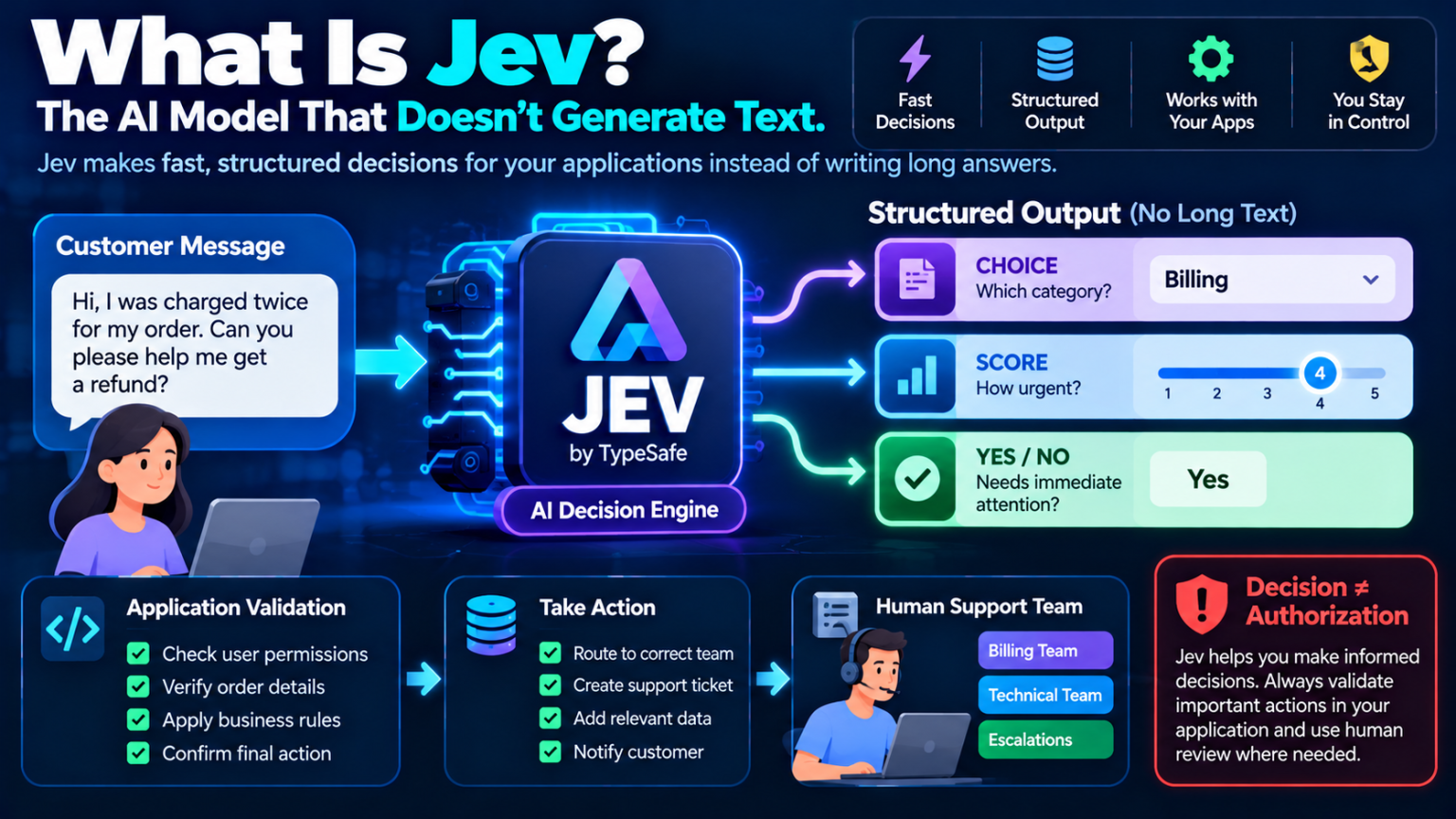
What Is Jev? The AI Model That Doesn’t Generate Text
Jev Explained for Beginners
Artificial intelligence is usually associated with chatbots that write emails, generate images, answer questions, and create computer code. Most popular AI models are designed to generate content, one token at a time.
But what if an AI model did not need to write a response at all?
Meet Jev, a decision-focused AI model developed by TypeSafe AI. Instead of generating paragraphs like a traditional chatbot, Jev is designed to evaluate information and return structured decisions that software can use directly.
The idea is surprisingly simple: sometimes, an application does not need an AI to explain something. It only needs an answer to a specific question.
For example, should a customer-support ticket go to the billing team or technical support? Is a message urgent? Which category best describes a request?
These are the kinds of decisions Jev is designed to help with.
In this guide, we will explore what Jev is, how it works, how it differs from ChatGPT, and where this new approach to AI could be useful.
1. What Is Jev AI?
Jev is the first System One model from TypeSafe AI. The company describes System One models as AI systems built to make fast, structured decisions for software applications.
A traditional language model generates text. Jev takes information about a situation, evaluates specific questions, and returns answers in defined formats.
According to TypeSafe’s official introduction, the model is intended for tasks where applications need decisions rather than long written responses.
Think of Jev as a decision-making component inside a larger software system.
For example, an online store might receive this customer message:
“I paid for express delivery, but my order still has not arrived. Can someone help?”
A traditional AI assistant might write a complete response to the customer.
Jev could instead answer focused questions such as:
- Which department should handle this request?
- Is the customer expressing urgency?
- Does the message concern a delivery problem?
The application receives structured results and decides what happens next.
The important distinction: Jev is not intended to replace every chatbot. It is designed to handle the decision-making parts of applications where a fixed, machine-readable answer is more useful than generated prose.
2. Why Build an AI Model That Doesn’t Generate Text?
At first, a model that does not write text may sound like a strange idea. After all, generating text is one of the main things that made modern AI popular.
However, many business applications do not need a complete paragraph for every task.
Imagine a hosting company receiving thousands of support tickets every day. Each ticket must be assigned to the right team:
- Billing
- Server management
- Domain registration
- Technical support
- Abuse and security
A general-purpose LLM could classify each message, but the application must ensure that the output matches the categories it understands.
If the model responds with “This seems to be related to a server configuration issue,” the software may need to extract the intended category from that sentence.
If the model instead returns a defined choice such as SERVER_MANAGEMENT, the application can process that result more directly.
Jev is designed around this second approach.
Its potential advantages include:
- Structured output: Answers are returned in predefined formats.
- Low latency: Decision-focused processing can be faster than using a large reasoning model for every task.
- Cost efficiency: Specialized models may reduce the cost of high-volume classification and routing.
- Simpler integration: Applications can consume the result without parsing a long generated explanation.
These benefits depend on the workload, model version, provider, and implementation. Jev still needs to be evaluated against alternatives using representative data from the application.
3. How Does Jev Work?
Jev uses a simple concept: State → Question → Decision → Action.
Step 1: Provide the state
The state is the information the model should evaluate. It could be a customer message, an order record, a support ticket, or a collection of structured fields.
Example:
“Customer reports that a payment was deducted twice and requests a refund.”
Step 2: Ask a focused question
The developer defines what needs to be decided.
For example:
“Which department should handle this message?”
The developer also defines the allowed answers and what each option means.
Step 3: Receive a structured decision
Jev returns a result in a defined format, potentially including the selected option, probability information, and a confidence signal, depending on the question type.
The output is intended for software to process directly.
Step 4: Let the application decide what happens next
The application can route the ticket, assign a priority, ask for human review, or send the case to a more capable language model.
Jev provides a judgment. Your software remains responsible for applying business rules and executing actions.
This separation is important because a model can make a wrong decision even when its output is perfectly valid.
4. Jev’s Three Main Question Types
Jev supports different types of questions so developers can describe the answer they need.
Choice
Use this when the answer must be selected from a predefined set of options.
Example: Which team should receive this ticket?
Possible answers: BILLING, TECHNICAL, or ACCOUNT_SUPPORT.
Score
Use this when the application needs an assessment on a defined scale.
Example: How relevant is this document to a particular search query?
The developer defines the scoring criteria and the scale to be used.
Noul
Jev uses this question type for yes-or-no-style judgments, with probability information associated with the answer.
Example: Does this message appear to describe an urgent server outage?
The application can inspect the result and decide whether to proceed automatically or request further review.
For technical details and current API behavior, consult the TypeSafe documentation.
5. Jev vs ChatGPT: What Is the Difference?
Jev and ChatGPT-style models serve different purposes.
| Feature | Jev | General-purpose LLM |
|---|---|---|
| Main purpose | Structured decisions | Text generation and broader reasoning |
| Typical output | Choices, scores, and yes/no-style judgments | Paragraphs, explanations, code, and other content |
| Best-fit tasks | Classification, scoring, routing | Writing, summarization, coding, complex analysis |
| Open-ended conversation | Not its intended purpose | A core capability |
| Business integration | Useful at defined decision points | Useful for flexible tasks and complex workflows |
| Can make mistakes? | Yes | Yes |
The distinction is not that Jev is smarter or less intelligent than every other AI model. It is designed for a narrower set of tasks.
If you want to write a blog post, ChatGPT or another generative model is the appropriate choice.
If your application needs to classify that blog post into a fixed category, Jev may be a useful option.
If you want to build a system that both classifies content and generates a response, you can combine the two approaches.
6. A Real-World Example: An AI Assistant for a Hosting Company
Consider a web-hosting business that receives hundreds of customer requests each day.
A customer might write:
“My website has been offline for 20 minutes, and I cannot access my control panel.”
A Jev-powered workflow could evaluate several questions:
- Does the message describe a possible service outage?
- Should it be routed to technical support?
- Does it appear urgent enough to flag for immediate review?
The hosting platform could then route the ticket to the correct queue and notify an engineer if appropriate.
A general-purpose LLM could be called afterward if a detailed troubleshooting response is required.
The workflow might look like this:
Customer message → Jev classification → Application validation → Ticket routing → LLM-generated response, if needed
This approach could help a hosting provider process routine requests more efficiently while reserving more expensive or complex AI calls for tasks that genuinely require them.
The same architecture could be used for e-commerce, customer service, document processing, content moderation, and internal business workflows.
7. Is Jev Faster and Cheaper Than Other AI Models?
Jev is designed for fast, structured decision-making, and published benchmarks suggest that it can be competitive on particular workloads.
For example, OpenRouter’s comparison of Jev and Claude Opus 5 evaluated both models on 3,080 customer-support utterances from the Banking77 dataset.
In that specific test, Jev 1.13 achieved 81.0% accuracy, while Claude Opus 5 achieved 84.4%. Jev had substantially lower median latency and lower reported cost per request in the benchmark setup.
These results illustrate the trade-off: a specialized decision model may offer major speed and cost advantages, while a general-purpose model can be more accurate on a particular task.
They do not prove that Jev will be faster, cheaper, or more accurate for every application. Performance depends on the task, the model version, the provider, the prompt or question design, and the evaluation data.
Businesses should test their own workload before choosing a model.
8. Can Jev Make Mistakes?
Yes. This is one of the most important points to understand.
Because Jev returns structured answers rather than unrestricted prose, it can avoid some problems associated with unexpected generated text. But a structured answer can still be incorrect.
For example, Jev might confidently classify a server outage as a routine billing issue. The output format would be valid, but the decision would be wrong.
Probability and confidence information can help applications decide which results to accept and which to escalate. They are not guarantees of correctness.
A sensible implementation should:
- Test Jev against labelled examples from the real application.
- Measure accuracy for different categories.
- Set thresholds based on the cost of mistakes.
- Send uncertain or high-impact cases to a stronger model or human reviewer.
- Re-evaluate performance as the data and requirements change.
Most importantly, do not use an AI judgment as the sole authorization mechanism for payments, account access, security permissions, or other sensitive actions. Enforce permissions and mandatory business rules in your application code.
9. Is Jev the Future of AI?
It is too early to say that Jev represents the future of all AI. Generative models remain essential for writing, coding, creative work, and tasks that require flexible explanations.
However, Jev highlights an important direction in AI development: different tasks may benefit from different kinds of models.
A business application does not always need one large model to perform every operation. It could use ordinary code for deterministic rules, Jev for focused judgments, and a general-purpose LLM for tasks that require detailed reasoning or content generation.
This combination may be particularly useful in high-volume workflows where latency, cost, and predictable output formats matter.
The future may not be a competition between decision models and generative models. It may be about combining them intelligently.
Conclusion
Jev is an AI model from TypeSafe AI designed to make structured decisions rather than generate natural-language responses.
It accepts information about a situation, evaluates defined questions, and returns typed answers that software can use. This makes it a potential fit for classification, scoring, routing, and other repetitive decision points inside applications.
It is not a replacement for ChatGPT, Claude, Gemini, or conventional software rules. Instead, it offers another tool for developers building AI-powered systems.
The key takeaway: Generative AI helps software create content. Decision-focused AI like Jev helps software choose what to do next.
For some applications, using the right model for each job could be more effective than asking a single AI model to do everything.
Further reading: TypeSafe AI’s Jev introduction · Jev documentation · OpenRouter’s benchmark