This Is What Happens When AI Reverse-Engineers Corporate Software
For decades, building professional software required large engineering teams, years of development and substantial financial investment. Recreating a mature application such as Photoshop or Illustrator was considered an enormous undertaking.
AI coding tools are beginning to challenge that assumption.
In October 2026, a collection of open-source creative applications associated with the ArtCraft project attracted attention after reports described a developer using Anthropic’s Claude to build alternatives to several Adobe Creative Cloud applications. The projects aim to reproduce familiar interfaces and workflows while providing freely available source code.
The development raises an important question: what happens when AI makes it dramatically easier to recreate software that took major companies years to build?
What is ArtCraft building?
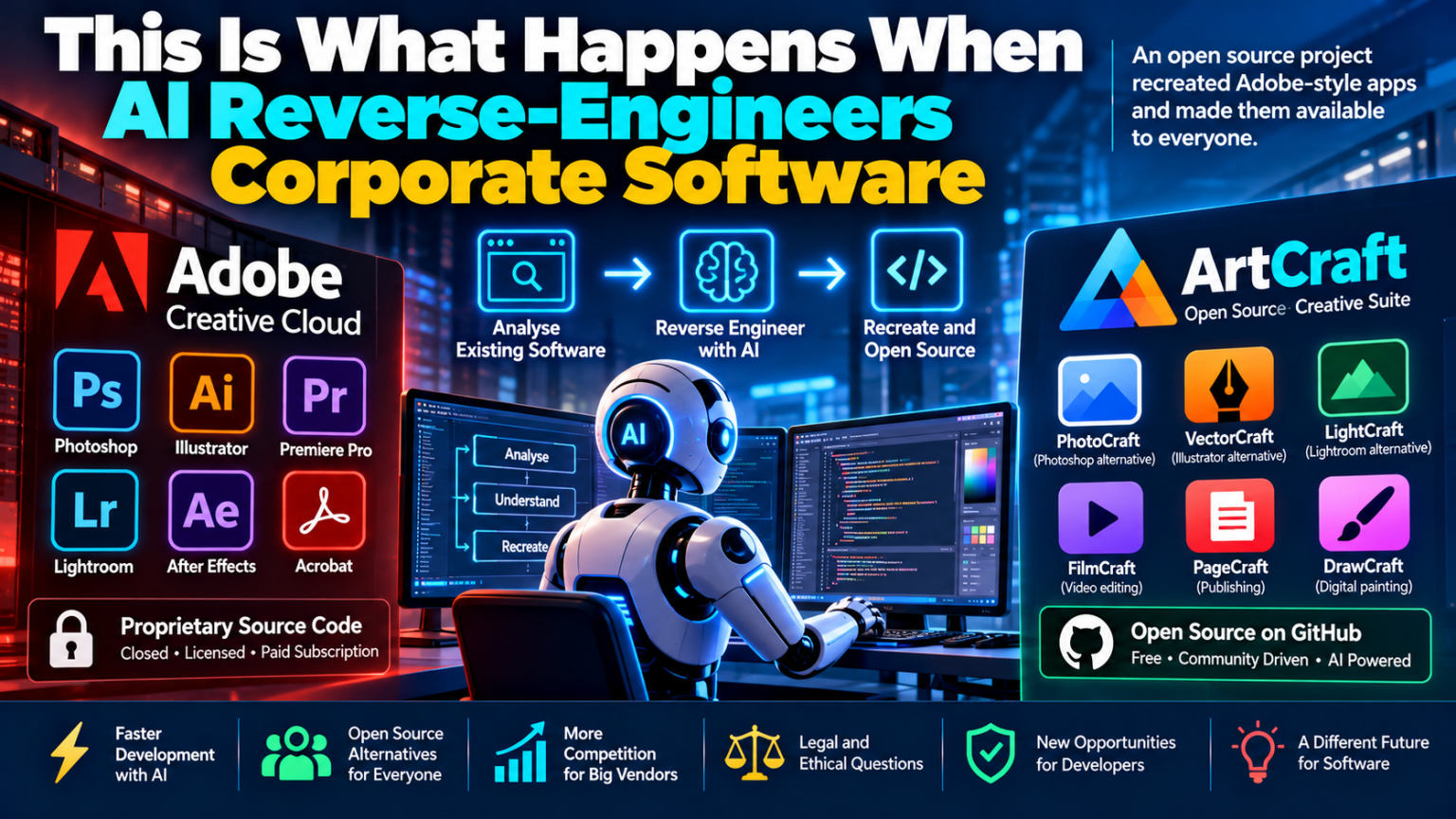
ArtCraft is an open-source creative software project whose ecosystem includes several applications designed around familiar professional workflows.
Examples include:
- PhotoCraft: An independent, clean-room reimplementation of workflows associated with Adobe Photoshop.
- VectorCraft: A vector graphics editor designed around workflows familiar to Adobe Illustrator users.
- LightCraft: An alternative focused on photo management and editing workflows associated with Lightroom.
- FilmCraft and other tools: Projects targeting additional creative workflows.
You can explore the ArtCraft repository, PhotoCraft on GitHub and VectorCraft on GitHub.
The applications are written in Rust, according to their project repositories, and are intended to provide native software experiences across supported platforms. The ecosystem also emphasises AI integration, allowing compatible agents to interact with creative tools through structured interfaces.
Tom’s Hardware reported on October 8, 2026, that a developer used Claude to accelerate development of a suite of Adobe-style alternatives. The developer’s stated approach is a clean-room reimplementation rather than a release of Adobe’s proprietary source code.
That distinction is critical: Adobe has not open-sourced its Creative Cloud suite. These are independent projects seeking to recreate selected functionality and workflows.
How AI changes software reverse engineering
Traditionally, reverse engineering software required specialists to inspect executable files, analyse application behaviour, trace functions and understand how different components interacted.
AI coding agents can help automate parts of this process.
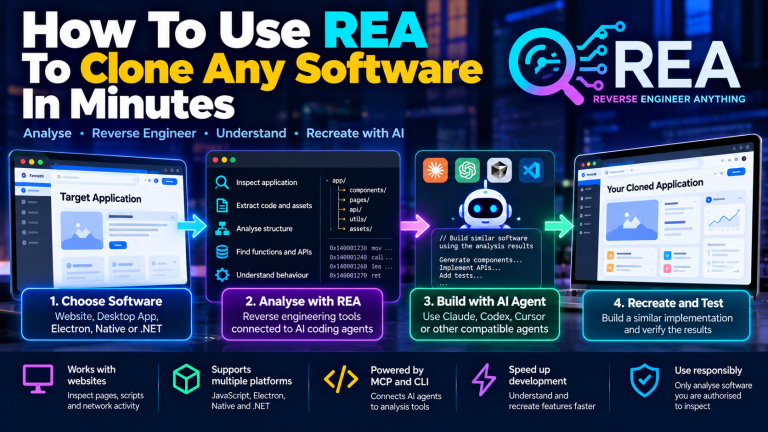
A developer can describe a feature, investigate how an application behaves, generate an initial implementation and then use tests to improve it. Tools for code analysis, decompilation and application inspection can supply evidence that an AI agent uses to guide its work.
A simplified workflow looks like this:
- Observe: Examine an application’s interface, behaviour and supported inputs and outputs.
- Analyse: Use available source code, debugging tools or authorised reverse-engineering techniques to understand the relevant functionality.
- Implement: Ask an AI coding agent to create a new implementation based on the findings.
- Test: Compare the results, correct errors and validate security and compatibility.
This does not mean AI can automatically recover an application’s original source code. It can, however, reduce the time needed to develop a new implementation of particular features.
The distinction between a quick prototype and a dependable professional application remains substantial.
Why this could disrupt established software companies
The traditional software business model often depends on years of product development, specialised engineering teams, proprietary features and recurring subscription revenue.
AI-assisted development could change the economics of competing with established products.
1. Lower development costs
A small team may be able to produce a working prototype much faster than before. This gives independent developers and open-source communities more opportunities to compete in markets previously dominated by large vendors.
2. More pressure on subscriptions
Users who need basic image editing, vector graphics or document tools may increasingly consider open-source alternatives.
Professional customers may still pay for advanced features, integrations, support, reliability and established workflows. However, vendors will need to demonstrate why their products justify their prices.
3. Faster competition
If AI helps developers reproduce common workflows, competitors may no longer need to invent every feature from scratch.
That could increase competition across creative software, office applications, development tools, project management systems and business software.
The greatest pressure may fall on products whose value depends heavily on familiar interfaces and established feature sets rather than exclusive services, specialised infrastructure or unique intellectual property.
Will this keep happening?
It is reasonable to expect more AI-assisted reimplementations, although the pace and commercial impact remain uncertain.
Three factors will influence how far this trend goes.
First, AI coding capability. Better models can help developers navigate large codebases, implement complex features and repair defects. Results will still depend on the quality of the instructions, tools and testing.
Second, open-source collaboration. A prototype created by one developer may remain fragile. A larger community can review code, fix bugs, improve documentation and strengthen security over time.
Third, legal and technical boundaries. Recreating functionality is not automatically equivalent to having permission to copy source code, protected assets, trademarks or proprietary material. Clean-room claims are relevant, but they do not by themselves establish that every aspect of a project is legally compliant.
A public repository also does not automatically mean an application is secure, complete or suitable for business-critical work.
What should software companies do?
Established vendors should not treat AI-generated alternatives as a problem that can be solved through legal action alone.
They can respond by improving their products, offering clearer pricing, supporting open standards, providing dependable integrations and making customer workflows easier.
Features that require sustained research, specialised infrastructure, high-quality data, strong security and reliable support may continue to offer meaningful competitive advantages.
Companies should also experiment with AI-assisted development internally. The same technology that enables competitors to build alternatives can help established teams improve their own software.
What should developers and businesses do?
For developers, the opportunity is to use AI to build useful, focused applications instead of assuming that every product needs to reproduce an entire commercial suite.
For businesses, the priority is to evaluate alternatives carefully rather than switching solely because an application is free or open source.
Before adopting a new AI-built tool, check:
- Security: Review dependencies, permissions, file access and network activity.
- Reliability: Test realistic workloads and important edge cases.
- Compatibility: Confirm that existing projects and file formats work correctly.
- Licensing: Review the project’s licence and the rights associated with bundled assets.
- Maintenance: Check whether issues are addressed and releases are maintained.
- Privacy: Understand whether data is processed locally or sent to external AI services.
For sensitive business files, test unfamiliar applications in an isolated environment before granting access to production data.
The bigger question: Who controls the future of software?
The significance of ArtCraft is not simply that AI helped create alternatives to Adobe-style creative tools. It is that the cost and effort of competing with established software may be changing.
A product that once required a large team to reproduce may become approachable for a smaller group of developers. That creates opportunities for open source, niche products and greater user choice—but also raises questions about code quality, intellectual property, security and long-term maintenance.
AI will not eliminate the need for experienced software engineers. It may instead shift more of their work toward architecture, verification, security and deciding what should be built in the first place.
The future of software may belong not only to the companies that build the biggest products, but also to the developers who can use AI to build focused, reliable alternatives. Whether those alternatives become serious competitors will depend on much more than how quickly their first versions appear on GitHub.