The Fastest-Rising Repo on GitHub Is a Little Scary: Meet REA
What if an AI coding agent could inspect an application without its source code, figure out how a feature works, and help you build a similar version?
That is the idea behind REA (Reverse Engineer Anything), an open-source project that connects AI coding agents to software reverse-engineering tools. Developers can use it to investigate applications, examine compiled binaries, trace functions and reconstruct software behaviour.
The project is attracting attention because it brings capabilities traditionally associated with specialist reverse engineers into AI-assisted development workflows. Its popularity has also reignited an uncomfortable question for software companies: if AI can help competitors understand a closed-source application, how much protection does keeping the source code private really provide?
What is REA, and why is everyone talking about it?
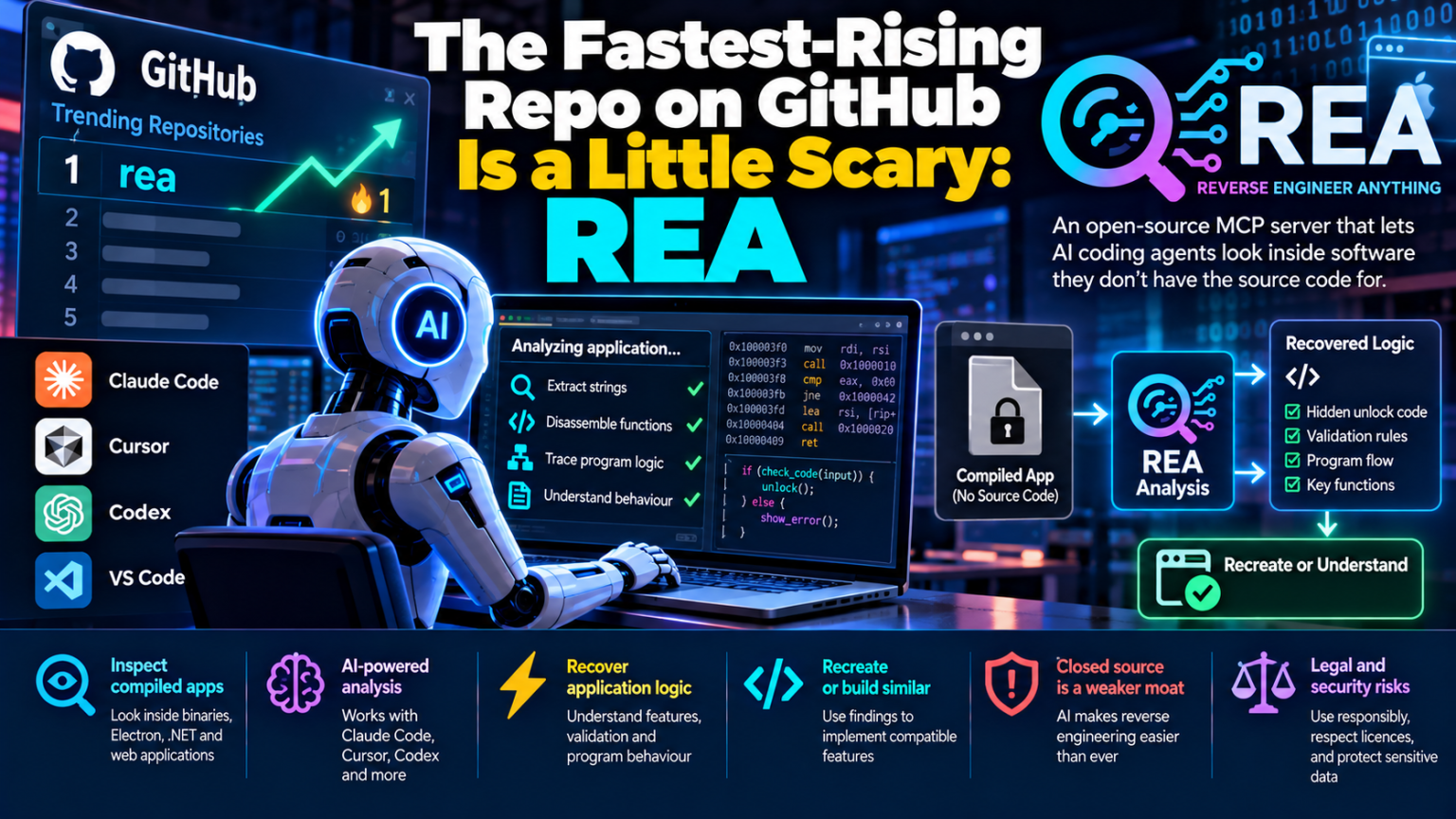
REA is an open-source command-line tool and Model Context Protocol (MCP) server. It allows compatible coding agents—including Claude Code, Cursor and Codex—to interact with reverse-engineering tools rather than relying entirely on guesses about how an application works.
You can explore the project on GitHub and read its documentation at REA.tools.
The project can help agents investigate several types of software:
- Native applications: Examine compiled binaries, functions, strings, assembly and decompiled pseudocode.
- JavaScript and Electron applications: Inspect modules, imports, application structure and component relationships.
- .NET applications: Investigate assemblies and intermediate-language instructions.
- Web applications: Examine supported page structures and application behaviour.
The description of REA as GitHub’s fastest-rising repository reflects the recent attention around the project; it should not be interpreted as a permanent or independently verified ranking.
What makes the project interesting is the workflow. Instead of asking an AI to reproduce an application based only on screenshots, a developer can ask it to investigate the actual software artefacts and explain what the evidence reveals.
The experiment: Can AI discover a hidden unlock code?
One demonstration described in a video published on October 9, 2026, illustrates the concept using a small Mac application.
The developer builds an application with a hidden unlock code, removes identifying names from the compiled binary, and asks an AI agent to recover the rules governing the unlock mechanism. The agent then compares its conclusions with the original source code to check whether its interpretation is correct.
The important point is that the agent does not need to recover the original source code verbatim to understand the underlying logic.
A compiled application may still contain useful clues, including strings, control flow, comparisons, function calls and references between functions. Reverse-engineering tools can expose some of this information in a more understandable form.
REA gives the coding agent a structured way to investigate those clues, follow the relevant logic and explain its conclusions.
However, a successful demonstration does not mean every application can be analysed equally well. Obfuscation, encryption, runtime checks, complex dependencies and anti-tampering measures can make analysis much more difficult.
You can find the project and its technical approach in the REA GitHub repository.
How REA works with AI coding agents
The workflow combines conventional reverse engineering with AI-assisted reasoning.
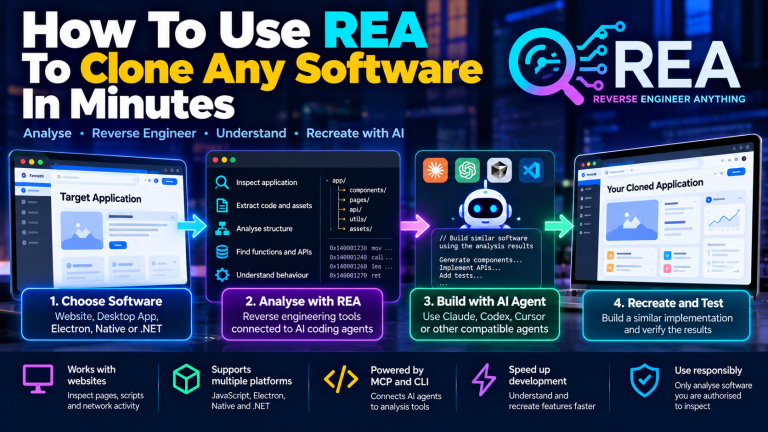
1. Open the target application
The developer identifies an application they own or have permission to analyse. REA connects the coding agent to the relevant inspection tools.
2. Investigate the software
The agent can request information about strings, functions, references, pseudocode and other available evidence, depending on the target and configured analysis provider.
3. Trace the behaviour
Rather than looking at isolated pieces of code, the agent can investigate how different functions connect and how particular inputs influence the program’s behaviour.
4. Build a new implementation
Once the behaviour is understood, the agent can help implement a similar feature in a separate project. The new implementation can use a different programming language, interface or architecture.
The key is that REA supports the investigation. The coding agent still has to interpret the evidence, write the implementation and test the result.
Does this mean closed-source software is no longer a moat?
Not entirely—but the economics of competing with established software could change.
For years, proprietary source code has provided a degree of secrecy. Competitors could observe an application’s interface and outputs, but understanding its internal implementation often required specialist knowledge, considerable time and substantial effort.
AI-assisted reverse engineering can lower some of those barriers.
Software features may become easier to reproduce
A competitor may be able to investigate a particular file format, calculation, user-interface workflow or application feature and implement a compatible alternative.
This is especially relevant when the desired functionality can be isolated and tested independently.
Smaller teams can investigate more ambitious targets
AI agents can help developers navigate unfamiliar code and organise findings. That could make certain reverse-engineering projects more accessible to independent developers and open-source communities.
Proprietary software still has other advantages
Source-code secrecy is only one component of a software company’s competitive position.
Products may also depend on proprietary data, cloud infrastructure, specialised hardware, customer relationships, distribution, professional support, continuous updates and complex integrations.
A competitor that understands one feature still has to build, maintain, secure and support a reliable product.
The more realistic conclusion is that closed source alone may offer less protection against imitation than it once did—not that proprietary software has become worthless.
The security lesson: Your secrets may be inside the binary
The hidden-unlock-code demonstration also illustrates a serious security principle.
If a password, API key, master token or other sensitive value is embedded in a distributed application, an attacker may be able to recover it through static or dynamic analysis.
Removing variable names or making a binary harder to read does not turn a client-side secret into a secure one.
Developers should avoid embedding sensitive credentials in desktop applications, mobile apps or browser code. Important authorisation decisions should be enforced by a trusted server, with credentials stored and managed appropriately.
For software vendors, practical protections include:
- Keep private keys, master credentials and sensitive tokens out of distributed binaries.
- Enforce critical access controls on the server.
- Use short-lived credentials and rotate exposed secrets.
- Apply code signing and integrity checks where appropriate.
- Test releases against realistic reverse-engineering and threat scenarios.
Obfuscation can increase the effort required to analyse software, but it should not be treated as a substitute for sound security architecture.
The legal and ethical catches
Reverse engineering is not automatically illegal, nor is every use automatically permitted. The legal position depends on the jurisdiction, purpose, licence terms, contractual obligations and methods used.
Analysing software you own or are authorised to test is different from bypassing access controls, extracting confidential information or copying protected material for unauthorised distribution.
Developers should review applicable laws and licence conditions before investigating commercial software. They should also distinguish between learning how a feature behaves and copying protected code, artwork, branding or other assets.
REA’s own GitHub documentation places responsibility on users to obtain any required authorisation and comply with applicable laws.
There are also technical limitations. Decompilers cannot guarantee recovery of original source code, and AI-generated explanations can be wrong. Important findings should be checked against independent evidence and tested rather than accepted on confidence alone.
How to get started with REA
For developers who want to experiment, the project provides a setup command:
npx rea-agents setupYou will need a supported Node.js and npm environment, a compatible coding agent, and any additional analysis tools required for your target. Native binary analysis can require software such as Hopper or Ghidra.
Follow the current installation guide, review the configuration changes before approving them, and begin with a small application you own.
A useful first exercise is to investigate one function, ask the agent to explain the evidence, and compare the result with known behaviour. This is a better starting point than attempting to reproduce an entire commercial application.
Conclusion: Reverse engineering is becoming an AI-assisted workflow
REA is an important example of how AI coding agents are moving beyond writing new code and into understanding existing software.
By connecting agents to reverse-engineering tools, it makes it easier to investigate compiled applications, trace behaviour and use the findings to build compatible or similar functionality.
That creates opportunities for developers, security researchers and open-source projects. It also raises questions about software protection, embedded secrets, licensing and the future value of proprietary implementations.
The lesson for software companies is straightforward: do not rely on keeping source code secret as the only barrier against imitation. Build products that are secure by design, continuously maintained, useful to customers and difficult to replace for reasons that go beyond code alone.
The lesson for developers is equally important: AI can accelerate reverse engineering, but evidence, authorisation, security and testing still matter.