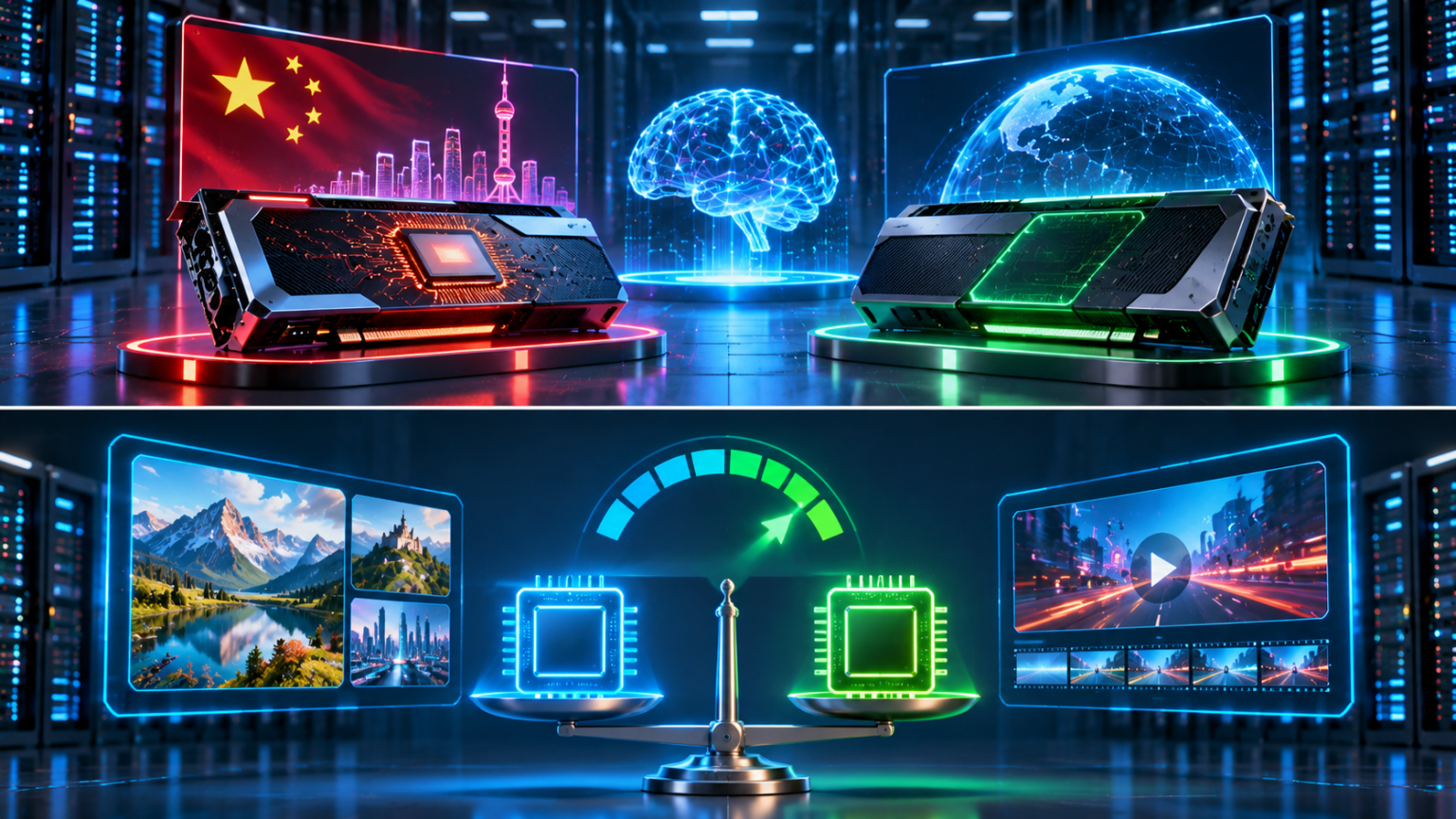
China’s push to build its own artificial intelligence hardware has produced another headline-grabbing moment. Shanghai-based chipmaker Iluvatar CoreX says its new Tiangai 300 AI GPU can match—and in selected tests outperform—NVIDIA’s H200, one of the company’s powerful data-centre accelerators.
The claim has attracted attention for a good reason. If a Chinese-made processor can deliver comparable performance on demanding AI workloads, it could give local cloud providers and AI developers another option at a time when access to advanced foreign chips remains politically and commercially complicated.
But does a reported five per cent advantage mean China has finally built a GPU that is faster than NVIDIA’s H200? Not quite. The results are interesting, but the details matter.
What is the Tiangai 300?
The Tiangai 300 is a general-purpose GPU developed by Iluvatar CoreX, a Shanghai-based chip designer. The company is positioning it for demanding AI work, including large language model inference, image and video generation, and other data-centre workloads.
Its public demonstration in Shanghai in October 2026 gave media outlets a look at the hardware running real workloads. The comparisons included multimodal tasks using models such as Z.ai’s GLM-5.3. This is significant because a working demonstration is more useful than a product roadmap slide—but a demonstration is still only one part of the evidence needed to establish performance.
The headline: a reported 5% lead over NVIDIA H200
The most important number is a result attributed to testing by Shanghai INESA. Iluvatar CoreX says the Tiangai 300 delivered around 1.05 times the H200’s throughput under typical deployment conditions in a test using a prefill-and-decode separated inference setup.
In simple terms, that is a reported throughput advantage of about five per cent in that particular configuration. It is not a statement that the Tiangai 300 is five per cent faster at every AI task, nor does it mean every customer will see the same result.
There is an important limitation: the full test methodology, system configuration and workload details have not been made available in enough detail for outsiders to reproduce the result independently. The number is encouraging, but it should be treated as a narrow benchmark claim rather than a final verdict.
What happened in the AI image-generation test?
The live demonstration also included text-to-image generation. Reports of the test gave the Tiangai 300 a throughput of approximately 0.101 images per second, with all requests completed. The H200 was reported at around 0.086 images per second, with an 87.5 per cent completion rate.
There is a catch: the Tiangai 300 reportedly took about 0.64 seconds longer to finish the overall task. That detail matters. Throughput, completion rate and total time are different measurements. A system can process more requests successfully while still taking longer to complete a particular run.
Without the complete benchmark setup—including the prompts, software versions, hardware configuration, timing rules and success criteria—it is difficult to decide how meaningful the difference is for real customers.
Other performance claims are worth watching
Additional reports attributed to Iluvatar describe advantages in selected workloads. These include a reported 15 per cent throughput improvement for a mixture-of-experts workload and a 10–30 per cent reduction in time to produce the first token in certain long-context agentic AI tasks.
These figures could matter in practical deployments. Faster first-token response can make an AI assistant feel more responsive, while higher throughput can help a service handle more users with the same hardware budget. But the results are workload-specific, and the available reporting does not provide a complete independent test package for each claim.
One training comparison also needs careful reading. The reported result involving Alibaba’s Qwen3-32B model compared Tiangai 300 with NVIDIA’s older H100—not the H200. It should not be presented as proof that Tiangai 300 beats H200 at training.
Why challenging NVIDIA is about more than raw speed
NVIDIA’s position in AI computing is not built on GPU hardware alone. Its CUDA software ecosystem, libraries, developer tools, optimised frameworks and broad support across cloud platforms make it difficult for competitors to replace.
For an organisation choosing an accelerator, the questions go beyond a benchmark chart:
- Software compatibility: Can existing AI models and frameworks run without major code changes?
- Reliability: Does performance remain consistent during long-running training and inference jobs?
- Availability: Can the supplier deliver enough cards and complete server systems?
- Power and cooling: What does the system cost to operate at scale?
- Total cost: How much does each million useful tokens or completed AI task actually cost?
- Support: Are documentation, updates, debugging tools and enterprise assistance mature enough?
A chip can win a selected benchmark and still struggle to become a practical replacement if the software stack, system integration or supply chain is not ready.
Why this matters for China’s AI industry
China has a strong incentive to develop domestic AI processors. Export controls, supply uncertainty and geopolitical tensions have made access to advanced accelerators a strategic issue. A capable local GPU could give Chinese cloud providers, research organisations and AI companies more flexibility.
Tiangai 300 is therefore important even if its real-world performance turns out to be broadly comparable to H200 rather than decisively better. A competitive domestic alternative can strengthen local supply, encourage software development and create more choices for AI infrastructure buyers.
At the same time, one product announcement does not prove that China has solved every challenge in advanced chip design, manufacturing, packaging, memory supply and large-scale deployment. Those are separate hurdles that take time to overcome.
So, is Tiangai 300 really faster than NVIDIA H200?
The honest answer: in some reported tests, it may be—but the evidence does not show that it is faster overall.
The reported five per cent throughput edge is worth paying attention to. The image-generation demonstration and other workload claims also suggest that Iluvatar CoreX is making progress. But the test conditions are not fully transparent, and most of the headline comparisons have not been independently reproduced in public.
To make a convincing case, Tiangai 300 will need repeatable third-party benchmarks across a broad range of models and workloads, transparent system configurations, clear power and cost measurements, and proof that the hardware can be delivered and supported at scale.
The bottom line
Tiangai 300 is a serious development in China’s effort to build competitive AI hardware. It is too early to call it an NVIDIA H200 killer, but it would also be a mistake to dismiss the progress. The next test is not another headline number—it is whether independent customers can buy the systems, run their own workloads and consistently achieve the promised results.
The AI GPU race is not decided by one benchmark. It will be decided by performance, software, reliability, supply and cost together.
Sources and further reading
- South China Morning Post: Iluvatar CoreX says Tiangai 300 matches NVIDIA H200
- Pandaily: Tiangai 300 live demo and reported 1.05× H200 throughput
- Wccftech: Tiangai 300 benchmark claims and the limits of the comparison
- Vector: What the available Tiangai 300 benchmark evidence does—and does not—show
Editorial note: Performance figures in this article are attributed to the company demonstration or reported tests. They should not be interpreted as a universal ranking of the two GPUs.