How Search Engines Work and the Role of Algorithms: A Beginner’s Guide
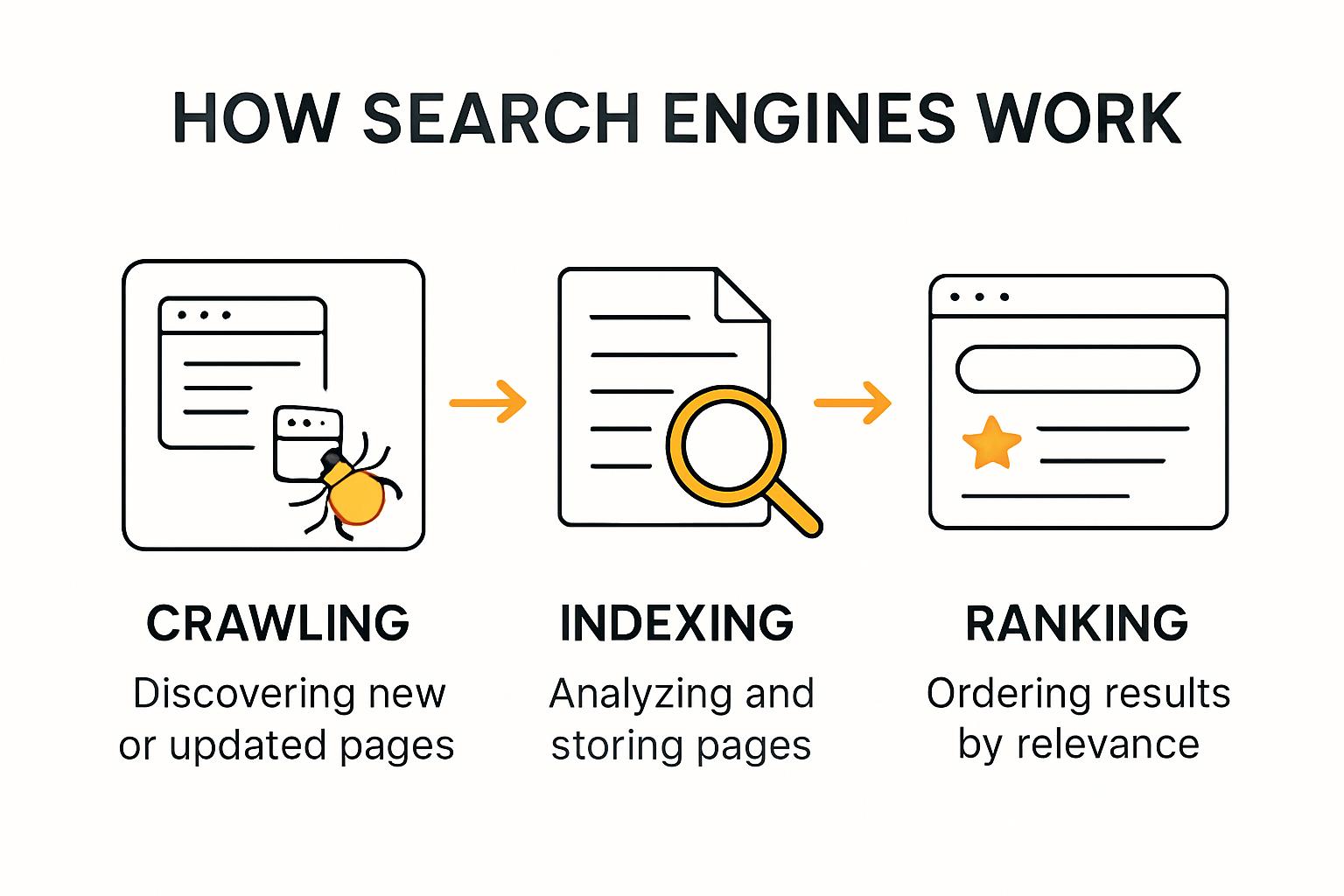
Have you ever wondered how Google can search billions of web pages and display useful answers in less than a second? How does it decide which website appears first, which pages appear on the second page, and which results are the most relevant to your search?
The answer lies in search engine technology and algorithms.
Search engines such as Google and Bing use automated systems to discover web pages, organise information, and rank results based on relevance and many other signals. They continuously process information from across the internet to help users find answers, products, services, news, and educational resources.
Understanding how search engines work is essential for website owners, bloggers, digital marketers, businesses, and anyone interested in search engine optimisation (SEO).
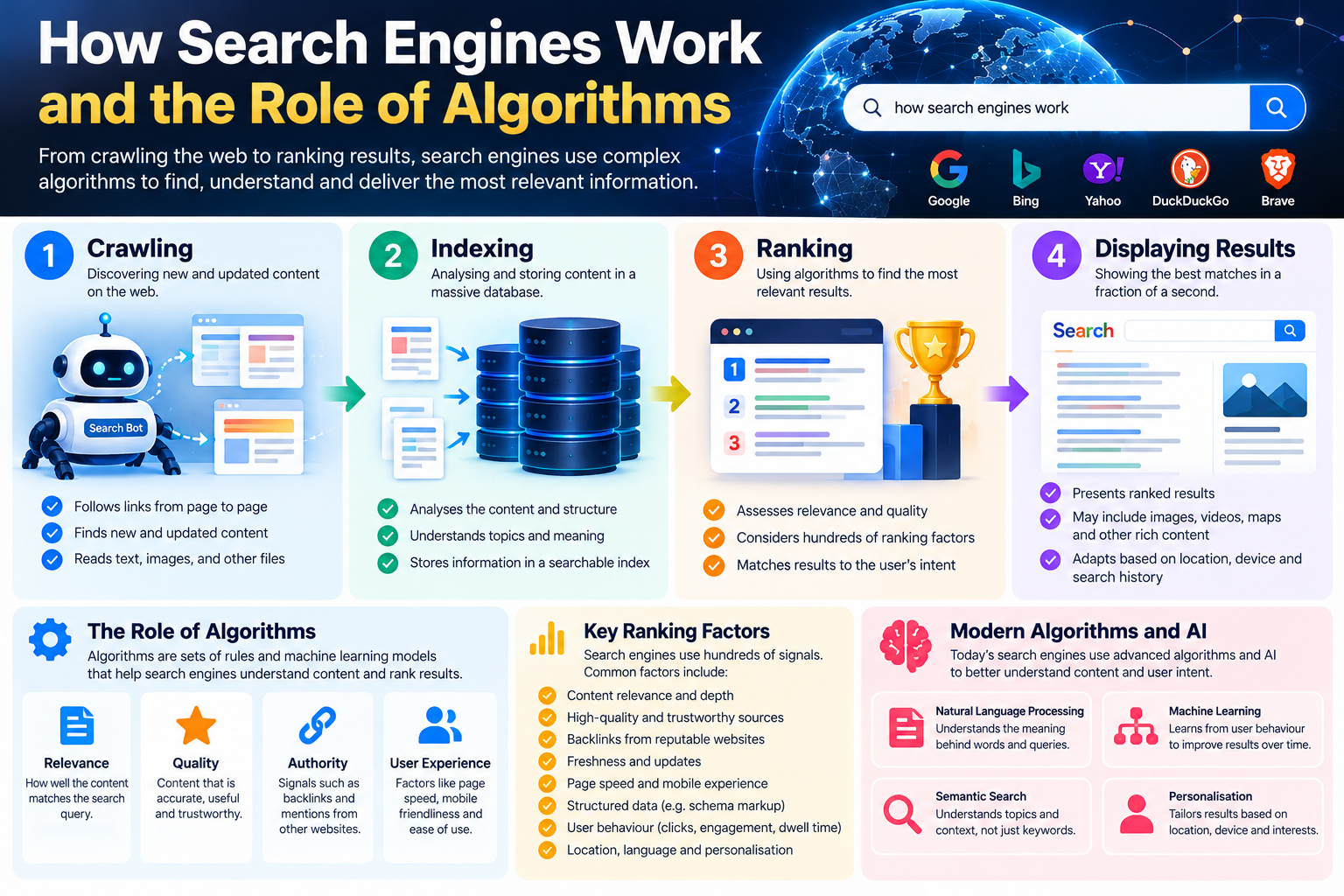
In this guide, we will explore the four main stages of search: crawling, indexing, ranking, and displaying results. We will also explain how algorithms influence search rankings and what you can do to help your website become easier to discover.
What Is a Search Engine?
A search engine is an online system that helps users find information across the web.
When you enter a query such as “best web hosting for small businesses,” the search engine attempts to identify pages that match your needs and presents them in a useful order.
Popular search engines include:
- Google: A widely used search engine for websites, images, videos, maps, news, and more.
- Microsoft Bing: A search engine that provides web results, multimedia results, and AI-assisted search experiences.
- DuckDuckGo: A search engine known for its privacy-focused approach.
- Brave Search: A search engine with an independent search index and privacy-oriented features.
Although their technologies and ranking systems differ, search engines share a broad objective: helping users find relevant information efficiently.
Google explains its process in its official guide, How Search Works.
The Four Main Stages of How Search Engines Work
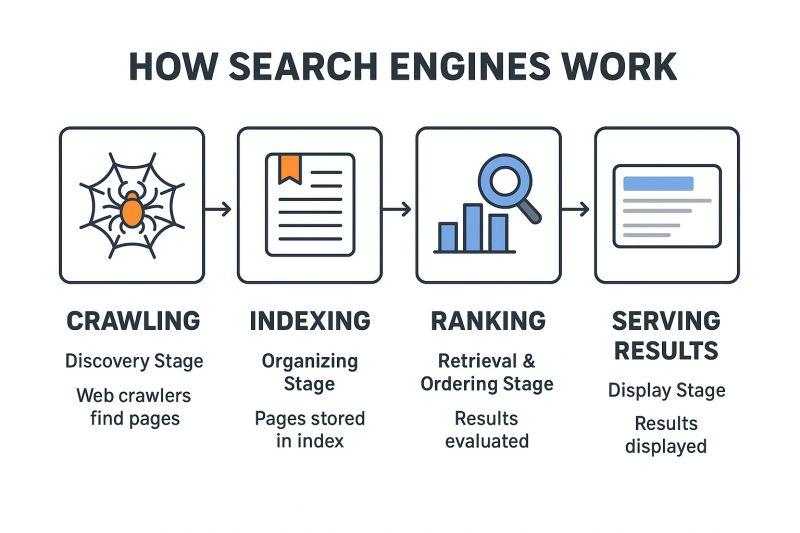
A simplified search engine workflow has four stages:
- Crawling — discovering web pages.
- Indexing — analysing and storing information about pages.
- Ranking — selecting and ordering relevant results.
- Serving results — presenting useful information to the user.
These stages are connected, but they are not always a simple, strictly sequential process. A search engine may revisit pages, update its index, or use different systems depending on the query.
1. Crawling: Discovering Web Pages
Crawling is the process by which search engines discover URLs and retrieve content from the web.
Search engines use automated programs, commonly called crawlers, bots, or spiders, to visit pages and follow links to other pages.
For example, imagine you publish a new blog post about domain registration. A search engine might discover the page through a link from another website, an internal link on your site, or a submitted XML sitemap.
The crawler can then request the page and examine its accessible content.
How crawling works:
- A crawler discovers a URL.
- It requests the page from the web server.
- It retrieves accessible content and follows eligible links.
- It may discover additional URLs.
- It can revisit pages later to check for changes.
However, discovering a URL does not guarantee that the page will be crawled immediately. Search engines manage crawling resources and consider factors such as website availability, URL patterns, and the likely value of revisiting content.
What can prevent crawling?
Common obstacles include:
- Server errors or frequent downtime.
- Incorrect robots.txt rules that block crawling.
- Broken internal links.
- Poor website architecture.
- Redirect loops or excessive redirect chains.
- Pages that are difficult to discover through links.
Website owners can learn more from Google’s documentation on crawling and robots.txt.
SEO tip: Make important pages accessible through clear internal links, maintain a reliable website, and ensure your robots.txt file does not accidentally block content you want search engines to crawl.
2. Indexing: Understanding and Storing Content
After discovering and crawling a page, a search engine may analyse its content and decide whether to include information about it in its index.
An index is a large, structured collection of information that helps the search engine retrieve relevant pages when users search.
Search engines may analyse elements such as:
- Page titles and headings.
- Main text and other visible content.
- Images and associated descriptions.
- Links between pages.
- Canonical URLs and duplicate content.
- Structured data.
- Language and other contextual information.
Consider a website that publishes an article titled “How to Choose a VPS Hosting Provider.” A search engine may analyse its text, headings, links, and other information to understand that the page discusses virtual private servers and hosting services.
If the page is indexed, it may become eligible to appear for relevant searches. Its eventual ranking depends on additional systems and signals.
Is every crawled page indexed?
No. Crawling and indexing are different processes.
A search engine may crawl a page but decide not to index it. Possible reasons include duplicate or substantially similar content, limited usefulness, technical issues, or other indexing considerations.
Likewise, a page can exist online for months without appearing in search results if a search engine has not discovered it or has not indexed it.
Website owners can use Google Search Console to inspect URLs, monitor indexing issues, and submit sitemaps.
SEO tip: Publish useful, original content with clear headings and a descriptive page title. Use canonical tags appropriately, avoid accidental noindex directives, and make important pages easy to discover.
3. Ranking: The Role of Search Engine Algorithms
Ranking is the process of determining which eligible results are most useful for a particular search query and how they should be ordered.
This is where search engine algorithms play a central role.
An algorithm is a set of computational rules and procedures used to process information and produce results. Modern search engines use many systems, signals, and machine-learning models rather than relying on one simple formula.
When someone searches for “best managed WordPress hosting,” the search engine attempts to identify pages that address the request and rank them according to its assessment of relevance and usefulness.
Factors can include the meaning of the query, the content of the page, the quality of the information, the context of the search, and signals related to the page or website.
Search engines do not publicly disclose every detail of their ranking systems. The exact signals and their relative importance can also differ across search engines and types of search results.
Important ranking considerations
Relevance: Does the page address the user’s query and likely intent?
Content quality: Is the information useful, clear, accurate, and sufficiently detailed for the subject?
Trust and reputation: Is there evidence that the source is reliable and appropriate for the topic?
Links: Do links from other pages help search engines discover the page and understand its context or importance?
Freshness: Does the query call for current information, such as today’s news or current prices?
Page experience: Can visitors use the page effectively, including on mobile devices?
Location and language: Does the result suit the user’s language or geographic context where that matters?
These considerations do not form a guaranteed checklist for achieving the first position. Their importance varies, and no single factor ensures a high ranking.
For Google’s explanation, see A guide to Google Search ranking systems.
4. Serving Results: Displaying the Search Results Page
Once a search engine has identified and ranked candidate results, it displays a results page tailored to the query and search experience.
A results page may contain more than traditional blue links. Depending on the search, it can include:
- Standard organic listings.
- Sponsored advertisements.
- Featured snippets or direct answers.
- Image and video results.
- Local business listings and maps.
- Product results.
- News results.
- AI-generated summaries or conversational search features.
The layout depends on the query, the search engine, and the features available for that search.
For example, a search for “weather in Kochi” may show a weather feature, while a search for “how to install WordPress” may show tutorials, videos, and step-by-step explanations.
Organic search rankings and paid advertisements are different. Paying for an advertisement does not automatically improve a page’s organic ranking.
The goal of the results page is to help users find an appropriate answer or next step with as little unnecessary effort as possible.
What Are Search Engine Algorithms?
Search engine algorithms help determine how information is interpreted, retrieved, evaluated, and ordered.
Early search systems relied heavily on relatively straightforward text-matching techniques and link-based analysis. Modern search engines use a more complex combination of information retrieval, language understanding, machine learning, and specialised ranking systems.
Algorithms help answer questions such as:
- Does this page match what the user is asking?
- Is the content about the intended subject?
- Which result is likely to be the most useful?
- Is the information current enough for this query?
- Are there multiple pages that substantially duplicate one another?
- Would a different result format, such as a map or video, be more helpful?
No single algorithm performs every task. Multiple systems can work together to evaluate and present results.
How Algorithms Understand Search Intent
Search intent refers to the purpose behind a query.
For example, the searches below contain different intentions:
| Search query | Likely intent |
|---|---|
| “What is cloud hosting?” | Informational |
| “Best VPS hosting providers” | Commercial research |
| “Buy a domain name” | Transactional |
| “Cloudflare dashboard login” | Navigational |
A page can contain the correct keywords but still fail to satisfy the user’s intent.
Someone searching for a definition may want a clear explanation, while someone searching for a hosting provider may want features, prices, comparisons, and buying guidance.
This is why effective SEO involves understanding the problem behind the search—not simply repeating a phrase throughout an article.
How AI Is Changing Search Algorithms
Artificial intelligence and machine learning have become important parts of modern search technology.
These systems help search engines interpret language, connect concepts, improve retrieval, and generate new types of search experiences.
Natural Language Processing
Natural language processing (NLP) helps computer systems analyse and work with human language.
It can help a search engine interpret relationships between words, recognise entities, and understand more of a query’s meaning.
For example, a query such as “How do I make my website faster on phones?” may be related to pages discussing mobile performance, responsive design, image optimisation, and page loading speed—even when those exact words do not all appear together.
Semantic Search
Semantic search focuses on meaning and context rather than relying only on exact keyword matches.
A search for “affordable server for a small online store” may be related to pages discussing entry-level cloud hosting, VPS plans, resource requirements, and e-commerce hosting.
Semantic understanding helps search systems identify useful connections between a query and relevant content.
Machine Learning
Machine-learning systems can help search engines evaluate patterns and improve different stages of search, including ranking and language understanding.
These systems are trained and evaluated using data, but their presence does not mean that every search result is personalised or that a search engine learns directly from every individual click in a simple way.
AI-Powered Search Experiences
Search engines increasingly offer AI-assisted summaries and conversational interfaces alongside conventional results.
These experiences can help users explore complex questions or combine information from multiple sources. They also create new challenges for website owners, including how information is represented and how users discover original sources.
For publishers, the fundamentals remain important: provide accurate information, explain subjects clearly, and make useful content accessible to search engines.
What Ranking Signals Should Website Owners Understand?
There is no universal formula that guarantees first-place rankings. However, website owners can focus on practices that improve content usefulness and technical accessibility.
1. High-Quality, Helpful Content
Write content that answers real questions and provides value beyond generic summaries.
Explain important concepts, include relevant examples, and make factual claims that can be checked. Avoid publishing large volumes of thin pages solely to target search keywords.
2. Clear Titles and Headings
Use a descriptive title and organise the article with logical headings. This makes the page easier for readers to scan and helps communicate its subject.
Use keywords naturally where they accurately describe the content. Avoid awkward repetition or misleading titles.
3. Internal and External Links
Internal links help readers and crawlers navigate related pages on your website.
External links to trustworthy sources can support factual explanations and help readers investigate a subject further.
Links from other websites can also be useful signals, but buying links or participating in manipulative link schemes can violate search engine spam policies.
4. Technical SEO
Ensure that your website loads reliably, important pages can be crawled, and the site uses appropriate canonical and indexing settings.
Use structured data only when it accurately represents the page and follows the relevant guidelines.
5. Mobile Usability and Page Experience
Your website should work well on phones, tablets, and desktops. Visitors should be able to read content, navigate menus, and interact with page elements without unnecessary difficulty.
Page experience matters, but excellent performance alone does not guarantee top rankings.
6. Content Maintenance
Review articles when important facts, prices, products, or procedures change.
Updating a date without improving the content does not automatically make a page more useful. Meaningful updates should reflect real changes or add relevant information.
Google’s SEO Starter Guide provides additional guidance for website owners.
Common Myths About Search Engine Algorithms
Misunderstandings about ranking systems can lead website owners to waste time or adopt risky strategies.
Myth 1: Repeating a keyword many times guarantees a high ranking.
Keyword stuffing can make content unpleasant to read and may violate spam policies. Use relevant terms naturally and focus on satisfying the query.
Myth 2: Every new page is indexed automatically.
Search engines may discover a page without indexing it. Technical accessibility, content quality, duplication, and other factors can affect indexing decisions.
Myth 3: More backlinks always mean better rankings.
Links can provide useful information about relationships and importance, but quality and context matter. Manipulative link schemes can create problems rather than improve performance.
Myth 4: Paid advertising directly boosts organic rankings.
Advertising and organic search are separate systems. Buying ads does not automatically improve a page’s organic position.
Myth 5: There is one secret algorithm that determines every result.
Modern search uses many systems and signals. Their effects vary by query, search feature, and context, and their complete implementation is not publicly disclosed.
How to Check Whether Your Website Appears in Search
If you own a website, you can monitor how search engines discover and display its pages.
A useful starting point is Google Search Console, which can help you:
- Check indexing and inspect individual URLs.
- Submit an XML sitemap.
- Review search impressions, clicks, and click-through rates.
- Identify certain technical issues.
- Understand which queries bring visitors to your site.
Bing also offers Bing Webmaster Tools for monitoring search performance and site discovery.
These tools can help you identify problems, but they do not provide a guaranteed way to force indexing or control ranking positions.
Conclusion: Why Search Engine Algorithms Matter
Search engines make the enormous amount of information on the internet easier to navigate. They discover web pages through crawling, analyse and organise content through indexing, evaluate candidate results using ranking systems, and present results in formats suited to the query.
Algorithms are central to this process. They help search engines interpret relevance, assess information, and return useful results. As machine learning and AI evolve, search experiences are expanding beyond traditional links to include richer answers and conversational interfaces.
For website owners, the most sustainable approach is to publish helpful content, maintain a technically accessible website, organise pages clearly, and monitor search performance over time.
You cannot control every ranking signal, but you can make your website easier to discover, understand, and use. That is the foundation of effective SEO.
Frequently Asked Questions
How do search engines work in simple terms?
Search engines discover web pages through crawling, analyse and store information through indexing, rank relevant pages for a query, and display the results to users.
What is a search engine algorithm?
It is a computational system used to process information and help determine which results are relevant and how they should be presented or ranked.
What are the four stages of search?
A simplified explanation is crawling, indexing, ranking, and serving or displaying results.
Does SEO guarantee a first-page ranking?
No. SEO can improve a site’s accessibility, content quality, and relevance, but no legitimate technique can guarantee a particular position.
How long does it take for a new website to appear in search results?
There is no fixed timeline. Discovery and indexing depend on factors such as links, crawling, technical accessibility, and the search engine’s evaluation of the content.
Does AI replace traditional search algorithms?
No. AI is one part of the broader search technology landscape. Search engines continue to use retrieval, indexing, ranking, and other systems, while AI supports some of these processes and enables additional search features.